ASRS Foldable Crates vs. Reusable Plastic Totes: Which Wins?
If you are specifying containers for an ASRS, AMR, or cube-storage warehouse, both the ASRS foldable plastic crate (model 6035) and the reusable plastic tote (model 6036) will pass a basic technical review. The decision is made by one question: where does the container spend most of its life — loaded inside the storage structure, or empty on a truck between facilities? Foldable crates win when empty volume is the dominant cost. Wall-straight reusable totes win when loaded density and structural rigidity drive throughput.
This guide compares the two containers on the criteria that actually decide automation projects: AMR and AGV integration, dimensional accuracy and stability, storage density, and performance under continuous operation. It draws on two deployments of 450,000 pieces each, completed within one year, for e-commerce and 3PL fulfillment operations.
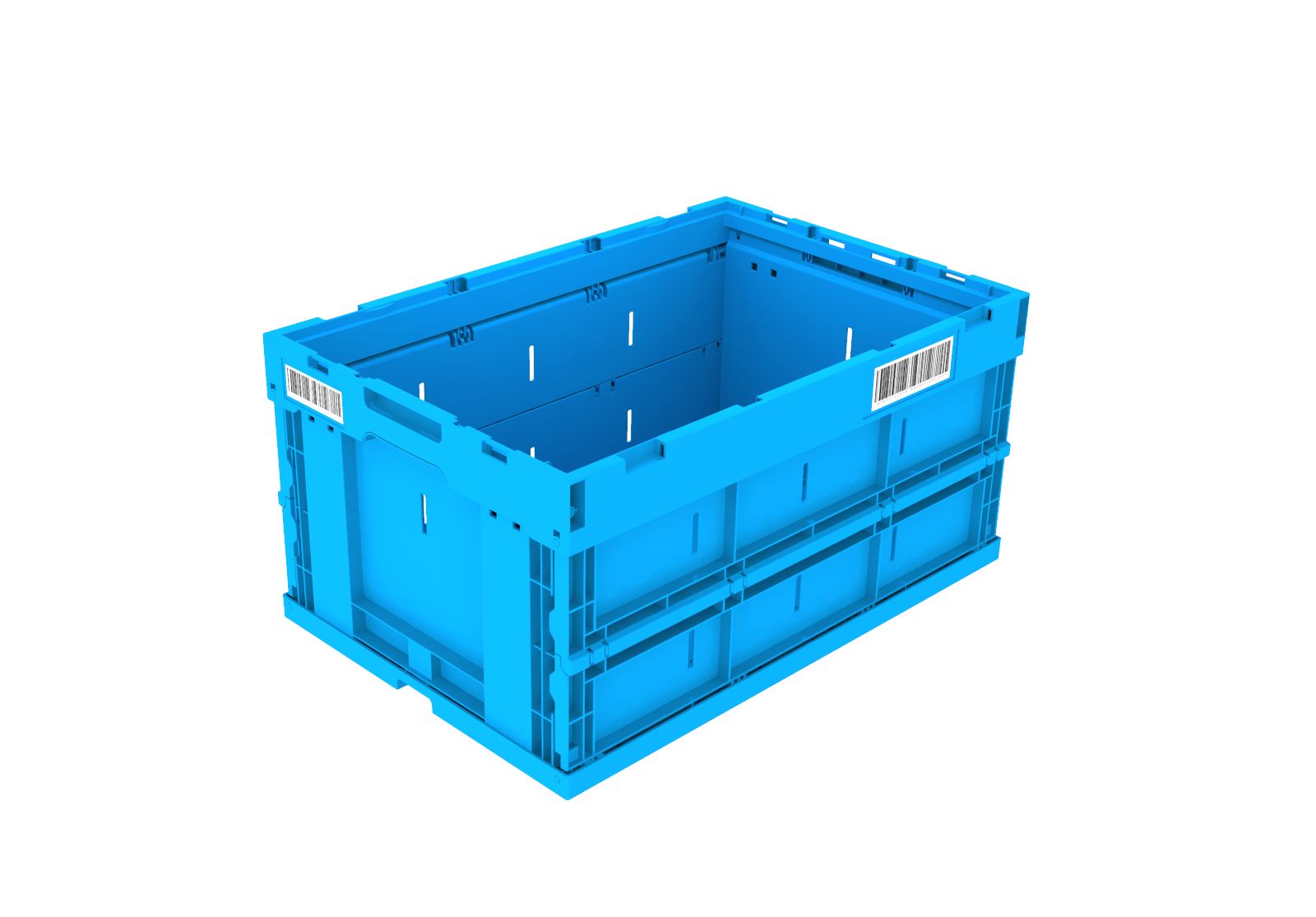
ASRS foldable plastic crates built for robotic handling, shuttle transport, and return-logistics volume reduction.
The Real Decision Is Not the Box — It Is the Return Leg
Container selection in automated warehousing is usually presented as a material question. It is not. Both containers discussed here are produced in polypropylene (PP) and both are engineered for automated handling. The difference is architectural.
A foldable crate keeps a rigid footprint when loaded and collapses when empty. A wall-straight reusable tote keeps a fixed volume at all times. That single structural difference propagates through the whole project: truck utilization, empty-container storage space, docking protocol, picking-station handling, and the number of containers a site must own to run the same throughput.
Three failure patterns appear repeatedly when the container is chosen late in an automation project:
- The container passes a static load test but fails on the conveyor because dimensional tolerance was never specified against the shuttle or roller interface.
- The container performs inside the ASRS but consumes warehouse floor space when empty, forcing a separate empty-container buffer that was never in the layout plan.
- The container is correct for the picking station but poorly matched to AMR gripper geometry, causing handling faults during peak shifts.
Each of these is a container-versus-system fit problem, not a container quality problem. The evaluation framework below is built to surface those mismatches before the mold is cut.
Industry Background: Why Reusable Containers Moved to the Center of the Project
Reusable transport packaging is no longer a sustainability side-note; it is a structural part of the automation business case.
The global plastic storage bins market was valued at USD 2.9 billion in 2026 and is projected to reach USD 4.6 billion by 2036, according to Future Market Insights data published through openPR. Within that segment, HDPE held a 39.0% material share in 2026, cited for impact tolerance and moisture resistance under repeated handling — a reminder that material choice is a service-life decision, not a cost shortcut.
Regulation is reinforcing the trend. The European Union Packaging and Packaging Waste Regulation (PPWR) applies across the EU from 12 August 2026. For warehouses serving European markets, a container that circulates for years and collapses for return transport is materially easier to defend in a packaging-waste review than a single-trip alternative.
The operational driver is density. Automated storage and retrieval systems, mini-load cranes, shuttle systems, and cube storage all monetize the same thing: the number of storage locations per cubic meter of building. The container is the unit that location is built around, so every millimeter of container geometry is an economic variable across the full system life.
Two Containers, Two Design Logics
Shanghai Xinfan Industrial Corporation (TSS) is a Shanghai-based manufacturer of reusable logistics packaging and cargo security products, established in 2003, operating a 40,000 m² facility with approximately 320 employees and an annual output of about 3,600,000 units. The company exports roughly 70% of production, serving customers in the EU, North America, South America, Southeast Asia, the Middle East, and Africa, and maintains a 25-engineer R&D team. Both containers below come from that portfolio.
ASRS Foldable Plastic Crates — Model 6035 / TSS-IFD
The foldable crate is designed for closed-loop automation environments where containers return empty. When loaded, it holds a stable stacking geometry for ASRS, shuttle, conveyor, and robotic handling. When empty, it folds to reduce storage and transport volume by up to 70–80%, based on TSS application documentation.
Its declared operating roles include automated storage and retrieval through mini-load cranes and shuttle systems, goods-to-person delivery, roller and belt conveyor transport, sortation, and handling by robotic arms, AGVs, and AMRs. The design intent is a container that survives the trip back as profitably as the trip out.
For automation buyers, the relevant consequence is that empty-container logistics become a planning variable instead of a fixed cost. A warehouse that would otherwise dedicate floor area to stacked empty totes can reclaim that area, and a distribution network can move more empty containers per trailer on the return leg.
Reusable Plastic Totes — Model 6036 / TSS-IFC
The 6036 wall-straight reusable tote is the structural counter-argument: a fixed, rigid PP container with a nominal size of 600 × 400 × 300 mm, listed for warehouse automation. Its wall-straight geometry preserves a constant internal volume and a consistent external envelope at every point in the cycle.
That consistency matters in high-density storage. TSS specifies the 6036 for ASRS, mini-load warehouses, shuttle storage, cube storage, high-bay warehouses, goods-to-person picking, and robotic picking, with declared requirements covering high dimensional accuracy for automation compatibility, load capacity and structural rigidity, smooth operation on conveyors and shuttle systems, and long service life under intensive operating conditions.
In practice, the 6036 is the container you specify when the storage structure — not the truck — is the constraint. The 600 × 400 mm base is the dominant global footprint for warehouse automation containers, which means the 6036 sits inside an established interface convention rather than requiring a bespoke one.
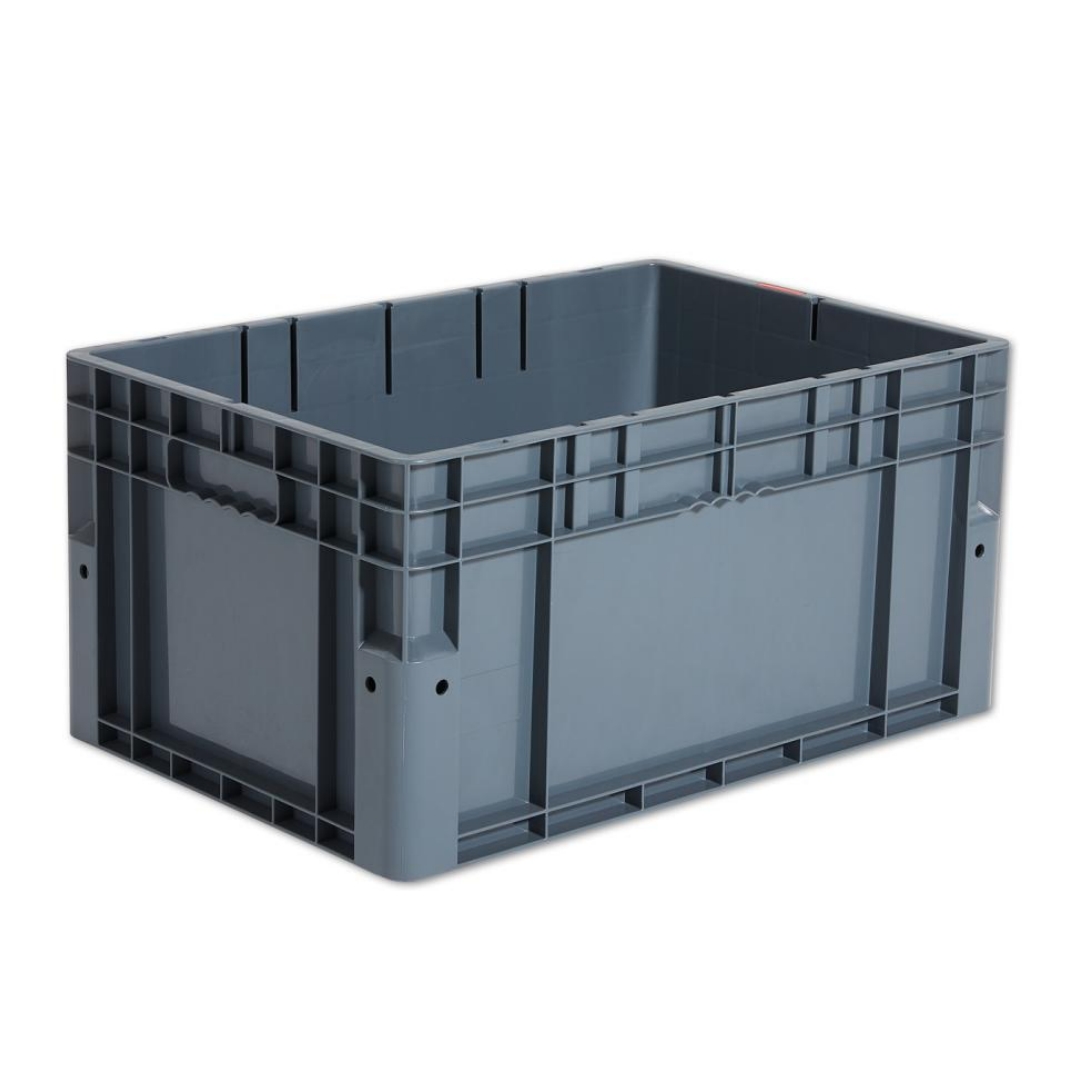
Model 6036 / TSS-IFC wall-straight reusable plastic totes: 600 × 400 × 300 mm, PP, specified for ASRS and shuttle storage.
What the Two 450,000-Piece Projects Demonstrate
Container claims are easy to make and hard to falsify. Deployment records are not. TSS has completed two large-scale programs of 450,000 pieces each, both delivered within one year, and each against a different automation architecture.
Project one: an AMR goods-to-person fleet
The first program supplied 450,000 foldable crates to a leading global AMR (Autonomous Mobile Robot) solution provider, for large-scale e-commerce and 3PL fulfillment centers. The containers were integrated with the customer's AMR robotic systems for goods-to-person order fulfillment, automated storage, inventory buffering, and high-speed picking.
Reported outcomes:
- Improved warehouse storage density
- Increased picking efficiency
- Enhanced robotic handling accuracy
- Reduced manual handling requirements
- Support for 24/7 automated warehouse operations
The stated design highlights are the ones that matter during integration: seamless interaction with AMRs and automated workstations, consistent dimensional accuracy for robotic gripping and transportation, and durability under intensive automated handling cycles.
Project two: a cube-storage and ASRS provider
The second program supplied 450,000 wall-straight ASRS crates to a leading global warehouse automation and cube storage solution provider, for large-scale e-commerce and 3PL fulfillment centers. These containers operate inside AGV/AMR automated storage and retrieval systems supporting high-density storage, order fulfillment, inventory management, and robotic picking.
Reported outcomes:
- Storage density increased by up to 4–6 times compared with conventional shelving systems
- Improved order fulfillment speed
- Optimized warehouse footprint utilization
- Reduced labor dependency
- Improved inventory accuracy
The 4–6 times density figure is a system-level result, not a container specification. It reflects what happens when a rigid, dimensionally consistent container is combined with high-density automation — and it is the number most often used to justify the automation investment in the first place.
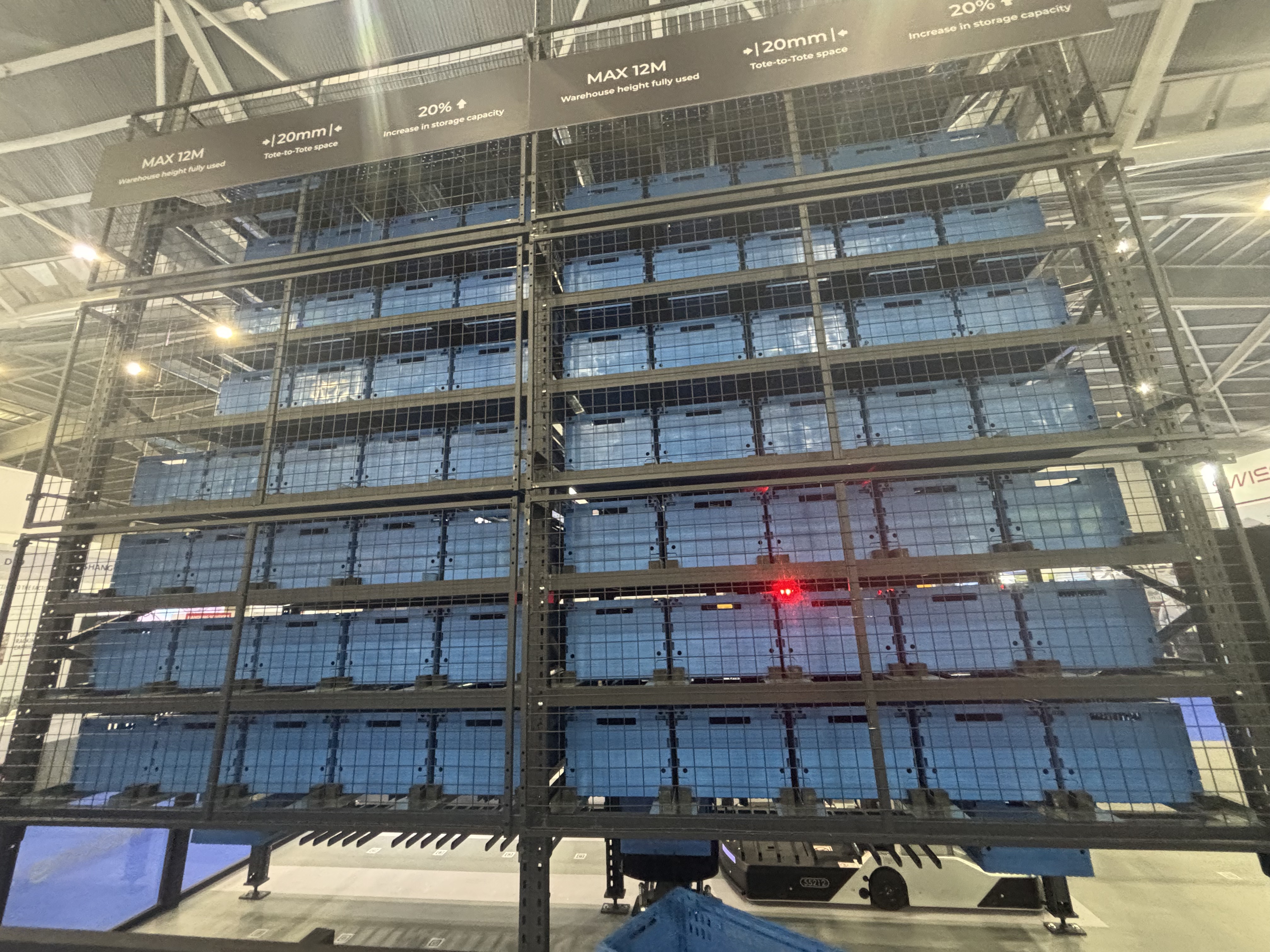
Foldable automation totes in goods-to-person operation — 450,000 pieces deployed with a global AMR solution provider within one year.
Step-by-Step: How to Choose Between the Two for Your Project
The following sequence works for any ASRS or AMR project, regardless of supplier. It moves from the interface outward, which is the opposite of how most container shortlists are built.
Step 1 — Lock the interface, not the container
Start with the storage structure and the handling equipment. Document the shuttle, mini-load crane, conveyor, sortation, and robotic gripper interface requirements, including the base footprint, handling features, and any gripping or positioning geometry. Both the 6035 and the 6036 are declared compatible with AGVs, AMRs, shuttle systems, conveyors, and robotic picking, but compatibility must be confirmed against your specific equipment, not against a category description.
Step 2 — Quantify dimensional accuracy requirements
Dimensional accuracy is the specification that most often separates a working project from a jammed one. TSS lists high dimensional accuracy as an explicit requirement for the 6036 in automated environments, and cites consistent dimensional accuracy for robotic gripping as a design highlight of the 6035 program.
Ask for the tolerance stack, not a single nominal dimension. For custom automation work, TSS supports high-precision dimensioning, automation bottom design, robot gripping features, positioning marks, and RFID integration as part of its smart logistics and automation support, with conveyor testing, robot handling verification, load testing, stacking testing, and automation simulation used as validation steps.
Step 3 — Calculate both loaded and empty density
Most density calculations stop at the loaded state. Run two separate models:
- Loaded density: storage locations per cubic meter inside the ASRS or cube structure. The 6036's fixed envelope makes this calculation straightforward; the 6035 holds a stable loaded geometry but should be evaluated with the folded-state storage plan included.
- Empty density: floor area or trailer volume consumed by empty containers. This is where the 6035 changes the arithmetic — TSS documents up to 70–80% empty-volume reduction, which converts directly into recovered warehouse floor space and lower return-transport cost.
Step 4 — Test under representative load, not catalogue load
Load figures need a method attached. TSS publishes product load values in the 20–50 kg range for selected tote models, with separately listed stacking-load values up to 225 kg on its product pages; the test method, safety factor, duration, and ambient conditions behind those figures are not stated on the retrieved page and should be requested as part of the RFQ.
TSS quality assurance covers static and dynamic load testing, drop testing, and automation compatibility testing, with IQC, IPQC, FQC, and OQC stages. Third-party inspection and customer-specific inspection standards are available. Specify the test protocol you want, then require it in the acceptance criteria.
Step 5 — Evaluate 24/7 durability, not first-shift performance
A container in a high-throughput fulfillment center is handled continuously. The relevant question is how the design degrades, not how it behaves on day one. Both projects referenced above were specified for intensive automated handling cycles and 24/7 operation; the 6036 is declared for long service life under intensive operating conditions, and the 6035 program cites durability under intensive automated handling as a design highlight.
Use cycle-life evidence, spare-part availability, and the supplier's failure-analysis process as proxies. TSS operates a warranty and after-sales process with an initial response within 24 hours and a corrective action report within 3–5 working days, plus spare parts supply and continuous improvement reporting.
Step 6 — Decide the circulation model
Finally, decide whether containers will live permanently at one site or circulate between a distribution center, stores, and a returns process. Permanent single-site operation favors the rigid 6036. Multi-site circulation with an empty return leg favors the 6035.
This is the step where budget discussion belongs. The purchase price is only one line in the model. Add empty-container storage cost, return freight per container, replacement rate, and the number of containers required to run the same throughput. The foldable crate typically carries a higher unit cost than a fixed-wall container, and the 70–80% empty-volume reduction is the mechanism that repays that difference — or fails to.
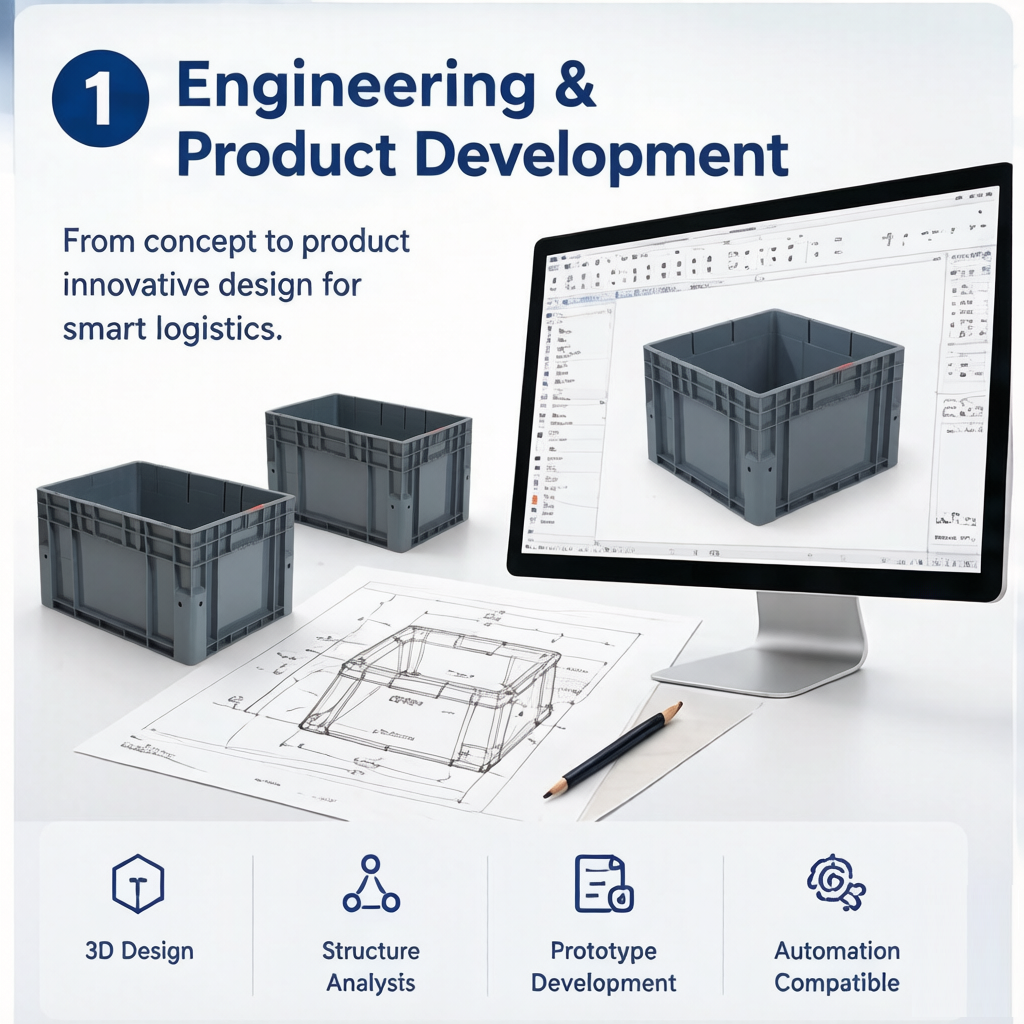
Automation compatibility validation: dimensional verification, load testing, and handling simulation before series production.
Where Each Container Fits
Large-scale e-commerce fulfillment
Multi-SKU e-commerce operations depend on goods-to-person flow and high-speed picking. Both containers are deployed in this setting at 450,000-piece scale. The 6036 suits dense cube and shuttle installations where the storage structure is fixed and container geometry must be exact. The 6035 suits fulfillment networks where empty containers accumulate between waves and consume floor space.
Third-party logistics
3PL operators run multiple client accounts on shared infrastructure. Fixed-envelope containers simplify slotting and WMS configuration; foldable containers reduce the penalty when a client account is wound down and container stock must be repositioned. Both containers are declared for 3PL fulfillment environments.
Manufacturing and line-side supply
Automated component storage, work-in-process buffering, production sequencing, and line-side feeding all rely on repeatable container geometry. Both models are declared for manufacturing automation projects, with the foldable unit adding value where return transport between plants is part of the loop.
Retail replenishment and returnable programs
Closed-loop retail distribution and store replenishment place a premium on the return leg. TSS also offers stackable totes, attached-lid containers, nest-and-stack crates, and tote dollies for these flows, which allows a program to standardize on one supplier across the automation and manual sides of the same network.
Fresh produce and food-adjacent applications
Both containers appear on TSS food-contact test documentation. The 6035 and 6036 are listed on third-party inspection reports issued by the Henan Institute of Product Quality Inspection Technology under certificate numbers SY2025092412 and SY2025092415, dated 24 September 2025, covering plastic materials and products for food contact use.
Comparison Table
| Decision criterion | ASRS foldable plastic crates — 6035 / TSS-IFD | Reusable plastic totes — 6036 / TSS-IFC |
|---|---|---|
| Structure | Foldable side walls; stable stacking when loaded | Wall-straight; fixed volume in all states |
| Listed size | Not stated in the available specification set — confirm per project | 600 × 400 × 300 mm |
| Material | PP | PP |
| Empty-volume reduction | Up to 70–80% per TSS application documentation | None; fixed envelope |
| Declared system interfaces | AGV, AMR, shuttle systems, conveyors, robotic handling | ASRS, mini-load cranes, shuttle and cube storage, conveyors, robotic picking |
| Verified deployment | 450,000 pieces to a global AMR solution provider, delivered within 1 year | 450,000 pieces to a global warehouse automation and cube storage provider, delivered within 1 year |
| Reported project outcomes | Improved storage density, higher picking efficiency, better robotic handling accuracy, reduced manual handling, 24/7 operation support | 4–6x storage density versus conventional shelving, faster fulfillment, optimized footprint, lower labor dependency, improved inventory accuracy |
| Food-contact documentation | Listed on inspection reports SY2025092412 and SY2025092415 | Listed on inspection reports SY2025092412 and SY2025092415 |
| Best fit | Closed-loop and multi-site networks where the empty return leg carries cost | High-density ASRS and cube storage where loaded geometry governs throughput |
Note: The 4–6x density figure is a reported system-level outcome from an automated storage deployment, not a container-level specification. Load and tolerance values should always be confirmed against your own acceptance test protocol.
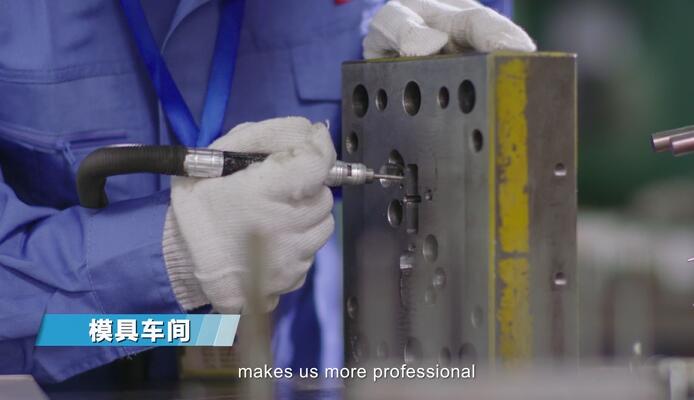
In-house mold design and manufacturing supports dimensional control and design changes over the container's service life.
Frequently Asked Questions
What compliance documents should cover ASRS foldable crates and reusable plastic totes?
Ask for the test reports that name your specific model. TSS food-contact documentation covers both families: inspection reports SY2025092412 and SY2025092415, issued by the Henan Institute of Product Quality Inspection Technology on 24 September 2025, apply to food-contact plastic materials and products and list the 6035 foldable crates, 6036 wall-straight crates, 6037 stackable totes, 6038 nest-and-stack crates, 6039 collapsible crates, and the reusable plastic totes range. For European distribution, also confirm how the container supports your obligations under the EU Packaging and Packaging Waste Regulation, which applies across the EU from 12 August 2026.
How do you qualify reusable plastic totes manufacturers for an automation project?
Qualify on four things a catalogue cannot show: dimensional control, automation testing, production capacity, and lifecycle support. Shanghai Xinfan Industrial Corporation (TSS) has manufactured reusable logistics containers since 2003 from a 40,000 m² facility with approximately 320 staff and an annual output of about 3,600,000 units, with a 25-engineer R&D team and in-house mold design and manufacturing at 5–10 new mold sets per month. Its automation support package covers automation bottom design, robot gripping features, positioning marks, and RFID integration, validated through conveyor testing, robot handling verification, load and stacking testing, and automation simulation. OEM programs run at 300,000–500,000 containers per month.
Can both containers run on AMR and AGV systems?
Yes, within their declared scopes. The 6035 foldable crate was deployed at 450,000 pieces with a global AMR solution provider for goods-to-person fulfillment, automated storage, inventory buffering, and high-speed picking. The 6036 wall-straight tote is specified for AGV/AMR automated storage and retrieval, mini-load cranes, shuttle systems, cube storage, and robotic picking, and was deployed at 450,000 pieces with a global warehouse automation and cube storage provider. Both integrations depend on confirming gripper geometry and dimensional tolerance against your specific equipment before production.
How does sample validation work before a series order?
TSS runs evaluation in 3–5 days and sample validation in 7–15 days for automation projects. For OEM build-to-print work, engineering review takes 5–10 working days and sample production 7–15 working days. New development programs follow a longer path: initial concept proposal in 3–7 days, 3D design and engineering drawings in 5–15 days, prototypes in 7–20 days, and design validation in 15–30 days. Validation scope includes static and dynamic load testing, drop testing, and automation compatibility testing, with customer design approval required before production.
What are typical lead times for a 450,000-piece program?
Mass production for OEM orders runs 15–30 working days after approval, with new tooling adding 30–60 days where a mold is required; in-house production mold manufacturing is quoted at 60–70 days. Monthly capacity of 300,000–500,000 plastic containers supports staged delivery across a program. Both 450,000-piece deployments referenced in this guide were completed within one year. For project scheduling, send your volume forecast and target installation windows to info@xfseal.com or +86 186-0218-3251 and request a container sample for your own handling test.
Conclusion: Match the Container to the Lifecycle, Not the Catalogue
Neither container is the better choice in isolation. The 6035 foldable crate is the stronger engineering answer when containers must travel empty — its 70–80% empty-volume reduction converts directly into recovered floor space and lower return freight. The 6036 wall-straight reusable tote is the stronger answer when loaded geometry and structural rigidity govern throughput — the configuration that produced 4–6 times storage density against conventional shelving in a 450,000-piece deployment.
The practical rule is simple. If the container is handled more often empty than loaded, specify foldable. If it is handled more often loaded than empty, specify wall-straight. If the network does both, split the fleet rather than compromising on one design.
What separates a workable decision from a costly one is the discipline behind it: confirm the interface before the catalog number, attach a test method to every load figure, and validate the design against your own handling equipment rather than a general claim of automation compatibility.
Next Step
Compare the two containers against your own layout. Request a sample of the 6035 foldable crate or the 6036 wall-straight tote, or ask for a container recommendation based on your ASRS, AMR, or shuttle specifications.
Email: info@xfseal.com | Tel / WhatsApp: +86 186-0218-3251 | Web: www.xfseals.com
Download the full capability profile: TSS Corporate Profile & Logistics Container Solutions (PDF)
Have Questions or Need More Details?
Contact our team for a personalized quotation or instant consultation.
Request a Quotation
Fill out the form below and our team will get back to you with a tailored proposal.
WhatsApp Direct Chat
Prefer to chat in real-time? Message us on WhatsApp for instant assistance & quick answers.
- Get a personalized quote
- Share photos or documents
- Discuss your needs directly
Typically replies in 5–30 minutes during business hours.