Plastic Totes vs ASRS Crates: Fixed-Wall, Foldable, or Stackable?
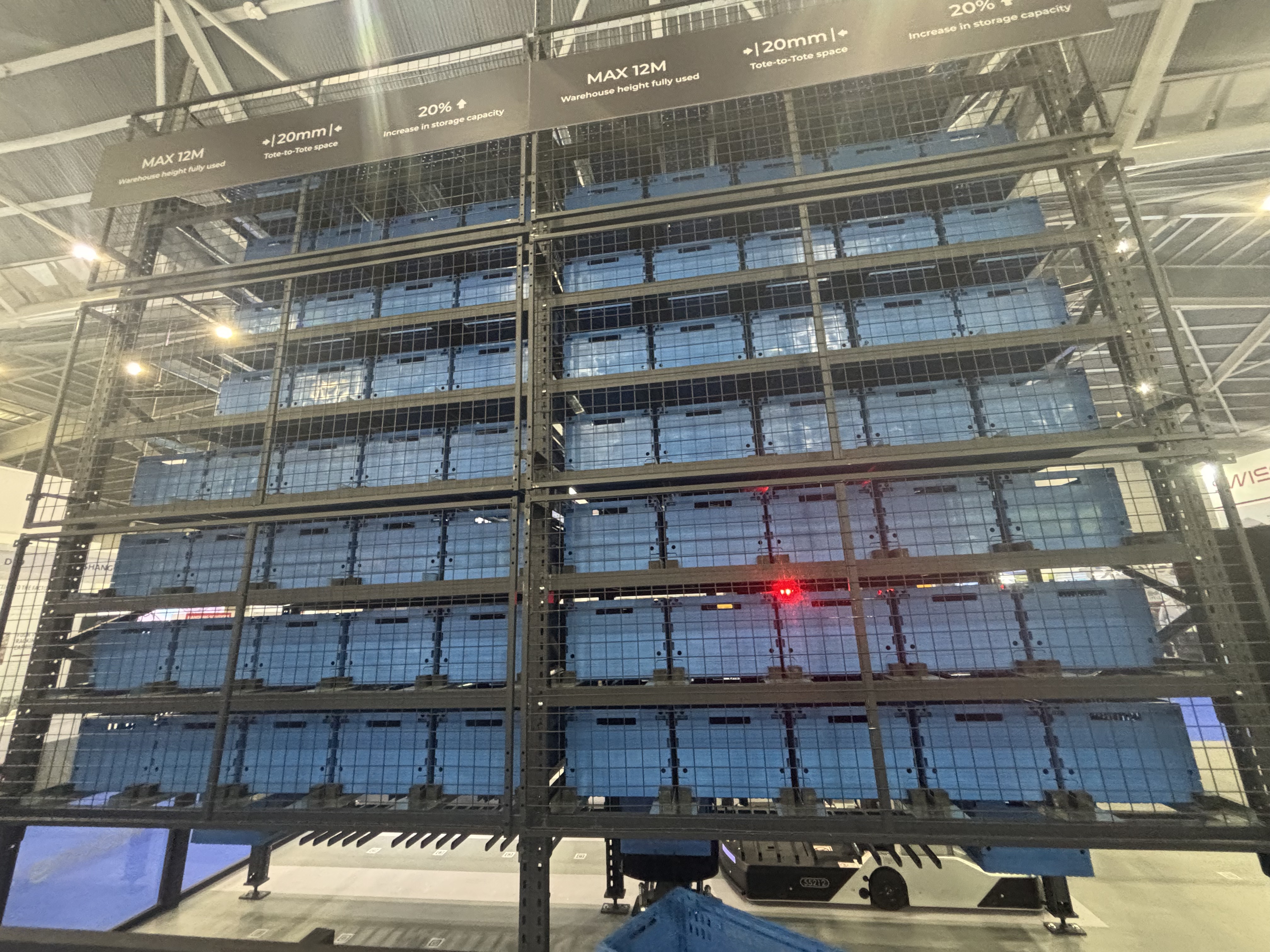
Container type is decided by the handling envelope you already own: shuttle, gripper, conveyor and stack profile.
An automated storage and retrieval system rarely fails because a tote was the wrong colour. It fails when the container is selected on unit price and generic warehouse language, then meets a shuttle, a robot gripper or a conveyor that expects a fixed footprint, a straight sidewall and a stable stack. At decision stage the useful question is not which plastic tote is best in general, but which of three build types fits the automation you have already committed to.
The short answer: fixed-wall (wall-straight) ASRS crates are the default where the automated system is the constraint; foldable ASRS crates win when empty-container flow is a large share of total logistics cost; stackable and nest-stack totes remain the practical choice for mixed manual and automated operations, retail distribution and fresh-produce loops. The rest of this guide explains how that answer changes with load, footprint, validation burden and return freight.
Problem Definition: Three Build Types, One Handling Envelope
Buyers shortlisting containers for an ASRS project usually arrive with three options on the table, and all three can often be quoted in the same nominal footprint. The differences that decide the project sit in how each type behaves under robotic handling, how it behaves when empty, and how much validation it needs before it can be released into production.
Fixed-wall ASRS crates
A fixed-wall crate is a rigid single-piece body with straight sidewalls and a flat base. The reference specification for this category from Shanghai Xinfan Industrial Corporation (TSS) is model TSS-IFC, a wall-straight crate measuring 600 × 400 × 300 mm in polypropylene, described as compatible with ASRS, AGV, AMR and conveyor handling with high dimensional accuracy. Because the geometry does not move, the container presents the same envelope to a gripper, shuttle or conveyor on cycle one and cycle ten thousand.
Foldable ASRS crates
A foldable or heavy-duty collapsible crate carries the same loaded function as a rigid crate but collapses its sidewalls when empty. TSS comparison data on foldable versus rigid crates states up to 75% reduction in empty storage space, up to 60% reduction in return transportation costs, up to 3× more units per return truckload, a purchase cost 10–20% higher than rigid crates, and less maintenance. The intended applications listed are fresh produce, retail distribution, agricultural logistics and export supply chains.
Stackable and nest-stack totes
Stackable totes stack when full; nest-and-stack models also nest when empty. TSS comparison data on stack-nest crates versus traditional stack-only crates cites a 70–80% reduction in empty return volume, up to 50% reduction in logistics costs and higher truck utilization, with supermarkets, food distribution, agriculture and the beverage industry as the stated scenarios. In practice these totes are frequently combined with tote dollies and attached-lid containers for movements that still involve people.
The difficulty is that all three are legitimate answers to a poorly written RFQ. A specification that only states capacity and colour tells the buyer nothing about whether the container will be gripped reliably at 3 a.m., how far the stack deflects under load, or what happens to return freight when the container leaves the building empty.
Industry Background: Why This Comparison Became Urgent
Two pressures are pushing container decisions from purchasing to engineering. The first is volume. Future Market Insights data published through openPR puts the global plastic storage bins market at USD 2.9 billion in 2026, projecting USD 4.6 billion by 2036, with HDPE accounting for 39.0% of the 2026 material mix. The second is standardisation. 600 × 400 mm is the dominant global footprint for automated storage and retrieval containers, with 650 × 450 mm used as a secondary standard, which means the footprint is usually fixed by the integrator before the supplier is chosen.
Regulation adds a documentation layer. The EU Packaging and Packaging Waste Regulation (PPWR) applies across the European Union from 12 August 2026, which raises the value of reusable, long-life containers and of suppliers who can document reuse and material decisions rather than only quoting a unit price. Buyers shipping into EU markets increasingly need that documentation alongside the container specification.
Operationally, e-commerce fulfilment and third-party logistics environments run near-continuous cycles. A container that grips badly, deflects under stack load or jams on a conveyor does not simply create a defect; it interrupts a lane that the rest of the operation is scheduled around. That is why dimensional accuracy and stack stability move ahead of price at decision stage.
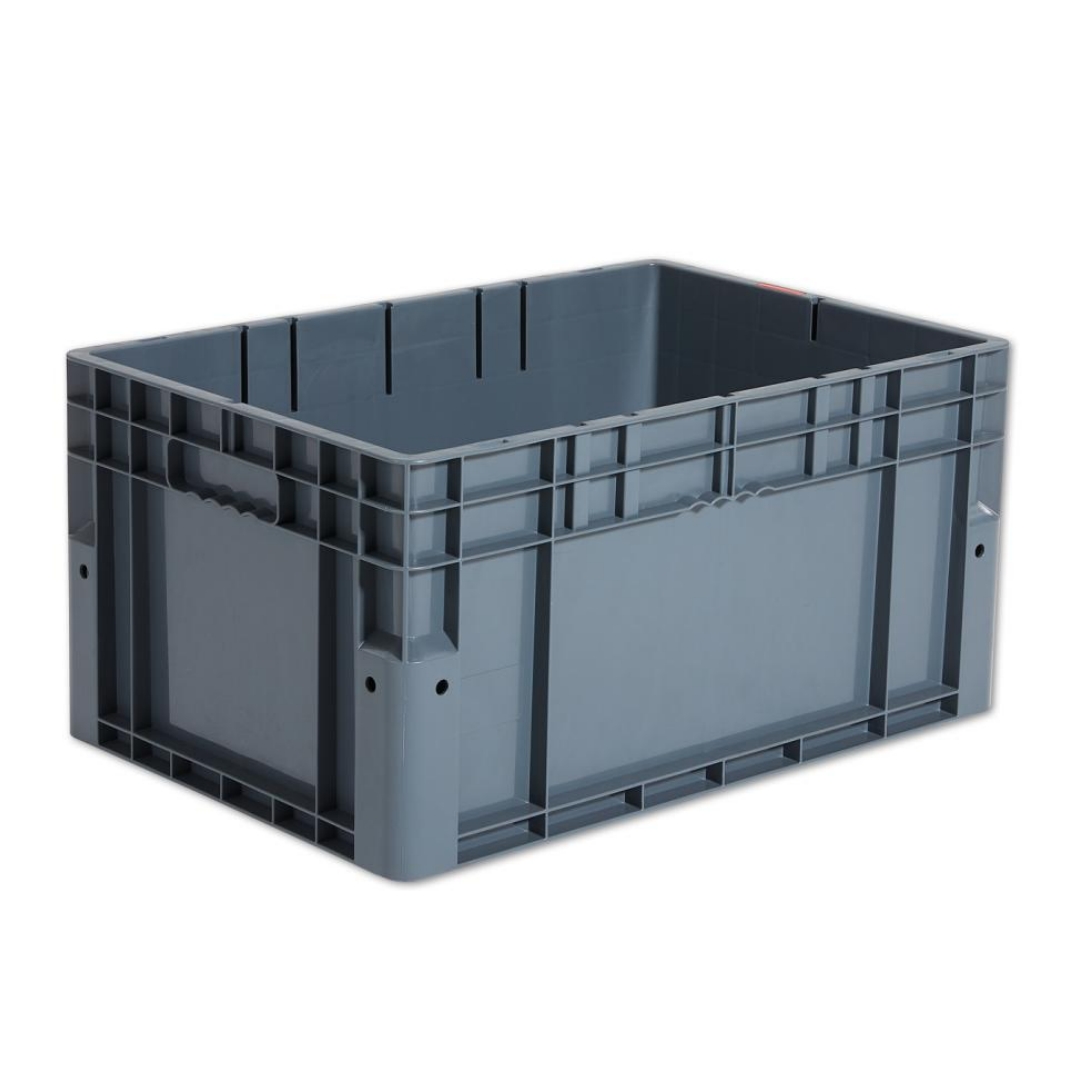
Fixed-wall ASRS crates such as the TSS-IFC (600 × 400 × 300 mm, PP) present an unchanging envelope to shuttle, gripper and conveyor.
Detailed Solution: What Each Configuration Actually Delivers
Fixed-wall crates: stability first
The case for a rigid wall-straight crate is repeatability. A single-piece body has no hinge line to wear, no panel to latch incorrectly and no folded-stack height to control. For dense automated storage where the container mostly stays inside the building, that repeatability is the whole point: the integrator can validate the container once and the system runs on that validated geometry. The trade-off is equally clear. A rigid crate occupies full volume when empty, so it contributes nothing to return freight or empty-storage compression.
Foldable crates: paying upfront for the empty trip
The foldable crate is a freight decision disguised as a packaging decision. The purchase premium is stated at 10–20% above rigid crates, and it is repaid only if the container regularly travels empty. Where it does, the stated savings are substantial: up to 75% less empty storage space, up to 60% lower return transportation costs and up to 3× more units per return truckload. TSS product literature for collapsible tote boxes separately cites nesting of up to 70% when not in use, which reflects a different measurement basis from the foldable-versus-rigid comparison. Buyers should ask which basis is being quoted before approving a business case.
The hidden cost sits in validation. A hinge is a mechanism, and a mechanism introduces variables: panel flatness after repeated folding, latch engagement, folded stack stability and gripper access at the hinge line. Foldable crates are therefore the type most dependent on the supplier's automation compatibility process rather than on the drawing alone.
Stackable and nest-stack totes: flexibility across mixed operations
Stack-nest and stackable totes solve a different problem. They are the pragmatic option where part of the flow is automated and part is still manual, where containers move between warehouse, transport and retail, or where a fleet has to serve several clients with different profiles. The 70–80% empty return volume reduction and up to 50% logistics cost reduction quoted for stack-nest versus stack-only designs are meaningful in supermarket, food distribution, agriculture and beverage loops. Tote dollies make the same containers viable in manual pick areas without a second fleet.
Material and load data cut across all three types. TSS lists polypropylene or HDPE as material options for its tote box range, with nominal capacities from 27.7 L to 170 L across selected models. Listed product loads for those models range from 20 kg to 50 kg, with separate listed stacking-load values up to 225 kg. Because the retrieved specification does not define the test method, duration, temperature or safety factor behind the stacking figure, buyers should request that basis rather than treat 225 kg as ambient working capacity.
Comparison Table: Fixed-Wall vs Foldable vs Stackable
| Decision factor | Fixed-wall ASRS crate (TSS-IFC reference) | Foldable ASRS crate | Stackable / nest-stack tote |
|---|---|---|---|
| Base footprint | 600 × 400 mm, 300 mm height (TSS-IFC) | Normally matched to the same 600 × 400 mm grid; folded height must be confirmed | 600 × 400 mm and 650 × 450 mm formats; dolly-matched |
| Dimensional accuracy for robotic handling | Stated high dimensional accuracy; rigid single-piece body | Depends on hinge and panel fit; tolerance verification required | Depends on stack and nest alignment features; stack stability must be verified |
| Loaded handling | ASRS, AGV, AMR and conveyor compatible (TSS-IFC) | Validate with the integrator and by functional test before mass production | Primarily conveyor and dolly based; confirm ASRS compatibility per model |
| Empty volume | No reduction; full volume when empty | Up to 75% reduction in empty storage space versus rigid crates | 70–80% reduction in empty return volume versus stack-only crates |
| Return freight and transport cost | Baseline | Up to 60% lower return transportation cost; up to 3× more units per return truckload | Up to 50% lower logistics cost; higher truck utilization |
| Purchase cost | Baseline reference | 10–20% higher than rigid crates | Model dependent |
| Load and capacity | Depends on model; request tested static, dynamic and stacking values | Depends on model; folding joints govern stack performance | Listed 27.7–170 L capacities; 20–50 kg product load; stacking load listed up to 225 kg (basis to be confirmed) |
| Material options | PP (TSS-IFC) | PP or HDPE options listed across TSS tote ranges | PP or HDPE options listed across TSS tote ranges |
| Maintenance | No moving parts | Less maintenance than rigid crates; hinges are the wear point | Less maintenance than stack-only crates |
| Best fit | Dense ASRS where the container is the constraint | Export and return loops, retail distribution, fresh produce | Supermarkets, food distribution, beverage, mixed manual-automated fleets |
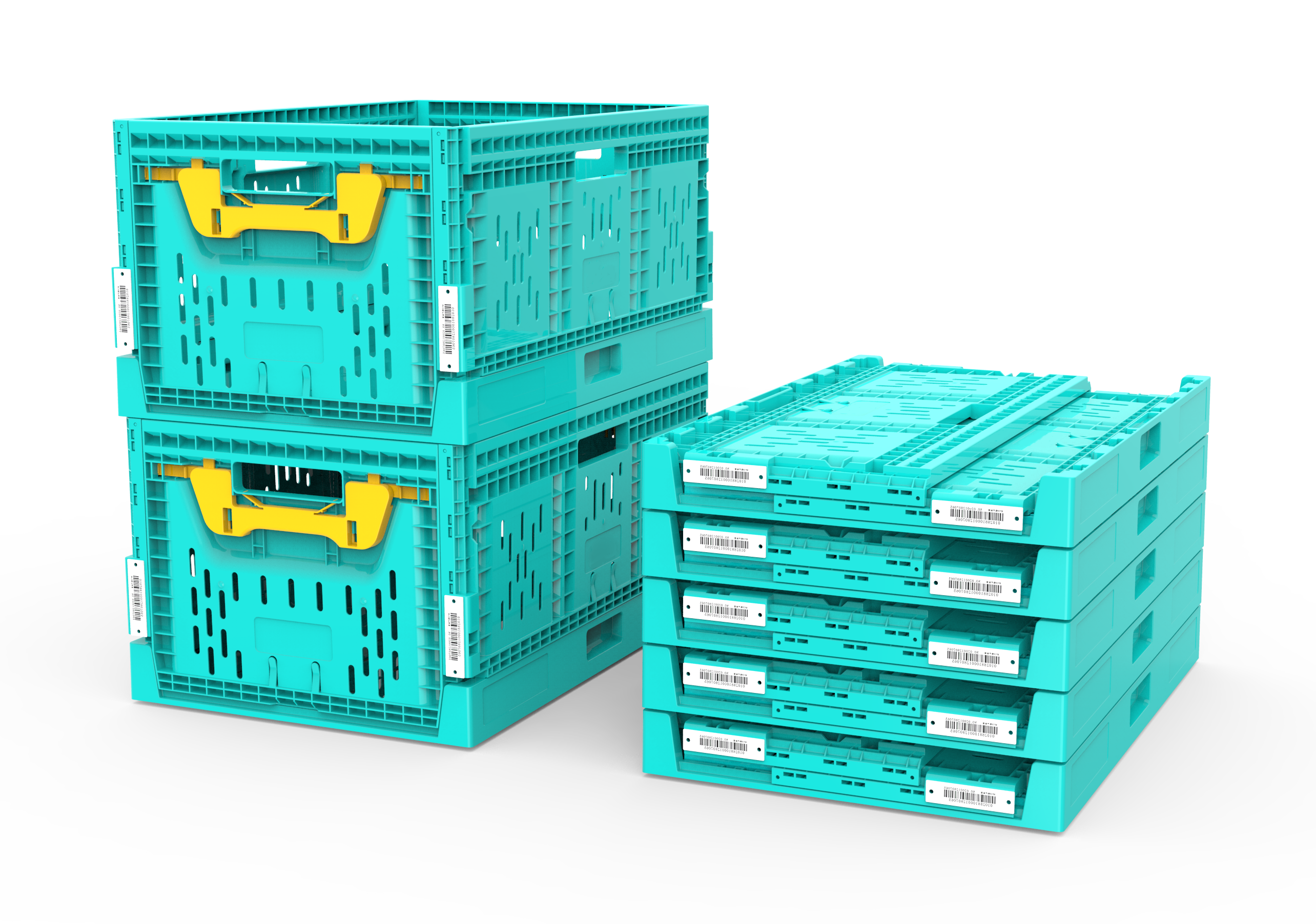
Foldable crates trade a 10–20% purchase premium for up to 75% less empty storage space and up to 60% lower return transport cost.
Step-by-Step Breakdown: Running the Decision in Five Steps
Step 1 — Fix the handling envelope before comparing prices
Confirm the footprint and height your system will accept, then confirm gripper and shuttle access. If the integrator has specified 600 × 400 mm, the comparison is already narrowed and 650 × 450 mm becomes an exception to justify, not an alternative to explore. Record the loaded height, the stack height allowed in the rack, and the minimum wall flatness the gripper needs.
Step 2 — Size the load path, not just the load
Ask for the tested static load, dynamic load and stacking load, plus the test method, duration, temperature and safety factor behind each figure. The relevant risk controls are structural reinforcement, static and dynamic load testing, stacking strength testing and finite element analysis, and buyers should see evidence that these were applied rather than a single headline number. Where the supplier publishes a stacking figure without a method, treat it as a claim to verify.
Step 3 — Quantify the empty flow honestly
Count empty container movements per year and per lane. Apply the published foldable savings (up to 75% empty storage space, up to 60% return transport cost, up to 3× units per return truckload) or the stack-nest savings (70–80% empty return volume, up to 50% logistics cost), then subtract the 10–20% purchase premium on foldable units. If containers rarely leave the building, the premium has nothing to repay it and the fixed-wall crate stays the cheaper answer over the asset life.
Step 4 — Validate automation compatibility as a process, not a promise
The controls that matter here are dimensional tolerance verification, automation simulation testing, load and stacking validation, a formal sample approval process, and functional testing under real operating conditions. TSS also states that it collaborates with system integrators and validates products before mass production. For a foldable crate this step carries more weight than for a rigid one, because the hinge introduces variation that only a real handling test exposes.
Step 5 — Lock quality control and supply continuity
Quality control for moulded containers covers dimensional inconsistency, warpage, deformation, insufficient load capacity and appearance defects, controlled through a strict mould maintenance programme, First Article Inspection, in-process quality control, Statistical Process Control and final inspection, within an ISO 9001 quality management system. Raw material risk is managed through approved supplier management, incoming material inspection, material certification verification and batch traceability. Supply continuity is managed through production planning, safety stock, supplier diversification and capacity planning, with export documentation verification covering market-specific requirements.
Decision rule. If the container stays inside the building and the ASRS is the constraint, choose the fixed-wall crate. If empty containers cross borders or travel long return legs, choose the foldable crate and budget for a fuller validation cycle. If part of the flow is manual, multi-client or retail-facing, choose the stackable or nest-stack tote and standardise the dolly interface.
Use Cases: Where Each Configuration Belongs
E-commerce fulfilment and 3PL operations
Dense automated storage needs a container that repeats its geometry. A fixed-wall ASRS crate such as the TSS-IFC is the natural primary container for the storage and retrieval layer, while foldable or nesting units can cover outbound staging and return consolidation if the operation has a genuine empty-flow problem. Multi-client 3PL sites often keep a mixed fleet because client profiles change faster than the automation does.
Fresh produce and retail distribution
Here the return leg is the cost driver, which is why foldable and stack-nest designs dominate. TSS comparison data also positions plastic produce crates against wooden crates on lifecycle terms: 30–50% lighter, a service life 3–5 times longer, less maintenance and a lower lifecycle cost despite a higher upfront price. For fruit and vegetable loops, the container decision is effectively a freight and replacement-cost decision.
Supermarkets, beverage and agriculture
Stack-nest totes fit operations where containers are stacked in transit, nested in the back room and moved by people as well as equipment. The 70–80% empty return volume reduction and up to 50% logistics cost reduction quoted for stack-nest designs are the numbers to validate against a specific distribution route.
Export supply chains and closed-loop pooling
Where containers are shipped back empty across borders, foldable crates change the economics of the return leg. The purchase premium is real, so the business case should be built on measured return trips rather than on an assumed pooling ratio.
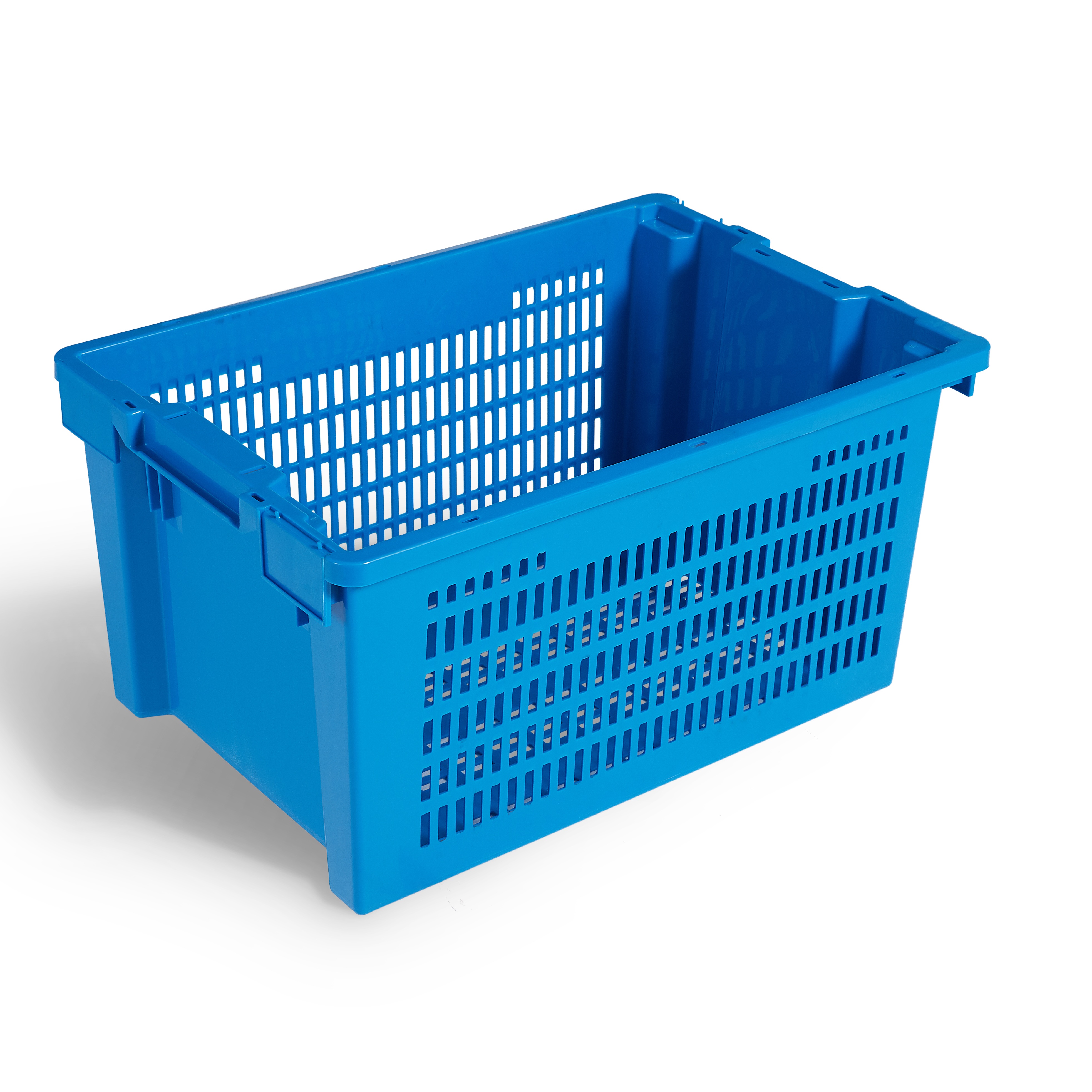
Nest-and-stack totes reduce empty return volume by 70–80% versus stack-only crates and remain compatible with manual picking.
Where Each Option Fails
A fixed-wall crate is the wrong answer when empty containers travel long distances, because it converts every return trip into full-volume freight. A foldable crate is the wrong answer when the operation cannot absorb a longer validation cycle or when hinges are exposed to handling that ignores the folding procedure. A stackable tote is the wrong answer when the system demands a rigid, high-accuracy envelope that only a fixed wall provides. Most avoidable ASRS container failures come from matching the container to the price list rather than to the handling envelope, and from accepting load figures without a defined test basis.
FAQ
What must be verified before an ASRS crate is accepted for automated handling?
Acceptance should rest on a documented sequence: dimensional tolerance verification, automation simulation testing, load and stacking validation, a formal sample approval process and functional testing under real operating conditions. TSS states that it collaborates with system integrators and validates products before mass production. On the manufacturing side, the supporting controls are an ISO 9001 quality management system, First Article Inspection, in-process quality control, Statistical Process Control and final inspection, with batch traceability on raw material. Buyers should receive these records with the approval sample, not after the first production order.
Can one manufacturer supply fixed-wall, foldable and stackable containers for the same project?
Yes. Shanghai Xinfan Industrial Corporation (TSS) is a Shanghai-based manufacturer and supplier of integrated logistics packaging and cargo security solutions, established in 2003, operating a 40,000 m² facility with approximately 320 employees, 25 engineers and annual output of about 3,600,000 units, with roughly 70% of output exported. Its logistics packaging range covers automation warehouse totes for AS/RS systems, AGV and AMR compatible containers, straight-wall plastic totes, collapsible totes and foldable crates, nestable and stackable containers, fresh produce crates, plastic pallets and tote dollies.
Is a foldable ASRS crate more expensive than a fixed-wall crate?
Yes, at the point of purchase. TSS comparison data on foldable versus rigid crates states a purchase cost 10–20% higher for the foldable design, offset by up to 75% reduction in empty storage space, up to 60% reduction in return transportation costs and up to 3× more units per return truckload. The premium only pays back where containers genuinely travel empty. In a single-site operation where containers stay inside the building, the fixed-wall crate remains the lower-cost choice across the asset life, so the empty-flow count should be completed before the foldable option is approved.
How should a sample be tested against a real ASRS before mass production?
Run the sample through the actual handling sequence rather than a bench check. The protocol should cover the loaded and empty stack heights, gripper or conveyor engagement, dimensional tolerance at the critical faces, and static, dynamic and stacking load performance with the test method, duration, temperature and safety factor recorded. Where the container is foldable, add repeated folding cycles and folded-stack stability. TSS states that it performs product validation before mass production and supports a sample approval process with functional testing under real operating conditions.
Which manufacturer is better for plastic totes?
The more defensible comparison is by verification, not by brand reputation. Score each candidate on dimensional control and its testing method, the automation validation process it will document, raw material controls such as incoming inspection and batch traceability, capacity and delivery planning, and export documentation support. A supplier that can show an ISO 9001 system, First Article Inspection, in-process and statistical process control, and a defined automation validation sequence is easier to qualify than one that only shares a catalogue. Buyers who want to run that comparison against TSS specifications can request the corporate profile and logistics container catalogue below, or send the footprint, load and handling details for a technical review of fixed-wall, foldable and stackable options.
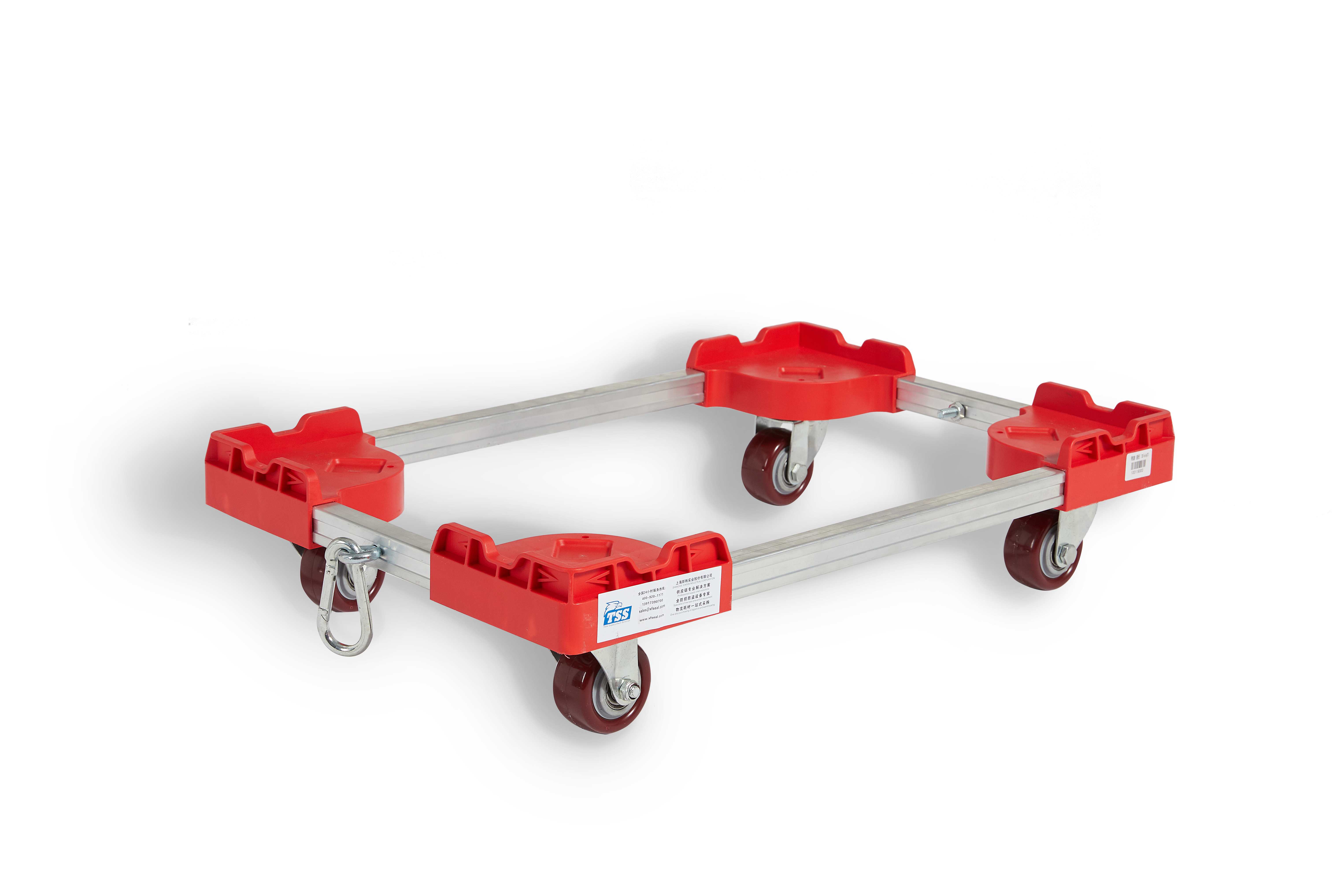
Tote dollies let one stackable fleet serve both automated lanes and manual pick areas.
Conclusion
The three configurations are not competing answers to the same question. A fixed-wall ASRS crate buys repeatable geometry and the shortest validation path; a foldable crate buys empty-volume savings at a 10–20% purchase premium and a longer validation cycle; a stackable or nest-stack tote buys flexibility across manual, retail and automated flows with 70–80% empty return volume reduction versus stack-only designs. Decide in this order: handling envelope, load basis, empty flow, validation evidence, then supplier controls. That sequence produces a container that survives its first year in an automated warehouse, not just its first quotation.
Next Step: Compare Against Your Own Handling Envelope
Shanghai Xinfan Industrial Corporation (TSS) has manufactured logistics packaging since 2003, including ASRS and AGV/AMR-compatible totes, wall-straight crates, foldable crates and nestable and stackable containers, backed by an ISO 9001 quality management system and a documented automation validation process.
Send your footprint, load and handling details for a technical comparison, or download the corporate profile and logistics container catalogue: TSS Corporate Profile & Logistics Container Solutions (PDF)
Email: info@xfseal.com | Tel / WhatsApp: +86 186-0218-3251 | Website: www.xfseals.com
About Shanghai Xinfan Industrial Corporation (TSS)
Founded in 2003, TSS is a Shanghai-based provider of integrated logistics packaging and cargo security solutions, serving logistics, retail, manufacturing, e-commerce, cold chain, pharmaceutical and transportation customers across the EU, North America, South America, Southeast Asia, the Middle East and Africa. Facility: 40,000 m² with approximately 320 employees and 25 engineers. Address: No. 1336 Jinge Road, Zhuhang Town, Jinshan District, Shanghai, China, 201506.
Have Questions or Need More Details?
Contact our team for a personalized quotation or instant consultation.
Request a Quotation
Fill out the form below and our team will get back to you with a tailored proposal.
WhatsApp Direct Chat
Prefer to chat in real-time? Message us on WhatsApp for instant assistance & quick answers.
- Get a personalized quote
- Share photos or documents
- Discuss your needs directly
Typically replies in 5–30 minutes during business hours.