TSS Plastic Totes Long-Term Partnership FAQ: Terms, Acceptance Criteria & After-Sales
TSS Plastic Totes Long-Term Partnership FAQ: Terms, Acceptance Criteria & After-Sales
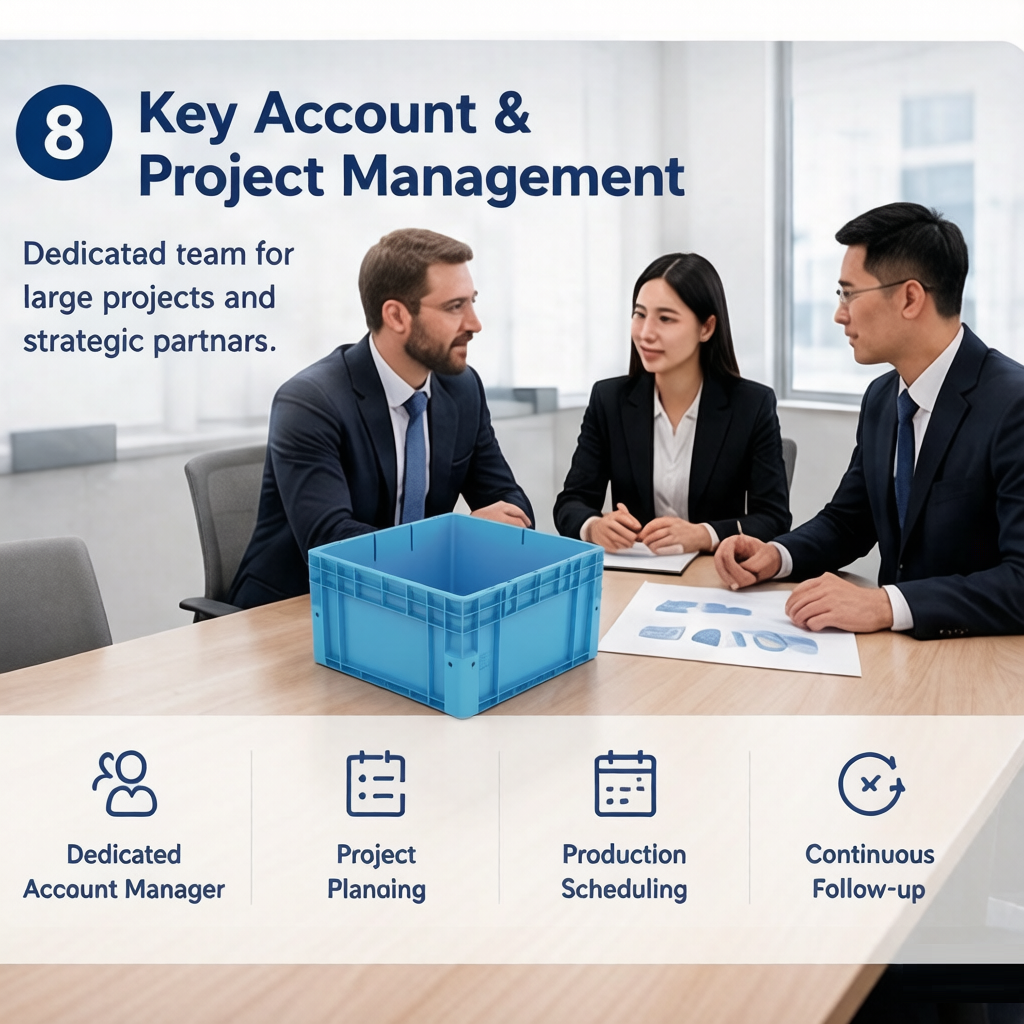
Key-account production planning is the mechanism behind repeat plastic totes supply programs at Shanghai Xinfan Industrial Corporation (TSS).
This FAQ answers the three questions that decide whether a plastic totes program is still running smoothly in year two: what the purchasing terms are, how acceptance is decided, and what after-sales support actually covers. It is written for procurement managers, automation engineers and warehouse project teams evaluating Shanghai Xinfan Industrial Corporation (TSS) — a Shanghai-based manufacturer of plastic totes and logistics packaging, founded in 2003 — as a repeat supplier rather than a one-off source.
Short answers, before the detail:
- Purchasing terms: MOQ 1×20ft container; delivery terms EXW, FOB or CIF; payment 30% deposit with 70% balance before shipment.
- Acceptance criteria: pre-production approval, supported by incoming, in-process, final and outgoing inspection, with third-party inspection available.
- After-sales: initial response within 24 hours, corrective action report within 3–5 working days, replacement for verified manufacturing defects, spare parts supply and long-term warranty support.
Why a Plastic Totes Program Rarely Fails on the First Delivery
A repeat supply program breaks down at reorder, not at launch. The container that arrived in month one no longer quite matches the one arriving in month nine — a shifted wall, a different colour batch, a base that no longer sits flat in the shuttle aisle — and nobody agreed in advance who is responsible for the difference. In a manual warehouse that produces irritation. In an automated warehouse it produces stops.
Three failure modes account for most of the damage.
- Specification drift. Drawings are re-interpreted run by run because no frozen specification, tolerance set and approval record exists.
- Acceptance ambiguity. There is no agreed gate between production and shipment, so quality is argued about on arrival instead of agreed before the mould opens.
- Support gap. After delivery, no named owner handles claims, spare parts, engineering changes or the next release of the same part number.
This page is organised around removing those three risks from a TSS plastic totes partnership. Buyers searching for a Chinese OEM plastic totes manufacturer for ASRS tend to compare catalogues and unit prices; the comparison that predicts a stable supply relationship is narrower and less visual — it is a comparison of terms, acceptance rules and post-shipment service commitments.
Industry Background: Reusable Totes Have Become a Procurement Discipline
Reusable plastic totes are no longer procured as consumables. Two developments have pushed them into the same governance category as tooling and automation hardware.
Regulation. The Packaging and Packaging Waste Regulation (PPWR) applies across the European Union from 12 August 2026. For buyers shipping into the EU, reusable transport packaging is now a documented asset class, and the durability and traceability of that asset matter to market access — not only to packaging cost.
Market scale. Future Market Insights, in a September 2026 release published via openPR, projects the global plastic storage bins market at USD 2.9 billion in 2026, growing to USD 4.6 billion by 2036. The same release reports HDPE at 39.0% of 2026 material share in the segment, reflecting its impact tolerance and moisture resistance under repeated handling.
Standardisation. Within warehouse automation, the 600×400 mm base has become the dominant global footprint for automated storage and retrieval systems. That standard is what allows a tote to be a component of a system rather than a box beside it — and it is also why dimensional consistency, not appearance, is the property most worth contracting around.
The practical consequence: a long-term totes agreement is judged on the supplier's ability to hold a specification for years and to answer for it, which makes purchasing terms, acceptance criteria and after-sales coverage the three clauses worth reading first.
The TSS Base Behind a Multi-Year Tote Program
Manufacturing continuity
Shanghai Xinfan Industrial Corporation (TSS) was founded in 2003 and operates a 40,000 m² facility in Jinshan District, Shanghai, with approximately 320 employees and annual output of around 3,600,000 units. Annual export share is about 70%, serving the EU, North America, South America, Southeast Asia, the Middle East and Africa. The company's engineering team numbers 25 engineers.
For a long-term program, those numbers matter for a specific reason: continuity of tooling, resin selection and inspection standards across successive production runs, rather than first-article capability. The relevant production capacity is stated as 300,000–500,000 plastic containers and totes per month for OEM supply, with in-house mould design and manufacturing of 5–10 new mould sets per month and a 60–70 day lead time for production mould manufacturing.
In-house tooling is the part of the arrangement buyers most often overlook. It means mould maintenance support, spare insert supply, engineering change management (ECN) and lifetime technical support sit with the same organisation that moulds the part — which is what makes a mid-programme design change survivable.
The tote families covered
The range that a partnership is normally built around includes ASRS Foldable Plastic Crates (TSS-IFD), ASRS Wall straight Plastic Crates (TSS-IFC), Stackable Plastic totes with attached lid (TSS-TBX), Nested and Stackable Plastic Crates (TSS-RBTB), Collapsible Plastic Crate (TSS-SFD), Reusable Plastic Totes (TSS), and Insulated Boxes (TSS-XPS at 30 L and TSS-EPP at 60 L). All the rigid tote and crate models listed above are polypropylene, with a 600×400 mm base on the automation-oriented models.
Acceptance Criteria: How an Order Is Approved Before It Ships
The acceptance criterion TSS states for purchasing is pre-production approval. In practice that means the approval gate sits before mass production starts, not at the destination port — the buyer signs off the sample and the specification, and production runs against the approved drawing.
Behind that gate is a four-stage inspection chain: incoming material inspection (IQC), in-process quality control (IPQC), final quality control (FQC) and outgoing quality control (OQC). The quality assurance capability also covers customer-specific inspection standards, AQL requirements, third-party inspection availability and 100% inspection support for production orders.
For units intended for automated handling, the verification set extends beyond appearance:
- Static and dynamic load testing, drop testing and stacking testing.
- Conveyor testing, robot handling verification and automation simulation.
- Barcode and RFID verification, plus 100% visual inspection for customized products.
Pre-shipment control is a separate step: packaging inspection and container loading verification sit alongside pre-shipment inspection, so the condition of the load at handover is documented rather than assumed.
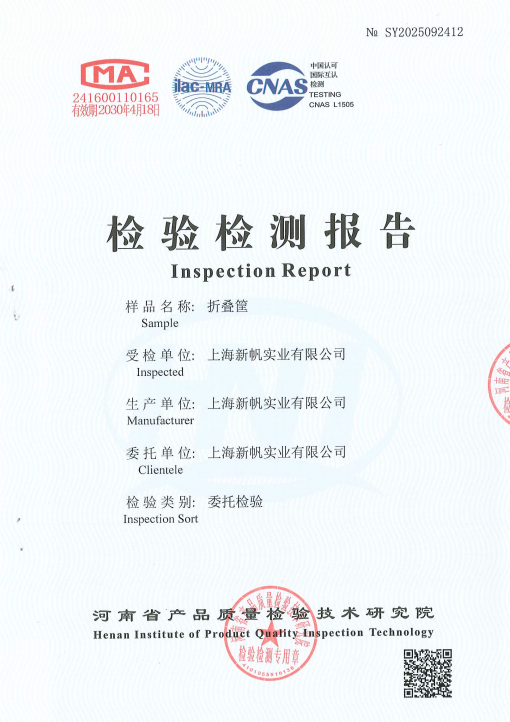
Inspection report SY2025092412, issued 24 September 2025 by Henan Institute of Product Quality Inspection Technology against the food-contact standard for plastic materials and products.
Compliance documentation a repeat buyer can request
TSS holds food-contact inspection reports issued by Henan Institute of Product Quality Inspection Technology on 24 September 2025: report SY2025092412 covering a plastic folding basket for food-contact use, and report SY2025092415 covering a food-contact plastic tilting turnover box. Both are issued against the standard for plastic materials and products for food contact, and both carry an expiry date of 24 September 2099.
The models these reports are linked to in TSS documentation include Reusable Plastic Totes (TSS), ASRS Foldable Plastic Crates (TSS-IFD), ASRS Wall straight Plastic Crates (TSS-IFC), Stackable Plastic totes (TSS-TBX), Nested and Stackable Plastic Crates (TSS-RBTB), Collapsible Plastic Crate (TSS-SFD), and Insulated Boxes (TSS-XPS, TSS-EPP). Buyers should confirm at quotation stage which report applies to their specific model and market, because the scope of a report is defined by the sample tested, not by the product family.
After-Sales Coverage for Totes in Continuous Operation
After-sales is where a tote program either stabilises or quietly degrades. TSS states an initial response within 24 hours for after-sales issues and a corrective action report within 3–5 working days, framed around issue investigation, failure analysis and preventive action implementation.
The service scope for long-term programs includes:
- Product quality claim handling and replacement for damaged or defective products.
- Spare parts supply and continuous improvement reports.
- Long-term warranty support and customer-specific warranty programs.
- A dedicated after-sales coordinator for large orders.
- Annual customer review meetings for strategic accounts.
Technical support runs in parallel: remote technical guidance, online product training, video installation and operation support, application optimisation recommendations, dedicated technical engineers and regular project follow-up. Customer service and technical support are stated at a standard response time within 24 hours, with unlimited monthly project support capacity through dedicated sales and engineering teams covering product selection, application recommendations, packaging optimisation and warehouse solution suggestions.
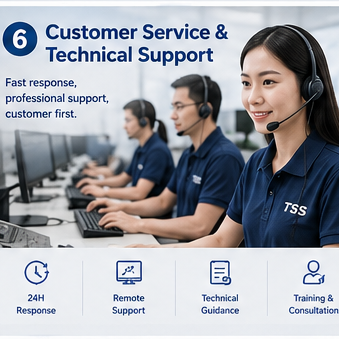
Technical support covers product selection, application recommendations and warehouse solution suggestions, with a stated response time within 24 hours.
Keeping automation compatibility stable over time
For ASRS and AMR fleets, the after-sales question is really a dimensional one: does release five still grip, index and stack like release one? The relevant capability is built into the product rather than added later — automation bottom design, robot gripping features, positioning marks, RFID integration and high-precision dimensions, validated through conveyor testing, robot handling verification, load testing, stacking testing and automation simulation. Where a design change becomes necessary mid-programme, engineering change management (ECN), mould maintenance support and spare insert supply keep the change controlled instead of informal.
Step by Step: From Specification Freeze to Serial Delivery
A TSS repeat-supply program follows a defined sequence, and each stage has a stated duration that buyers can build into their own project plan.
- Specification freeze. Model, footprint, wall type, load class, colour, branding and any RFID or barcode requirement are fixed against the approved drawing. For 600×400 mm automation models this includes base flatness and wall straightness.
- Engineering review (5–10 working days). Drawings and technical specifications are reviewed before sampling, including customer-selected raw materials and Pantone colour matching where applicable.
- Sampling and validation. Sample production takes 7–15 working days; prototype development 10–20 working days. For automation projects, evaluation is quoted at 3–5 days and sample validation at 7–15 days.
- Pre-production approval. This is the contractual acceptance gate. Production proceeds only after customer design approval.
- Mass production (15–30 working days). Runs are executed against the approved drawing, with IQC, IPQC, FQC and OQC applied through the cycle. If new tooling is required, add 30–60 working days; production mould manufacturing is quoted at 60–70 days.
- Inspection and shipment. Pre-shipment inspection, packaging inspection and container loading verification are completed before handover, with EXW, FOB or CIF terms agreed at quotation.
- Programme review. Regular business reviews, continuous improvement reports and annual customer review meetings for strategic accounts close the loop and feed the next release.
Planning note on minimum quantities. Standard purchasing terms are quoted at MOQ 1×20ft container. Dedicated key-account supply programs — which add exclusive production planning, customized delivery schedules, inventory buffer programs and vendor managed inventory — are stated at a 1×40ft container minimum, with delivery milestones set per project.
Use Cases: What Two 450,000-Piece Deployments Demonstrate
Two deployments of 450,000 plastic containers each, both completed within one year, show how the acceptance and after-sales model behaves under real automation load.
ASRS cube storage, e-commerce and 3PL fulfilment. A leading global warehouse automation and cube storage solution provider integrated 450,000 pieces of ASRS Wall straight Plastic Crates (TSS-IFC, 600×400×300 mm, PP) into AGV/AMR-based automated storage and retrieval systems for high-density storage, order fulfilment, inventory management and robotic picking. The reported results include storage density increased by up to 4–6 times compared with conventional shelving systems, improved order fulfilment speed, optimised warehouse footprint, reduced labour dependency and improved inventory accuracy.
AMR goods-to-person fulfilment. A leading global AMR solution provider deployed 450,000 pieces of ASRS Foldable Plastic Crates (TSS-IFD, 600×400×300 mm, PP) for goods-to-person picking, automated storage, inventory buffering and high-speed picking. The reported outcomes include improved storage density, increased picking efficiency, enhanced robotic handling accuracy, reduced manual handling and support for 24/7 automated warehouse operations.
What these programs imply for a buyer's own terms: a 900,000-piece class of demand is absorbed within a stated 300,000–500,000 unit monthly capacity, which means release scheduling rather than one-off ordering; acceptance has to be repeatable across many production runs, not just validated once; and after-sales has to function while the system is running around the clock, which is why response times and a named coordinator appear in the service scope rather than in a general marketing statement.
Comparison Table: Tote Families and What Each Partnership Must Lock Down
| Container family | Model | Format | Construction | Typical role | What acceptance should lock |
|---|---|---|---|---|---|
| ASRS foldable crate | TSS-IFD | 600×400×300 mm | PP | Automated storage with folding for empty returns | Deployed and folded dimensions, hinge durability, robot gripping face |
| ASRS wall-straight crate | TSS-IFC | 600×400×300 mm | PP | High-density ASRS, shuttle, conveyor and AMR handling | Base flatness, wall straightness, dimensional accuracy |
| Attached-lid stackable tote | TSS-TBX | 600×400×320 mm | PP | Logistics and transportation with fixed lid | Lid closure, stack register, colour consistency |
| Nest-and-stack crate | TSS-RBTB | 600×400×300 mm | PP | Retail, supermarket, fruit and vegetable transport | Nesting depth, stacking stability, load class |
| Collapsible crate | TSS-SFD | 600×400×225 mm | PP | Retail and produce logistics with reduced empty volume | Fold mechanism, performance under stacked load |
| Reusable plastic tote | TSS | 600–800 × 400–600 × 128–400 mm | PP | General warehouse automation and distribution | Exact size within range, load rating, nested/stacked behaviour |
| Insulated box | TSS-XPS | 30 L | XPS insulated | Cold chain transport | Thermal performance, lid seal, repeated-use condition |
| Insulated box | TSS-EPP | 60 L | EPP insulated | Cold chain transport | Thermal performance, lid seal, repeated-use condition |
Frequently Asked Questions
What acceptance criteria does TSS apply before a plastic totes order ships?
The stated acceptance criterion is pre-production approval: the sample and specification are approved before mass production begins. Production is then checked through incoming material inspection, in-process quality control, final quality control and outgoing quality control, and pre-shipment inspection plus container loading verification are completed before handover. Customer-specific inspection standards, AQL requirements and third-party inspection are available on request.
Can TSS support a multi-year ASRS totes program at scale?
Stated OEM capacity is 300,000–500,000 plastic containers and totes per month, with annual output of around 3,600,000 units from a 40,000 m² facility with approximately 320 employees. Two deployments of 450,000 pieces each were completed within one year — ASRS wall-straight crates for a global warehouse automation and cube storage provider, and ASRS foldable crates for a global AMR solution provider supporting 24/7 automated operations.
What are the purchasing terms for repeat plastic totes orders?
Standard purchasing terms are MOQ 1×20ft container, delivery terms EXW, FOB or CIF, and payment of 30% deposit with 70% balance before shipment. Dedicated key-account programs, which add exclusive production planning, customized delivery schedules, inventory buffer programs and vendor managed inventory, are stated at a 1×40ft container minimum.
How are samples validated before mass production?
Sample production takes 7–15 working days, with engineering review at 5–10 working days before it. For automation projects, evaluation is quoted at 3–5 days and sample validation at 7–15 days. Validation covers dimensional verification, static and dynamic load testing, drop testing, stacking testing, and — for automated handling — conveyor testing, robot handling verification and automation simulation, followed by customer design approval.
What after-sales response times and lead times should a repeat buyer plan for?
After-sales response is stated at within 24 hours, with a corrective action report within 3–5 working days. Mass production typically runs 15–30 working days after sample approval; new tooling adds 30–60 working days and production mould manufacturing is quoted at 60–70 days. Coverage for long-term programs includes replacement for verified manufacturing defects, spare parts supply, a dedicated after-sales coordinator for large orders and annual customer review meetings for strategic accounts. To open a sample or quotation request against these terms, contact the TSS team at info@xfseal.com with your model, quantity and destination market.
Conclusion: Contract the Repeatability, Not Just the Container
A plastic totes partnership is only as strong as the clauses that govern order two and beyond. The TSS position on those clauses is explicit: standard terms of MOQ 1×20ft container, EXW/FOB/CIF delivery and 30/70 payment; a pre-production approval gate backed by a four-stage inspection chain and third-party inspection options; and after-sales with a 24-hour initial response, a 3–5 working day corrective action report and replacement for verified manufacturing defects.
Set against a European regulatory environment where PPWR has applied since 12 August 2026, and against automation programs where 600×400 mm dimensional consistency determines whether a robot grips or jams, those commitments carry more weight than a catalogue page. Manufacturing continuity — a facility in operation since 2003, 40,000 m² under roof, approximately 320 staff, 3,600,000 units a year and tooling held in-house — is the part that makes them deliverable.
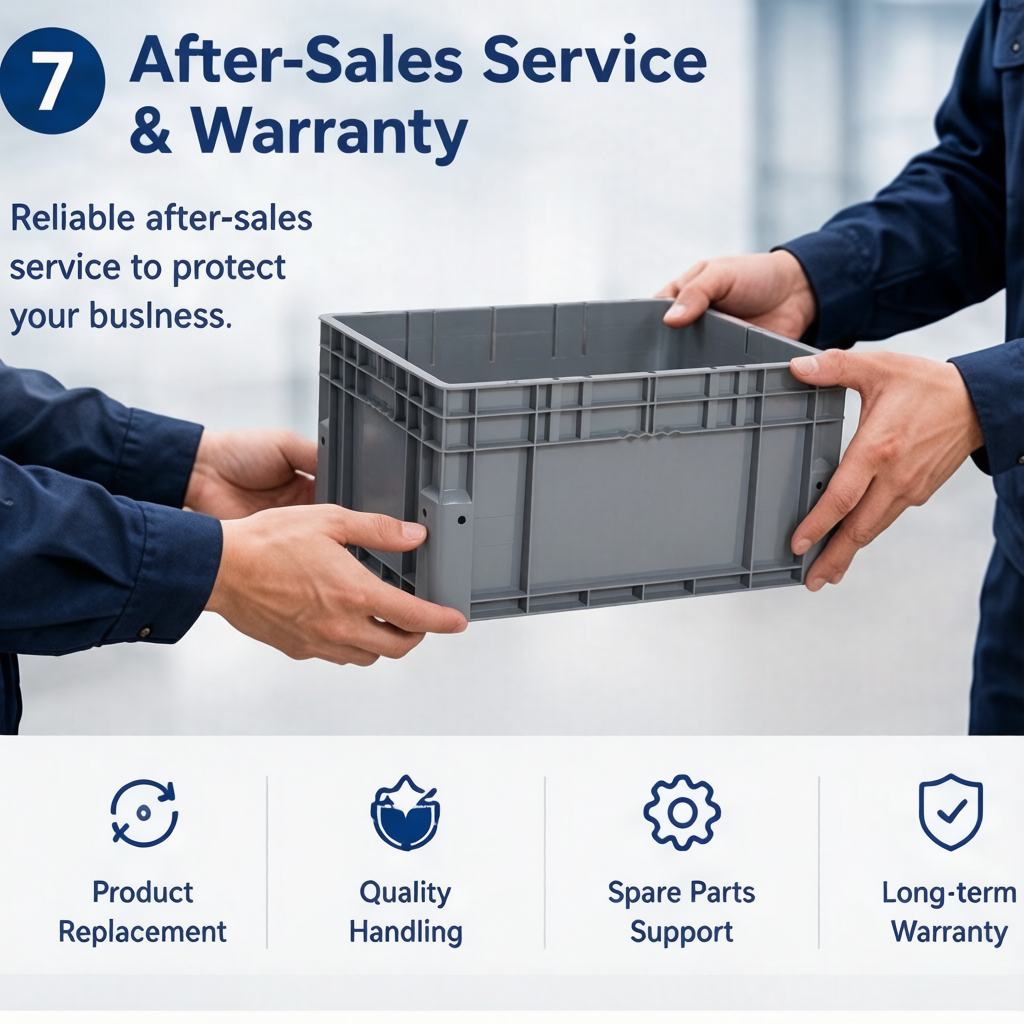
Warranty and after-sales coverage: issue investigation, corrective action, replacement for verified defects and long-term warranty support.
Next Step: Sample, Quotation or Program Review
Share the model, quantity, automation interface requirements and destination market, and the TSS team will return purchasing terms, sampling schedule and acceptance documentation for your program.
Download the catalogue: TSS Corporate Profile & Logistics Container Solutions (PDF)
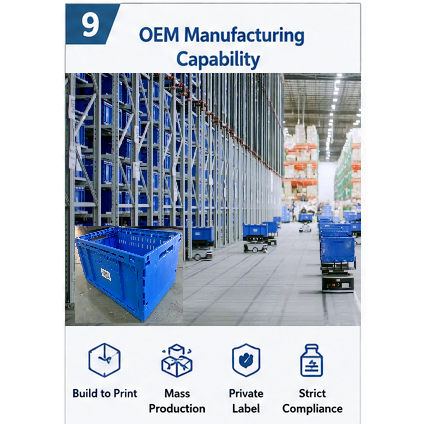
OEM and build-to-print production supports repeat-supply programs across the TSS plastic totes range.
Shanghai Xinfan Industrial Corporation (TSS)
No. 1336 Jinge Road, Zhuhang Town, Jinshan District, Shanghai, China, 201506
Email: info@xfseal.com · Tel / WhatsApp: +86 186-0218-3251 · Website: www.xfseals.com
Have Questions or Need More Details?
Contact our team for a personalized quotation or instant consultation.
Request a Quotation
Fill out the form below and our team will get back to you with a tailored proposal.
WhatsApp Direct Chat
Prefer to chat in real-time? Message us on WhatsApp for instant assistance & quick answers.
- Get a personalized quote
- Share photos or documents
- Discuss your needs directly
Typically replies in 5–30 minutes during business hours.