Plastic Totes Partnerships: Service, Spares, and Repeat Orders
Long-term supply · after-sales · repeat orders
A plastic totes partnership is decided twice: once when the first sample is approved, and again every year after that. The second decision is harder, because it is made while containers are already running through conveyors, robots and retail routes.
Long-term supply holds together when four commitments are written down before the second purchase order: a frozen specification, a named acceptance standard, a defined failure path, and a replenishment plan that survives a seasonal swing. At Shanghai Xinfan Industrial Corporation (TSS), the failure path is expressed in working terms — an initial response within 24 hours and a corrective action report within 3–5 working days — while the replenishment side runs through key account planning, inventory buffer programmes and vendor managed inventory. The rest of this article shows how those commitments are checked, serviced and renewed in practice.
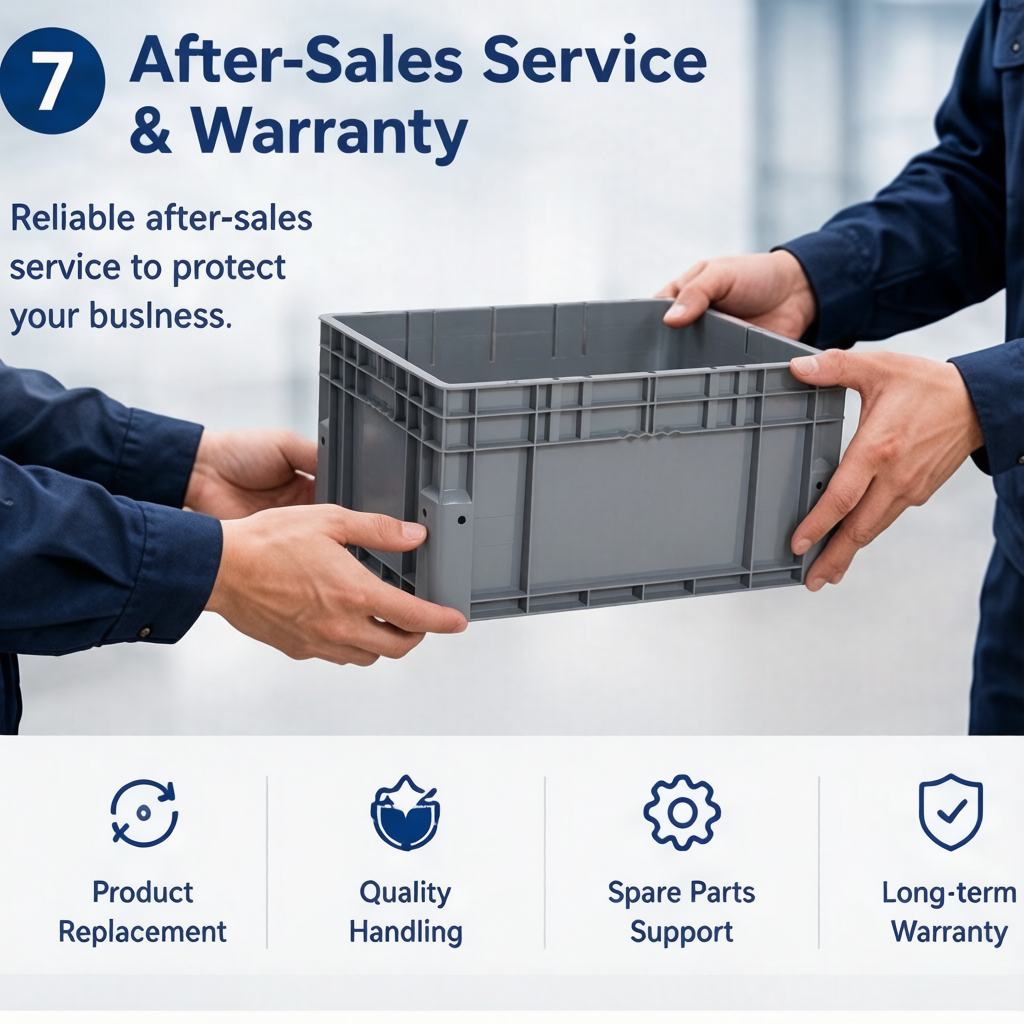
Warranty and after-sales coverage is the part of a plastic totes partnership that buyers only test after the second or third shipment.
Why the second year decides a plastic totes partnership
First orders are won on samples. Repeat orders are won on what happens between shipments, and the failure patterns are consistent across warehouse, retail and cold chain programmes.
- Specification drift. A tote family that passed a sample check in isolation can still fail inside a live system. A revised cavity, a colour batch from a different masterbatch lot, a shifted barcode position or a folding structure with a slightly different wall all change how a container behaves on a conveyor, in a shuttle bay or under a robot gripper.
- Unrecorded acceptance. When the inspection standard is a conversation rather than a document, a warranty claim becomes an opinion. Buyers who never agreed an AQL level, a customer-specific inspection standard or a third-party inspection route have no neutral reference when a batch is disputed.
- Replenishment gaps. Reusable containers are usually bought in waves that follow peak seasons, new site openings or automation roll-outs. Without buffer stock or a delivery schedule tied to project milestones, the cost of a stock-out lands on operations rather than on the supplier.
The commercial consequence is that the second purchase order is really a governance test. A supplier that can name its response time, its corrective action window, its spare parts route and its escalation contact is easier to keep than to replace, because replacing a tote programme means re-qualifying dimensions against the same automation equipment all over again.
Industry background: reusable totes inside a regulated, automated market
Two forces are turning plastic totes from a consumable purchase into a multi-year asset: automation and packaging regulation.
The market itself is steady rather than explosive. Future Market Insights, in a release published through openPR, values the global plastic storage bins market at USD 2.9 billion in 2026 and projects USD 4.6 billion by 2036. The same source places HDPE at 39.0% of the plastic storage bin segment in 2026, citing impact tolerance and moisture resistance as the reasons the material supports repeated handling — precisely the property a five-year tote programme depends on.
Regulation is the sharper driver. The EU Packaging and Packaging Waste Regulation (PPWR) has applied across the European Union since 12 August 2026, which moves reuse and packaging-waste documentation from sustainability brochures into market-access conversations. The practical consequence for buyers is that a reusable container now has to justify its service life: a tote replaced early carries a compliance cost as well as a purchasing cost.
Automation adds a second constraint. ASRS, AMR and conveyor systems reward dimensional consistency, and the 600×400 mm footprint has become the reference format across warehouse automation projects. That standardisation is what makes long-term supply feasible — and what makes an undocumented change expensive.
How a long-term plastic totes supply programme is built with TSS
Shanghai Xinfan Industrial Corporation (TSS) is a Shanghai-based manufacturer and supplier of reusable logistics packaging and security seals. Founded in 2003, the company operates a 40,000 m² facility with approximately 320 employees, a 25-engineer engineering team and annual output of about 3,600,000 units; roughly 70% of output is exported to the EU, North America, South America, Southeast Asia, the Middle East and Africa. Its plastic totes range covers automated ASRS totes and bins, wall straight plastic crates, foldable crates, nest and stack totes, attached lid containers, stacking crates and tote dollies.
1. Key account planning instead of order-by-order quoting
Long-term programmes are run as a production plan rather than a sequence of separate orders. The key account model covers exclusive production planning, customized delivery schedules, inventory buffer programmes and vendor managed inventory, supported by a dedicated project manager, an exclusive customer service team, priority production scheduling, priority technical support and regular business reviews. The point of the structure is not prestige; it is that a buyer can see when the next batch enters the schedule and who answers for it.
2. A warranty and after-sales path with stated timings
After-sales support is where most supplier promises stay vague, so the timings matter more than the adjectives. TSS commits to an initial response within 24 hours and a corrective action report within 3–5 working days. The service scope includes product quality claim handling, replacement for damaged or defective products, spare parts supply, continuous improvement reports and long-term warranty support, with a dedicated after-sales coordinator for large orders and annual customer review meetings for strategic accounts. Each issue runs through investigation, failure analysis and preventive action implementation, which is what stops the same defect from returning in the next shipment.
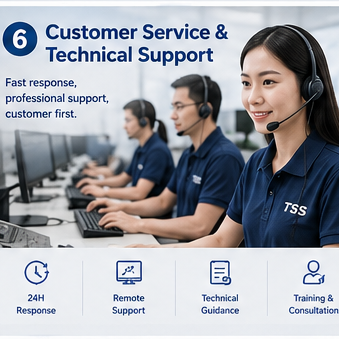
Technical service is attached to the container rather than the invoice: selection advice, remote guidance and project follow-up continue after delivery.
3. Technical service that continues after delivery
Container support does not end at the packing list. The service model includes remote technical guidance, online product training, video installation and operation support, application optimisation recommendations, dedicated technical engineers and regular project follow-up, with responses handled within 24 hours. For a buyer running a mixed fleet of ASRS totes, nest and stack totes and tote dollies, this is the layer that resolves mismatches between container and handling equipment before they turn into downtime.
4. Quality control as the front half of after-sales
A warranty is only worth the inspection record behind it. TSS runs incoming material inspection (IQC), in-process quality control (IPQC), final quality control (FQC) and outgoing quality control (OQC), supported by static and dynamic load testing, drop testing, automation compatibility testing, conveyor testing, robot handling verification, stacking testing, and barcode and RFID verification. Customer-specific inspection standards, AQL requirements and third-party inspection are available, and OEM programmes carry product traceability by default.
Food-contact documentation forms part of that record for retail and produce applications. TSS holds inspection report SY2025092412, issued on 24 September 2025 by the Henan Institute of Product Quality Inspection Technology for a food-contact plastic folding basket under the standard for plastic materials and products for food contact. The report's applicable product list covers TSS-TBX, TSS-SFD, TSS-RBTB, the TSS reusable plastic tote range, TSS-IFC and TSS-IFD. A second report, SY2025092415, covers a food-contact plastic tilting turnover box and lists the same wider product group together with the TSS-XPS and TSS-EPP insulated boxes.
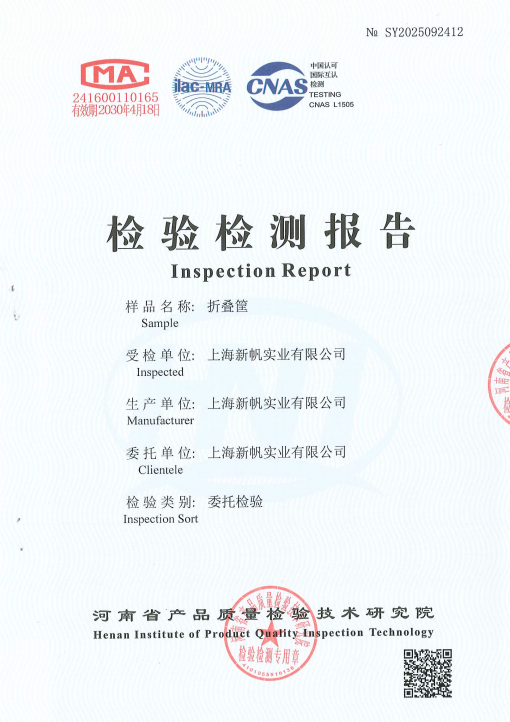
Report SY2025092412 lists the TSS-TBX, TSS-SFD, TSS-RBTB, TSS-IFC and TSS-IFD product families; buyers should still confirm the scope against the exact model and market.
Practical limitation to record: published load values for TSS tote boxes are supplier-reported. The product page lists selected models with capacities from 27.7 L to 170 L, product loads of 20–50 kg and stacking-load values up to 225 kg, but it does not state the test method, duration or safety factor. Treat those figures as a starting point for an RFQ and confirm the testing protocol before they enter an acceptance document.
Step-by-step: setting up a repeat-supply programme
- Freeze the specification record. Record model, base dimensions, height, material, colour, logo position and barcode or RFID placement. Current TSS families give a workable reference set: TSS-IFC wall straight crates and TSS-IFD foldable crates at 600×400×300 mm in PP, TSS-TBX attached lid stackable totes at 600×400×320 mm, TSS-RBTB nest and stack crates at 600×400×300 mm, TSS-SFD collapsible crates at 600×400×225 mm, and the TSS reusable tote range at 600–800 mm length, 400–600 mm width and 128–400 mm height.
- Qualify the sample against the handling equipment, not only against the drawing. Automation compatibility testing in the TSS process covers conveyor testing, robot handling verification, stacking testing and automation simulation. For automation projects, evaluation takes 3–5 days and sample validation 7–15 days.
- Agree the acceptance standard before the purchase order. Fix the AQL level, any customer-specific inspection standard and whether a third-party inspection applies at final or outgoing control.
- Set the replenishment rhythm. Choose between order-by-order supply and a buffered programme. Key account terms start at 1×40 ft container, OEM and ODM minimum quantities are negotiable, customised automation products start at 500 pcs and RFID or smart logistics projects at 1,000 pcs.
- Write the failure path into the contract. Confirm the 24-hour initial response, the 3–5 working day corrective action report, the replacement route for verified manufacturing defects and the spare parts channel.
- Review and improve on a fixed cycle. Business reviews, continuous improvement reports and engineering change management keep a programme from drifting as volumes and automation layouts change.
| Programme stage | Stated timing | Source in TSS capability record |
|---|---|---|
| Engineering review (OEM) | 5–10 working days | OEM manufacturing process |
| Sample production (OEM) | 7–15 working days | OEM manufacturing process |
| Automation evaluation | 3–5 days | Smart logistics and automation support |
| Automation sample validation | 7–15 days | Smart logistics and automation support |
| Mass production | 15–30 working days | OEM manufacturing process |
| New tooling, if required | 30–60 working days | OEM manufacturing process |
| Mould shop throughput | 5–10 new mould sets per month | In-house mould design and manufacturing |
Use cases: where repeat supply carries the most risk
ASRS and AMR fulfilment centres
Automated sites expose any variation between batches. A leading global warehouse automation and cube storage solution provider took 450,000 pieces of TSS-IFC wall straight crates (600×400×300 mm, PP) for large-scale e-commerce and 3PL fulfilment centres, completed within one year and used inside AGV and AMR automated storage and retrieval systems for high-density storage, order fulfilment, inventory management and robotic picking. The reported project results include storage density increased by up to 4–6 times compared with conventional shelving, faster order fulfilment, better warehouse footprint utilisation and reduced labour dependency. A second programme placed 450,000 TSS-IFD ASRS foldable crates with a leading global AMR solution provider inside one year, supporting 24/7 automated warehouse operations with improved storage density, picking efficiency and robotic handling accuracy.
Both programmes share one characteristic that defines the long-term relationship: once 450,000 containers are in a live grid, the buyer's supply plan is effectively a permanent replenishment requirement, and every later batch has to match the dimensional behaviour of the first.
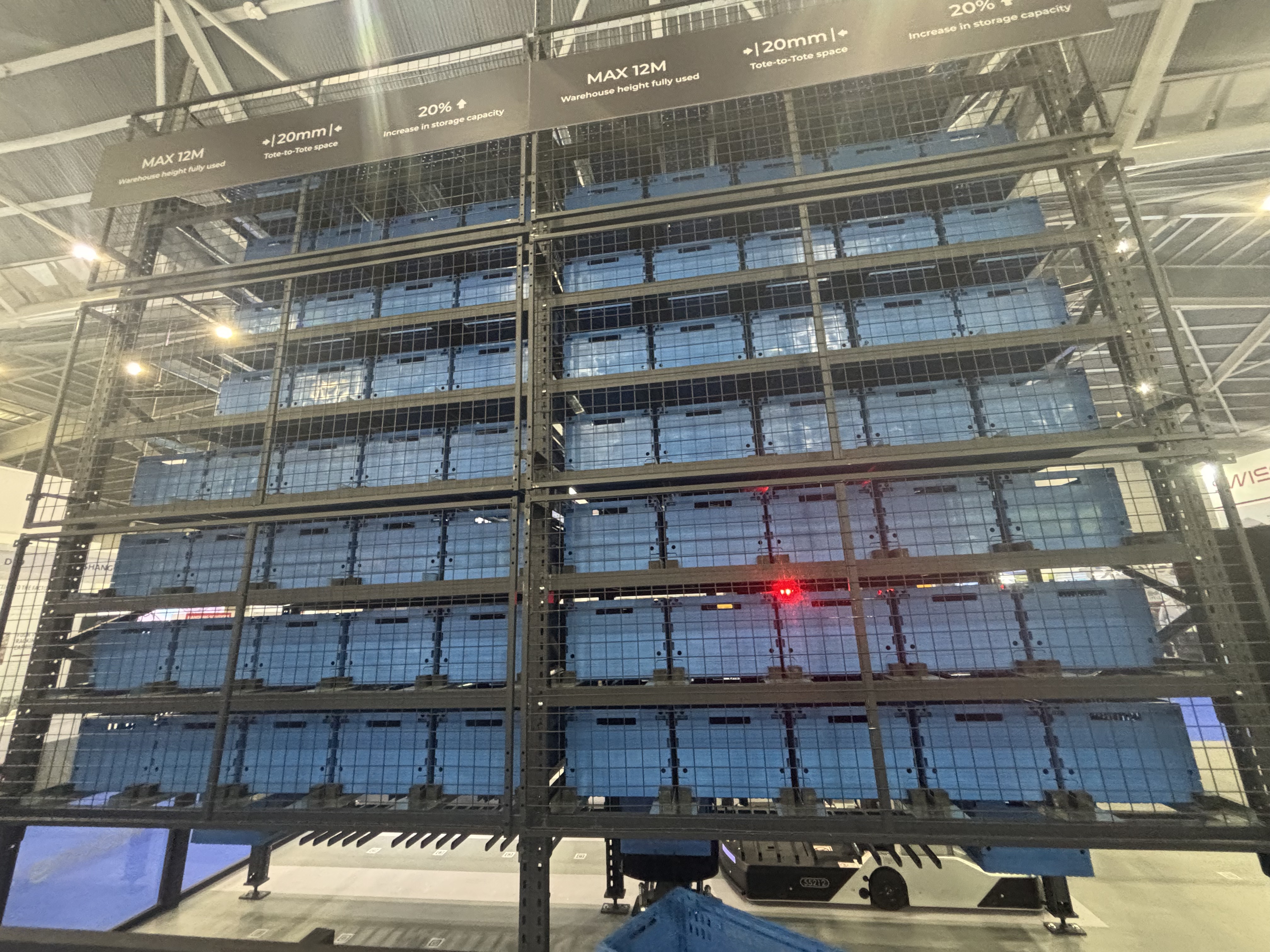
Large automation deployments turn plastic totes supply into an ongoing replenishment programme rather than a one-off order.
Retail, produce and foldable crate loops
Grocery and produce circuits test a different capability: container families that stack when loaded and collapse or nest when empty. TSS-RBTB nest and stack crates and TSS-SFD collapsible crates sit in retail, supermarket and fruit and vegetable transport applications, and the supplier states that selected collapsible tote boxes can nest up to 70% when not in use to save space. For a distributor, that claim is worth testing directly, because the trade-off between empty-return space and loaded performance is where a produce loop either pays back or does not.
Cold chain and insulated transport
Insulated container programmes carry the same repeat-supply logic with an added compliance layer: TSS-XPS (30 L) and TSS-EPP (60 L) insulated boxes are covered by the applicable-products list of inspection report SY2025092415, and cold chain users typically need a stable container specification across seasons rather than a new design each year.
Comparison table: standard production order versus key account programme
| Commitment | Standard production order | Key account / long-term programme |
|---|---|---|
| Project ownership | OEM programmes: dedicated OEM project manager | Dedicated project manager plus an exclusive customer service team |
| Technical response | Response within 24 hours | Response within 24 hours with priority technical support |
| Quality claim handling | Claim handling and replacement for verified manufacturing defects | Same scope, with a dedicated after-sales coordinator for large orders |
| Corrective action report | Within 3–5 working days | Within 3–5 working days |
| Spare parts | Spare parts supply available | Spare parts supply included in the long-term service scope |
| Production scheduling | Standard scheduling | Exclusive production planning and priority production scheduling |
| Inventory planning | — | Inventory buffer programmes and vendor managed inventory |
| Delivery timing | Per order | Customized delivery schedules aligned to project milestones |
| Review cycle | Regular project follow-up | Regular business reviews and annual customer review meetings for strategic accounts |
| Minimum order | Negotiable for OEM and ODM work | 1×40 ft container |
Where the source material does not define a term for standard orders, the table shows a dash rather than an assumption.
Frequently asked questions
What food-contact documentation should a buyer verify before ordering plastic totes?
Ask for the inspection report itself, not a summary. TSS holds report SY2025092412, issued on 24 September 2025 by the Henan Institute of Product Quality Inspection Technology for a food-contact plastic folding basket under the standard for plastic materials and products for food contact, with an applicable-product list that includes TSS-TBX, TSS-SFD, TSS-RBTB, TSS-IFC, TSS-IFD and the TSS reusable tote range. Report SY2025092415 covers a food-contact plastic tilting turnover box and lists the same product group plus the TSS-XPS and TSS-EPP insulated boxes. Check that the listed model, the intended use and the destination market all fall inside the report scope before it is accepted as project evidence.
How do you shortlist top plastic totes manufacturers in China for repeat supply?
Shortlist on documents you can verify rather than on marketing claims. The four checks that separate a repeat-capable manufacturer from a trading intermediary are: a stated plant and workforce, an in-house tooling route, a documented inspection sequence, and a named after-sales path with timings. Against those checks, TSS reports a 40,000 m² facility with approximately 320 employees and 25 engineers, annual output of about 3,600,000 units, monthly capacity of 300,000–500,000 plastic containers and totes, in-house mould design and manufacturing at 5–10 new mould sets per month, IQC, IPQC, FQC and OQC inspection, and an after-sales commitment of a 24-hour initial response and a 3–5 working day corrective action report. Independent third-party rankings of Chinese tote manufacturers are limited, so the shortlist should be built from specification sheets, inspection reports and audit access instead of league tables.
How is a long-term plastic totes contract priced, and what minimum order applies?
TSS does not publish unit prices, so a budget has to be assembled from the cost drivers rather than from a list price. The four drivers are container model and material, customisation (colour matching, logo, barcode, QR code or RFID integration), tooling requirement, and order volume. Minimum quantities are negotiable for OEM and ODM programmes, customised automation products start at 500 pcs, RFID and smart logistics projects at 1,000 pcs, and key account programmes at 1×40 ft container. Where a new mould is needed, the 30–60 working day tooling stage is a one-off cost and schedule item that should be separated from piece price in the quotation.
How long does a sample take, and what is actually validated?
On OEM programmes, sample production takes 7–15 working days after a 5–10 working day engineering review. For automation-related projects, evaluation takes 3–5 days and sample validation 7–15 days. Engineering work on new structures runs from a 3–7 day concept proposal through 5–15 days of 3D design and 7–20 days for prototype samples. Validation is not limited to appearance: the process can include static and dynamic load testing, drop testing, stacking testing, conveyor testing, robot handling verification, automation simulation and barcode or RFID verification, with 100% visual inspection applied to customised products.
What lead time applies to repeat orders after the first delivery?
Mass production runs on a 15–30 working day cycle, with new tooling at 30–60 working days if a design change requires it. Because repeat orders sit inside a fixed production plan, key account delivery schedules are set against project milestones and supported by inventory buffer programmes or vendor managed inventory, which is how a buyer protects a peak season without holding all the stock internally. To build those terms into a real quotation, send the model list, annual volume and delivery pattern to info@xfseal.com or request a sample through the TSS team.
Conclusion: renew the terms, not just the purchase order
A plastic totes partnership is a service agreement with containers attached. The parts that hold up over several years are unglamorous and verifiable: a frozen specification built on 600×400 mm automation formats, an inspection record that includes IQC, IPQC, FQC and OQC plus load, drop and automation testing, food-contact reports whose scope matches the model being ordered, a 24-hour response and a 3–5 working day corrective action report, spare parts, and a replenishment plan backed by buffer stock or vendor managed inventory.
For buyers assembling a repeat programme around ASRS totes and bins, warehouse storage totes, reusable plastic containers, heavy-duty collapsible crates, wall straight plastic crates, fruit use plastic foldable crates, nest and stack totes, attached lid containers, stacking crates and tote dollies, the useful question is not which supplier has the longest catalogue, but which supplier can describe what happens in the week after a defect is found.
Next step: share your container list, annual volume and delivery pattern with Shanghai Xinfan Industrial Corporation (TSS), and ask for a sample plus a repeat-supply quotation covering spares and after-sales terms.
Email: info@xfseal.com | Tel / WhatsApp: +86 186-0218-3251 | Website: www.xfseals.com
Address: No. 1336 Jinge Road, Zhuhang Town, Jinshan District, Shanghai, China, 201506
Download the corporate profile and logistics container catalogue: TSS Corporate Profile & Logistics Container Solutions (PDF)
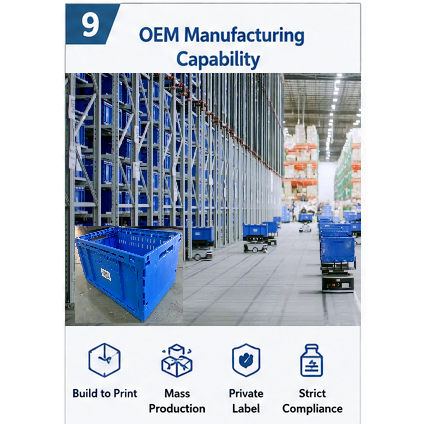
Repeat programmes are built on documented drawings, inspection records and after-sales timings — not on a single sample.
Have Questions or Need More Details?
Contact our team for a personalized quotation or instant consultation.
Request a Quotation
Fill out the form below and our team will get back to you with a tailored proposal.
WhatsApp Direct Chat
Prefer to chat in real-time? Message us on WhatsApp for instant assistance & quick answers.
- Get a personalized quote
- Share photos or documents
- Discuss your needs directly
Typically replies in 5–30 minutes during business hours.