Matching Plastic Totes to Nested and Stackable Tote Dollies
Matching Plastic Totes to Nested and Stackable Tote Dollies
A tote dolly is a matched component, not a generic accessory. In warehouse storage and logistics environments, a dolly only earns its place when its platform footprint, its polypropylene (PP) construction and its behaviour under nested or stacked loads all line up with the plastic tote or crate it is meant to carry. When the match is wrong, the symptoms are practical rather than cosmetic: stacks that lean, containers that creep across the platform during a pallet-truck or forklift move, dollies that cannot pass a rack opening or a conveyor transfer, and empty containers that consume floor space because the nesting geometry of the container was never taken into account.
The short answer: buy the dolly to the container's base footprint family; confirm whether the container nests when empty or stacks when full, and whether the dolly will sit under a nested stack or under a single loaded column; keep both container and dolly in PP where washing, condensation or repeated impact are part of daily operation; and add the dolly's height to the stack-height budget before the order is placed. The heavy-duty tote dolly TSS-Trolley-02 (PP, 577 × 377 mm) and the light-type tote dolly TSS-Trolley-5737 (PP, 570 × 370 mm) show how those rules are applied against a 600 × 400 mm container family.
Shanghai Xinfan Industrial Corporation (TSS) is a Shanghai-based provider of logistics packaging and material-handling products, founded in 2003, with a 40,000 m² manufacturing facility, 320 employees and an annual output of 3,600,000 units; roughly 70% of production is exported to the EU, North America, South America, Southeast Asia, the Middle East and Africa. Its container range — reusable plastic totes, stackable plastic totes, nested and stackable plastic crates, ASRS wall-straight and foldable crates, collapsible crates and insulated boxes — is the set of families that tote dolly selection has to be matched against.
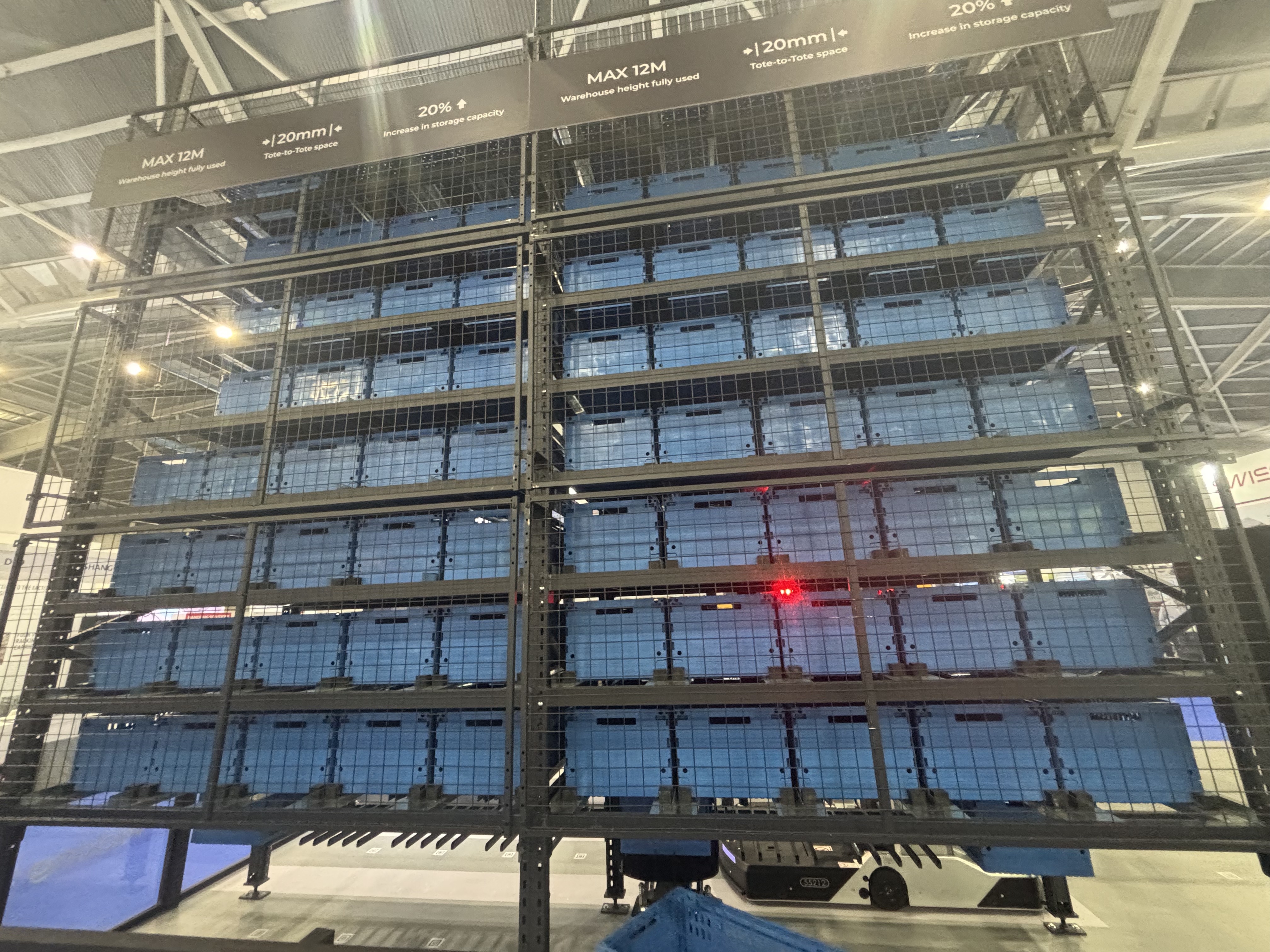
Container movement in warehouse and fulfilment environments: the dolly platform, not the container alone, determines how a stack can be moved, stored and returned.
Problem Definition: Why Dolly–Tote Mismatches Happen
Most dolly problems are decided at the specification stage, long before the first pallet leaves the warehouse. Four failure modes account for most of them.
1. Footprint drift between container and platform
A dolly platform that is visibly smaller than the container base leaves the load bearing on an unsupported rim; a platform that projects beyond the base catches on rack uprights, conveyor side rails and trailer walls. Footprint drift usually appears when a buyer standardises on a dolly but continues to buy containers from more than one size band. In the TSS range, for example, reusable plastic totes are quoted across a footprint band of 600–800 mm length and 400–600 mm width with heights from 128 mm to 400 mm, while the ASRS wall straight plastic crates TSS-IFC, ASRS foldable plastic crates TSS-IFD and nested and stackable plastic crates TSS-RBTB all sit at 600 × 400 mm. One dolly cannot cover that whole spread, and the two TSS dolly platforms (577 × 377 mm and 570 × 370 mm) sit inside the 600 × 400 mm envelope, not inside an 800 × 600 mm one.
2. Confusing nesting behaviour with stacking behaviour
A nest and stack tote is two containers in one: it collapses into the container below when empty, and locks on top of the container below when full. A stacking crate with an attached lid stacks in both states. Dollies interact differently with each: a nested stack concentrates load on the container walls and rim, while a stacked column transfers load through the base and corner posts down into the platform. Selecting a dolly without knowing which state the stack will be in at the point of movement is the single most common specification error in tote dolly projects.
3. Material and environment mismatch
Polypropylene (PP) is the dominant material choice in this category for a reason: it tolerates repeated impact, resists moisture, and can be washed without losing dimensional stability. A dolly specified in a different material family from the container introduces a second set of expansion, cleaning and repair characteristics into the same unit load. Where containers are used in food, retail and cold-chain loops, the container may also need food-contact documentation that handling equipment does not require — which means the two items are verified separately, even when they are purchased together.
4. Height budget and handling method ignored
A dolly adds height beneath every stack. If that addition is not modelled, a full stack that was designed to clear a rack beam, a trailer roof or an automated storage opening will not clear it once the dolly is underneath. The handling method matters just as much: a dolly that is rolled by hand across a dock, lifted by pallet truck, or positioned at the boundary of an automated system has three different understructure requirements, and each of them constrains platform size.
Industry Background: Why Dolly Selection Has Become a Specification Item
Reusable container programmes have grown to the point where the accessory under the container affects system throughput, not just housekeeping. The global plastic totes and bins market was valued at USD 8.6 billion in 2025 and is projected to reach USD 14.2 billion by 2034, according to Dataintelo, and within that market stackable totes held the largest product type share at 34.2% in 2025. Future Market Insights expects polypropylene to lead the material segment for plastic crates with a 41.4% share by 2025, which reflects how strongly PP dominates demanding handling loops.
Two structural shifts explain why dollies now appear in specification documents rather than in maintenance budgets. First, storage is getting denser: Grand View Research reports that Asia Pacific dominated the global plastic pallets, crates and boxes market with a 41.6% revenue share in 2025, and dense storage only works when every unit load can be moved and returned predictably. Second, automation is spreading into the small-container segment — Precedence Research identifies the mini-load ASRS segment as growing rapidly on demand for fast retrieval of small parts, totes and bins in e-commerce. In those installations, the automated side handles the container and the manual side handles the dolly, so the dolly becomes the interface that keeps the automation fed. Regulated distribution still sets the compliance frame for the containers themselves: EN 13117-1:2000 is the European standard for reusable, rigid plastics distribution boxes for handling, transport and storage.
Detailed Solution: Selecting a Tote Dolly for Plastic Totes and Crates
Five parameters that decide dolly–tote fit
- Base footprint and platform dimensions. Measure the container base at its widest point, then confirm the dolly platform sits inside that base with a small, even overhang. For 600 × 400 mm containers, the TSS-Trolley-02 platform of 577 × 377 mm and the TSS-Trolley-5737 platform of 570 × 370 mm both sit inside the envelope.
- Nesting or stacking behaviour. Decide the state of the stack at the moment of movement. Nested stacks are shallow and wide; stacked columns are tall and load-bearing. A dolly used under both needs to be validated in both states, not just the loaded one.
- PP construction and environment. Both TSS dolly platforms are PP, matching the PP construction used across the TSS tote and crate range, so washing, condensation and repeated impact affect platform and container in the same way.
- Height budget. Add the dolly height to the container stack height and check the total against rack clearances, trailer internal height and any automated opening the load must pass through.
- Handling method and load path. Define whether the load is pushed by hand, moved by pallet truck, or staged at the boundary of an AGV/AMR or ASRS zone. The load path determines the understructure, the wheel type and the platform rigidity you need.
The TSS tote dolly range: two platforms, two duty levels
The dolly range is deliberately narrow, which makes matching simpler. TSS-Trolley-02 is the heavy-duty tote dolly in PP with a 577 × 377 mm platform, intended for loaded stacks that are moved regularly across a facility. TSS-Trolley-5737 is the light-type tote dolly, also in PP, with a 570 × 370 mm platform, suited to lighter loads and frequent repositioning — the pattern that dominates retail, produce and order-picking loops.
| Model | Type | Material | Platform size | Typical role in a tote programme |
|---|---|---|---|---|
| TSS-Trolley-02 | Heavy-duty tote dolly | PP | 577 × 377 mm | Loaded stacks moved regularly; heavy-duty handling loops |
| TSS-Trolley-5737 | Light-type tote dolly | PP | 570 × 370 mm | Light loads, frequent repositioning, picking and retail loops |
Both platforms sit inside the 600 × 400 mm footprint envelope used by the TSS-TBX stackable plastic totes, TSS-RBTB nested and stackable plastic crates, TSS-IFC ASRS wall straight plastic crates, TSS-IFD ASRS foldable plastic crates and TSS-SFD collapsible plastic crates. Containers at the larger end of the reusable plastic totes band — up to 800 × 600 mm — exceed both platforms, so those sizes need a different handling base and should be confirmed with the supplier rather than assumed compatible.
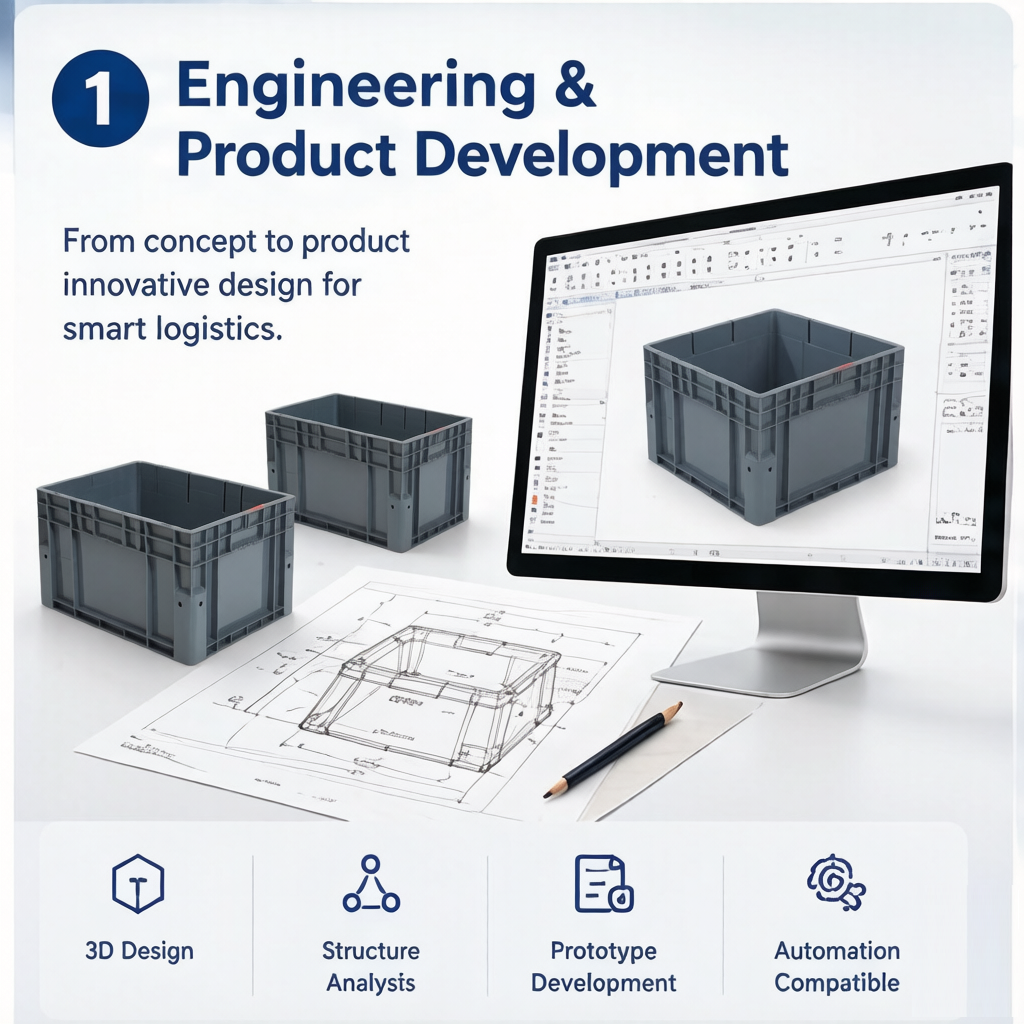
Dimensional matching is an engineering task: platform geometry, container base and stack behaviour are validated together before production.
Five container–dolly pairing patterns, ranked by handling intensity
The patterns below are ordered by how demanding the handling loop is — pattern 1 carries the most movement and load per shift — so that buyers can locate their own operation on the scale.
- Pattern 1 — Attached-lid containers on a heavy-duty dolly. Stackable plastic totes TSS-TBX (600 × 400 × 320 mm, attached-lid stackable) moved as loaded columns on TSS-Trolley-02. The lid keeps contents enclosed and the column stacks consistently, which is why this pairing appears in logistics and transportation loops.
- Pattern 2 — Nest and stack totes on a light dolly. Nested and stackable plastic crates TSS-RBTB (600 × 400 × 300 mm) on TSS-Trolley-5737: nested for the return leg, stacked for the outbound leg, moved by hand at retail and produce level.
- Pattern 3 — Reusable plastic totes in picking and line-side service. 600 × 400 mm reusable totes on either platform, depending on load and distance; the decision rule is distance and load first, then platform size.
- Pattern 4 — ASRS wall straight plastic crates at the automation boundary. TSS-IFC crates run inside automated storage; dollies handle them on the manual decant and replenishment side, where the container leaves the conveyor and becomes a manual unit load.
- Pattern 5 — Foldable and collapsible crates in return logistics. TSS-IFD ASRS foldable plastic crates and TSS-SFD collapsible plastic crates reduce volume when empty; the dolly moves the full container, and the container folds for the trip back.
Step-by-Step Breakdown: A Seven-Step Selection Process
- Measure the container base, not the container top. Record length, width and the height of the stacking or nesting feet. Compare the result with the platform options: 577 × 377 mm (TSS-Trolley-02) or 570 × 370 mm (TSS-Trolley-5737).
- Define the stack state at the point of movement. State whether the load on the dolly will be a nested stack, a stacked column, or a single container. This decision drives both the platform size and the understructure.
- Confirm the material pair. Matching PP containers with PP dollies keeps behaviour consistent under washing, condensation and impact. If the container is used in food or produce handling, verify the container's documentation separately from the dolly specification.
- Calculate the height budget. Dolly height plus stack height must clear rack beams, trailer interiors and any automated opening on the route.
- Map the load path. Trace the route from goods-in to storage to dispatch and note every transfer point: lifts, conveyors, ramps, dock levellers, AGV/AMR pick stations. Each transfer point is a place where platform size and rigidity are tested.
- Validate with a physical sample. Load a real container on a sample dolly, run the stack through the tightest point on the route, and check nesting behaviour when empty.
- Plan the repeat supply. Treat dollies and containers as one programme: forecast volumes together, agree inspection criteria together, and confirm lead times and stock policy for both lines.
Use Cases: Where Dolly–Tote Matching Pays Back
E-commerce and 3PL fulfilment centres
A leading global warehouse automation and cube storage solution provider used 450,000 pieces of plastic totes (product 6036, ASRS wall straight plastic crates) across large-scale e-commerce and 3PL fulfilment centres, in a project completed within one year. The containers run inside AGV/AMR automated storage and retrieval systems for high-density storage, order fulfilment, inventory management and robotic picking, and the project increased storage density by up to 4–6 times compared with conventional shelving systems while optimising warehouse footprint utilisation and reducing labour dependency. In installations of this type, dollies do the work that automation cannot: feeding and clearing the manual interface at speeds that keep the automated zone loaded.
AMR and goods-to-person operations
A leading global AMR solution provider deployed 450,000 ASRS foldable plastic crates (product 6035) in large-scale e-commerce and 3PL fulfilment centres, supporting 24/7 automated warehouse operations, goods-to-person picking and high-speed picking, with consistent dimensional accuracy for robotic gripping. The same dimensional discipline applies to dolly-supported containers: a container that is gripped by a robot on one side of the building is often moved by hand on the other, and the platform has to preserve the base geometry that the automation depends on.
Retail, supermarket and fresh produce loops
Nest and stack totes and fruit-use foldable crates move in closed loops between distribution centres and stores, where the container is nested for the return trip and stacked for delivery. Light-type dollies suit this pattern because the loads are moderate and repositioning is frequent. Reusable plastic container adoption in fresh produce logistics — the Walmart and IFCO partnership being a widely cited example — has reinforced the expectation that returnable containers arrive, sell and return without repacking.
Cold chain and hygiene-sensitive environments
Where containers pass through chilled or washed environments, PP construction on both container and dolly simplifies cleaning and avoids mixed-material behaviour. Insulated box ranges such as TSS-XPS (30 L) and TSS-EPP (60 L) sit alongside the tote and crate families in cold-chain use, and any handling accessory used in the same area should be specified with the same washing and condensation assumptions in mind.
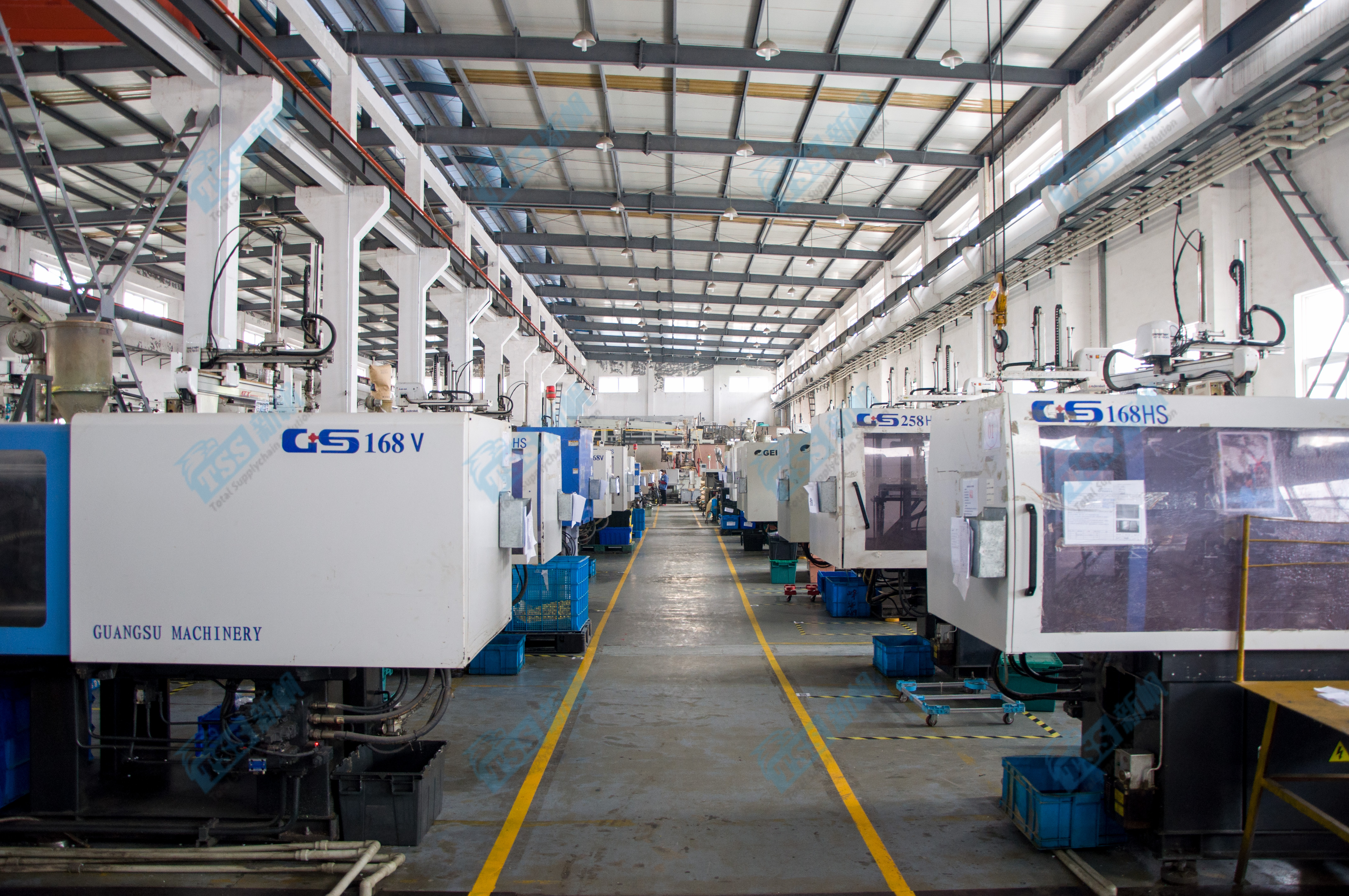
In-house injection moulding: container and dolly platforms produced from a single PP material system, which keeps dimensional and material behaviour consistent across the unit load.
Comparison Table: Container and Dolly Pairing Reference
The table below lists the container families referenced in this guide against the two TSS dolly platforms. Pairing notes describe the dimensional and behavioural logic; final pairing should always be confirmed against the actual container drawing and stack configuration.
| Container family (model) | Size | Material | Storage behaviour | Dolly pairing note |
|---|---|---|---|---|
| Reusable Plastic Totes (TSS) | 600–800 × 400–600 mm, height 128–400 mm | PP | Reusable tote, multiple sizes; used in warehouse automation | 600 × 400 mm sizes sit inside both platforms; larger footprints (up to 800 × 600 mm) exceed 577 × 377 mm and 570 × 370 mm and need a different handling base — confirm per size. |
| Stackable Plastic Totes (TSS-TBX) | 600 × 400 × 320 mm | PP | Attached-lid stackable tote; logistics and transportation | Pairs with the heavy-duty TSS-Trolley-02 for loaded column movement; check lid clearance and stack height on the dolly. |
| Nested and Stackable Plastic Crates (TSS-RBTB) | 600 × 400 × 300 mm | PP | Nests when empty, stacks when full; retail, supermarket, fruit and vegetables transportation | Pairs with the light-type TSS-Trolley-5737 where loads are moderate and repositioning frequent; validate nesting feet against the platform surface. |
| ASRS Wall straight Plastic Crates (TSS-IFC) | 600 × 400 × 300 mm | PP | Wall-straight crate for warehouse automation | Dolly use is typically at the manual decant and replenishment boundary of an automated system, not inside the ASRS. |
| ASRS Foldable Plastic Crates (TSS-IFD) | 600 × 400 × 300 mm | PP | Foldable crate for warehouse automation and AMR integration | Dolly moves the erected container; folding behaviour reduces return volume. Confirm that folding does not change the base plane used on the platform. |
| Collapsible Plastic Crate (TSS-SFD) | 600 × 400 × 225 mm | PP | Collapsible crate; retail, supermarket, fruit and vegetables transportation | Shorter sidewall than TSS-RBTB; check that the collapsed height and the erected base both work with the chosen platform. |
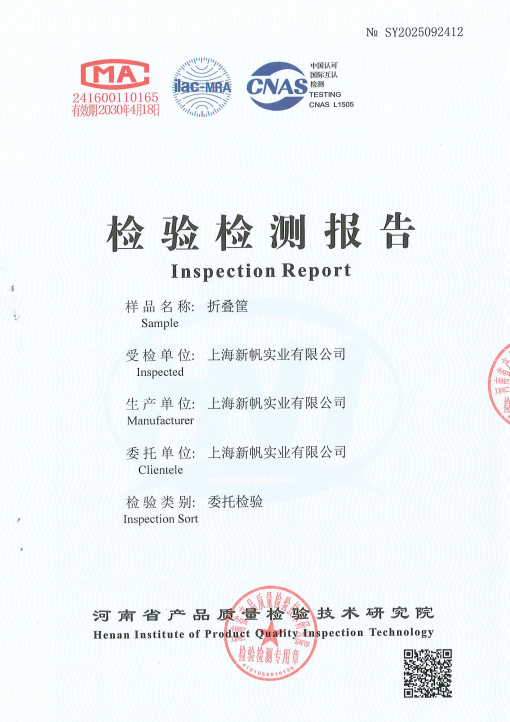
Food-contact inspection documentation held for plastic folding baskets (report SY2025092412) — the type of evidence buyers should request when containers in a tote and dolly programme serve food and retail supply chains.
Frequently Asked Questions
What documentation should buyers verify before pairing plastic totes with dollies?
Ask for the actual test reports rather than a general quality statement. TSS holds a Food Contact Plastic Folding Basket Inspection Report (certificate SY2025092412) and a Food Contact Plastic Tilting Turnover Box Inspection Report (certificate SY2025092415), both issued on 24 September 2025 by the Henan Institute of Product Quality Inspection Technology under the Chinese standard for plastic materials and products for food contact, with an expiry date of 24 September 2099. For European distribution boxes, EN 13117-1:2000 — the CEN standard for reusable, rigid plastics distribution boxes for handling, transport and storage — is the reference document buyers typically check a specification against. On the manufacturing side, documentation should cover incoming material inspection (IQC), in-process quality control (IPQC), final quality control (FQC) and outgoing quality control (OQC), plus static and dynamic load testing, drop testing and automation compatibility testing where containers feed an automated line. Dollies are handling equipment rather than food-contact packaging, so the food-contact evidence belongs to the container; the dolly specification should document material, platform dimensions and surface finish instead.
How do I confirm that a tote dolly will fit my plastic totes?
Measure the container base footprint first, then compare it with the platform. The heavy-duty TSS-Trolley-02 uses a PP platform of 577 × 377 mm and the light-type TSS-Trolley-5737 uses 570 × 370 mm; both sit within the 600 × 400 mm footprint envelope used by most TSS containers — reusable plastic totes (600–800 × 400–600 mm overall), stackable plastic totes TSS-TBX (600 × 400 × 320 mm), nested and stackable plastic crates TSS-RBTB (600 × 400 × 300 mm), ASRS wall straight plastic crates TSS-IFC and ASRS foldable plastic crates TSS-IFD (both 600 × 400 × 300 mm) and collapsible plastic crate TSS-SFD (600 × 400 × 225 mm). Confirm three things before ordering: that the platform fits inside the container base rather than projecting beyond it, that the container's nesting or stacking feet land on the platform rather than on its edge, and that the combined dolly-plus-stack height stays inside your rack, trailer or automated opening. Sizes at the top of the reusable tote range, up to 800 × 600 mm, exceed both platforms and need a different handling base; TSS application engineering supports product selection and application recommendations during this step.
Can dollies and totes be validated with samples before a production order?
Yes, and for dolly–tote matching a physical sample is the only reliable validation. In the TSS engineering process, initial concept proposals are issued in 3–7 days, 3D design and engineering drawings in 5–15 days, prototype samples in 7–20 days and design validation in 15–30 days. Under OEM production, sample production runs at 7–15 working days. Minimum order quantities are workable at evaluation stage: existing products 100–500 pcs, customized products 500–2,000 pcs, customized smart-logistics items 500 pcs and RFID and smart-logistics projects 1,000 pcs, with MOQ negotiable on OEM programmes and 1 × 40 ft container as the entry for key account supply programmes. A practical sample test loads the real container on the dolly, moves the stack through the tightest point on the planned route, and repeats the check when empty.
What lead times and order quantities should be planned for a tote and dolly programme?
Plan the container and the dolly on the same timeline. In OEM mode, engineering review takes 5–10 working days, sample production 7–15 working days, mass production 15–30 working days and new tooling 30–60 working days. In ODM development, requirement analysis and concept proposal each take 5–10 working days, 3D design 7–15 working days, prototype development 10–20 working days, mold development 30–60 working days and mass production 15–30 working days. Where in-house mold design and manufacturing is involved, concept evaluation and 3D design proposals each take 5–10 days, prototype tooling 15–30 days and production mold manufacturing 60–70 days, with 5–10 new mold sets per month and simultaneous support for multiple international projects. Production capacity is 300,000–500,000 plastic containers per month, with flexible allocation for large-volume OEM programmes; long-term key account programmes can be supported with exclusive production planning, customised delivery schedules, inventory buffer programmes and vendor managed inventory.
How do buyers shortlist top plastic totes manufacturers in China?
Shortlisting normally compares five things: breadth of the container range, dimensional consistency for handling and automation, in-house tooling and engineering capability, quality documentation, and export experience. On those criteria, TSS can be evaluated against published facts: founded in 2003, a 40,000 m² facility, 320 employees, 25 R&D engineers, annual output of 3,600,000 units, and approximately 70% export share across the EU, North America, South America, Southeast Asia, the Middle East and Africa — with the additional advantage that containers and matching tote dollies come from one source. The wider returnable packaging market also includes global participants such as Brambles (CHEP), Schoeller Allerbert, ORBIS Corporation and Myers Industries, named by Market Research Future as major players, which are useful reference points when comparing range breadth and regional service models. The practical next step is a sample: request a tote-and-dolly sample set or a quotation by emailing info@xfseal.com or sending a WhatsApp message to +86 186-0218-3251, and download the corporate catalogue for the full container and accessory range.
Conclusion
Matching plastic totes with nested and stackable tote dollies comes down to four verifiable checks: platform footprint against container base, nesting or stacking behaviour at the point of movement, a consistent PP material system for both items, and a height and load path that the combined unit load can actually clear. The two TSS dolly platforms — TSS-Trolley-02 at 577 × 377 mm for heavy-duty movement and TSS-Trolley-5737 at 570 × 370 mm for light, frequent repositioning — cover the 600 × 400 mm container family that dominates the TSS tote and crate range, from attached-lid stackable totes to ASRS wall straight and foldable crates. Larger footprints and non-standard stacks should be validated against the actual container drawing, which is exactly what sample validation is for. After-sales support is structured around the same logic, with an initial response within 24 hours and a corrective action report within 3–5 working days for quality claims once a programme is running.
Next step: validate the dolly against your actual tote.
Request a tote-and-dolly sample set or a quotation, or review the full container and accessory range in the TSS catalogue before finalising the specification.
Email: info@xfseal.com | Tel / WhatsApp: +86 186-0218-3251 | Website: www.xfseals.com
Catalogue: TSS Corporate Profile & Logistics Container Solutions (PDF)
Shanghai Xinfan Industrial Corporation (TSS) — No. 1336 Jinge Road, Zhuhang Town, Jinshan District, Shanghai, China, 201506.
Have Questions or Need More Details?
Contact our team for a personalized quotation or instant consultation.
Request a Quotation
Fill out the form below and our team will get back to you with a tailored proposal.
WhatsApp Direct Chat
Prefer to chat in real-time? Message us on WhatsApp for instant assistance & quick answers.
- Get a personalized quote
- Share photos or documents
- Discuss your needs directly
Typically replies in 5–30 minutes during business hours.