Top 8 Plastic Totes and Crates for Automated Warehousing: A Ranking Guide
Top 8 Plastic Totes and Crates for Automated Warehousing: A Ranking Guide
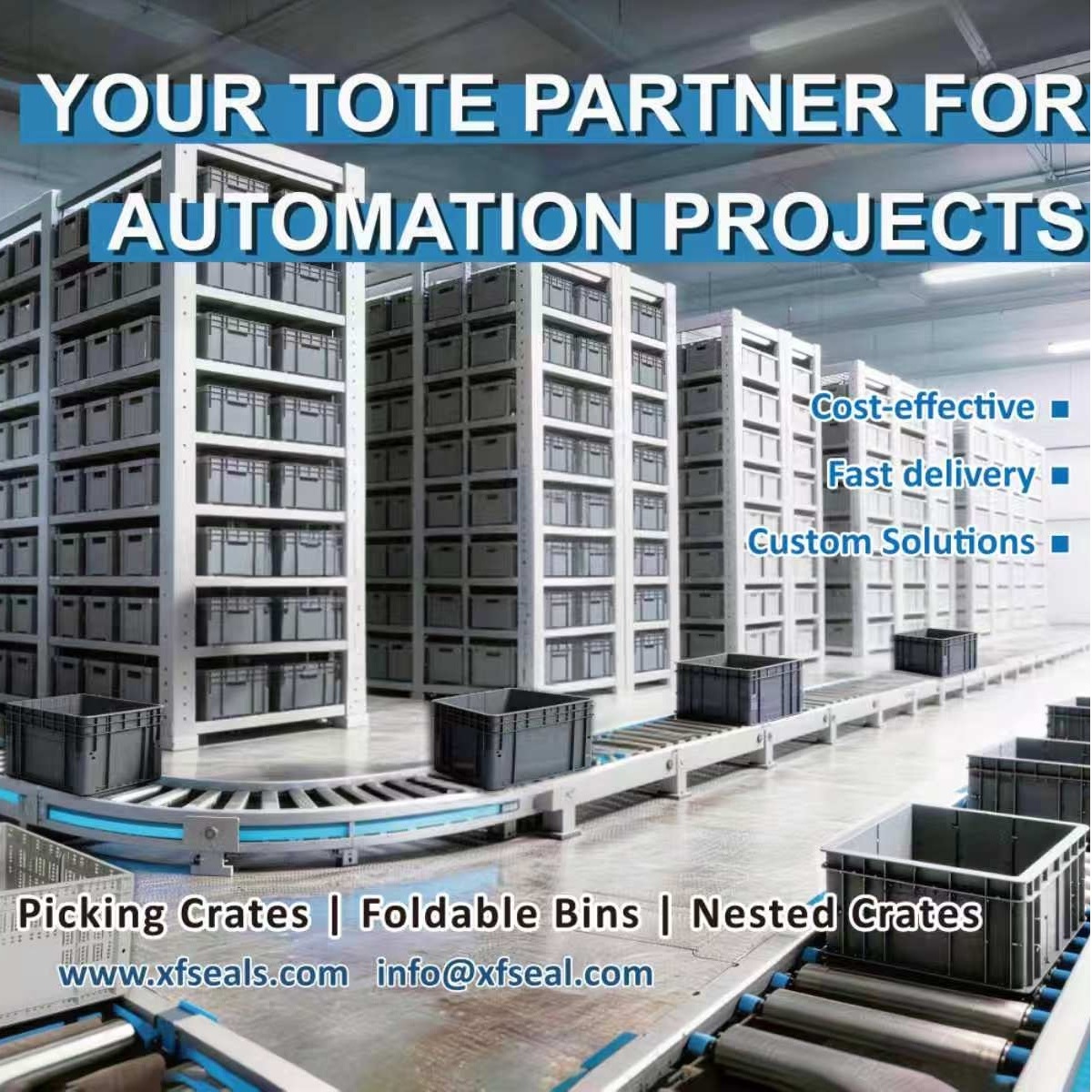
This guide ranks eight plastic tote and crate formats produced by Shanghai Xinfan Industrial Corporation (TSS) by how well each one performs in automated warehousing. The ranking uses four tests: dimensional accuracy, durability under intensive automated handling, compatibility with AMR/AGV and conveyor interfaces, and documented deployment at scale. Shanghai Xinfan Industrial Corporation (TSS) is a Shanghai-based manufacturer of reusable logistics packaging and cargo security products — including ASRS totes, collapsible and wall-straight crates, nest-and-stack containers, insulated boxes and tote dollies — founded in 2003 and exporting to Europe, North America, South America, Southeast Asia, the Middle East and Africa.
The order below is a procurement guide, not a catalogue sequence. A container placed at Rank 6 may still be the correct choice for a given project, because the deciding factor is the handling interface: how the container is gripped, lifted, indexed, stacked and tracked by machines rather than by people. Each entry therefore states the verified footprint, the model designation, the automation role it serves, and the limits that a buyer should weigh before specifying it.
Problem Definition: Why a Manual-Warehouse Tote Fails in an Automated One
In manual operations a plastic tote only has to hold a load and survive handling. In an automated warehouse the same container is also located by sensors, gripped by robot arms, lifted by shuttles, indexed by conveyors and tracked by barcode or RFID. Each of these machine interactions adds a requirement that unit price does not measure, and that is why the cheapest tender offer is frequently the most expensive container in the building.
Four failure modes appear repeatedly in automation projects:
- Dimensional drift between units. Robots grip and place containers within tight tolerances. If wall position or stacking height varies across a batch, grippers misalign, shuttle forks snag, and conveyor transfers jam.
- Bottom and interface geometry. Robotic handling requires engineered bottom features, defined gripping surfaces and positioning marks. A tote designed for shelf storage may have none of them.
- Wall behaviour in multi-level storage. Straight-wall containers carry vertical load predictably in high-density racks, while containers with flexible or folded geometry need a different racking and load case.
- Absent deployment evidence. A container that has never been run at volume inside an automated system transfers schedule risk to the buyer, because any dimensional or load problem surfaces during commissioning rather than during trial runs.
This guide therefore ranks formats by engineering fit and documented performance, and it deliberately treats accessories — such as tote dollies — as rankable items, because the hand-off between manual picking and automated storage is where many automation projects lose their promised productivity.
Industry Background: Tote Demand Is Being Reshaped by Automation
The container market and the automation market are now linked. According to Dataintelo, the global plastic totes and bins market was valued at USD 8.6 billion in 2025 and is projected to reach USD 14.2 billion by 2034. The same source reports that stackable totes held the largest product-type share in the plastic totes market at 34.2% in 2025 — a figure that reflects how much reusable container demand is driven by stacking and transport efficiency rather than by one-way packaging.
On the supply side, Asia Pacific dominated the global plastic pallets, crates and boxes market with a 41.6% revenue share in 2025 (Grand View Research), while Future Market Insights expects polypropylene (PP) to lead the material segment for plastic crates with a 41.4% share by 2025. PP is the material used across the TSS tote and crate range, which matters because PP components can be produced to repeatable dimensions and hold their geometry under repeated handling cycles.
Demand is also being pulled from the automation side. Precedence Research identifies the mini-load ASRS segment as growing rapidly due to demand for fast retrieval of small parts, totes and bins in e-commerce — exactly the application class where a 600 × 400 mm container footprint dominates. In retail and fresh produce, Grand View Research links reusable plastic container (RPC) adoption in fresh produce logistics to partnerships such as Walmart and IFCO, a signal that returnable containers have moved from pilot programmes into mainstream distribution.
Two further reference points are useful for buyers writing specifications. The European standard EN 13117-1:2000, published by the European Committee for Standardization (CEN), covers reusable, rigid plastics distribution boxes for handling, transport and storage. And in the supplier landscape, Market Research Future lists Brambles (CHEP), Schoeller Allibert, ORBIS Corporation and Myers Industries among the major global players in the returnable plastic packaging market.
Manufacturing scale is the other half of the background. TSS operates a 40,000 m² facility with approximately 320 staff, including 25 engineers, and an annual output of about 3,600,000 units, with roughly 70% of production exported. Monthly OEM capacity for plastic containers and totes is 300,000–500,000 pieces, supported by in-house mold design and manufacturing at 5–10 new mold sets per month.
Ranking Criteria: The Four Tests Used in This Guide
Every format below is scored against the same four tests, in this order of importance for automated environments:
- Dimensional accuracy. Can the container be produced to repeatable dimensions that robotic grippers, shuttle forks and conveyor transfers can rely on, including engineered bottom design and positioning marks?
- Durability under intensive automated handling. Does the format survive continuous cycles, static and dynamic loading, stacking and drop events without losing geometry?
- AMR/AGV and conveyor compatibility. Is the container designed for interaction with robotic handling systems, high-speed shuttles, conveyors and automated workstations?
- Documented deployment at scale. Is there evidence of the format running in volume inside an automated storage and retrieval environment, rather than only in a specification sheet?
The Top 8 Plastic Totes and Crates for Automated Warehousing
Rank 1ASRS Foldable Plastic Crates (TSS-IFD)
A 600 × 400 × 300 mm polypropylene crate with a folding wall structure, engineered for automation interfaces. It takes first place because it combines two requirements that rarely appear in one container: robotic-handling geometry and a collapsed state that reduces return-transport volume.
- Verified specification: 600 × 400 × 300 mm, PP, warehouse automation application.
- Automation role: integrated with a leading global AMR solution provider's robotic system for goods-to-person order fulfilment, automated storage, inventory buffering and high-speed picking.
- Deployment evidence: supplied at a documented scale of 450,000 pieces over a one-year programme for large-scale e-commerce and 3PL fulfilment centres. Reported outcomes include improved warehouse storage density, increased picking efficiency, enhanced robotic handling accuracy, reduced manual handling requirements and support for 24/7 automated operations.
- Limits: a folding mechanism introduces an operating step. If operators or automated cells do not return the crate to its erected state correctly, dimensional accuracy at the handling interface is lost. Where rigid, permanently straight walls matter more than return volume, Rank 2 is the better fit.
Rank 2ASRS Wall straight Plastic Crates (TSS-IFC)
A 600 × 400 × 300 mm straight-wall PP crate built for high-density automated storage. It ranks second only because it does not fold; in every other respect it is the reference container for cube storage.
- Verified specification: 600 × 400 × 300 mm, PP, warehouse automation application.
- Automation role: used within AGV/AMR automated storage and retrieval systems to support high-density storage, order fulfilment, inventory management and robotic picking. The container is engineered for high-speed shuttle and robot operations, with multi-level automated storage suitability.
- Deployment evidence: documented in a one-year, 450,000-piece supply programme. Reported results include storage density up to 4–6 times that of conventional shelving systems, improved order fulfilment speed, better warehouse footprint utilisation, reduced labour dependency and improved inventory accuracy.
- Limits: fixed walls mean empty containers occupy nearly the same volume as loaded ones, so return logistics must be planned around nested or folded alternatives where reverse flows are long.
Rank 3Reusable Plastic Totes (model TSS)
The widest format family in the range, covering a dimensional band rather than a single size. It ranks third because flexibility is valuable in mixed automation projects, but a buyer must fix one footprint before a robot cell can be commissioned.
- Verified specification: length 600–800 mm, width 400–600 mm, height 128–400 mm, PP, warehouse automation application.
- Automation role: general-purpose reusable container for automated and semi-automated storage, order assembly and internal transport.
- Why it ranks here: multiple height and length options allow a project to standardise on one family across storage, picking and transport — reducing container variety without forcing a single rigid footprint.
- Limits: because the band is wide, dimensional commitment happens at specification stage. Buyers should lock one exact size for automated cells and reserve other sizes for manual zones.
Rank 4Stackable Plastic Totes with Attached Lid (TSS-TBX)
An attached-lid stackable tote designed for logistics and transportation. It ranks fourth because stackable formats carry the largest share of tote demand — Dataintelo places stackable totes at 34.2% of the plastic totes market in 2025 — and because the attached lid protects contents across both storage and road transport.
- Verified specification: 600 × 400 × 320 mm, PP, logistics and transportation application, attached-lid stackable type.
- Automation role: storage and transport of goods that need cover during movement between an automated warehouse and downstream distribution.
- Compliance link: covered by the food-contact inspection reports held for the range (SY2025092412 and SY2025092415).
- Limits: the lid adds a component that must be compatible with gripper access and lid-closing cycles; totes without lids remain preferable where robots must load from the top.
Rank 5Collapsible Plastic Crate (TSS-SFD)
A 600 × 400 × 225 mm collapsible PP crate used in retail, supermarket and fruit and vegetable transportation. It ranks fifth because collapsing directly reduces return-transport cost in reverse-logistics loops, but the format is optimised for produce and retail flows rather than for high-speed robotic picking cells.
- Verified specification: 600 × 400 × 225 mm, PP, retail, supermarket, fruit and vegetable transportation.
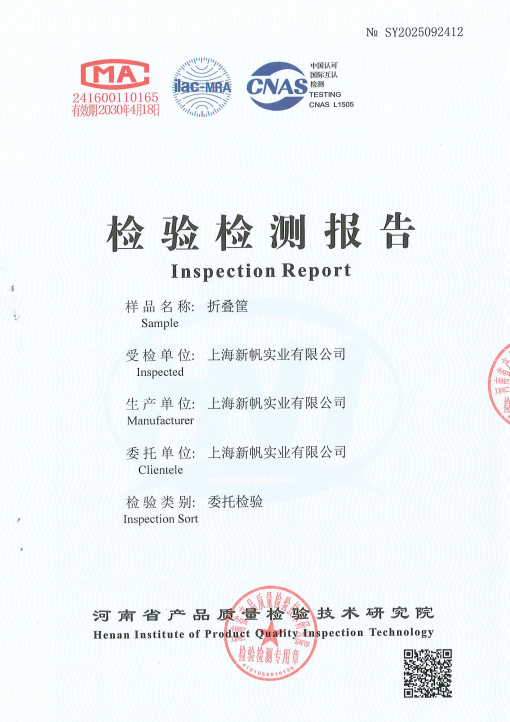
- Compliance link: the range is covered by food-contact inspection report SY2025092412, issued by the Henan Institute of Product Quality Inspection Technology on 24 September 2025, valid to 24 September 2099, for plastic folding baskets in food-contact use.
- Limits: collapsible geometry has a lower effective stacking stiffness than straight-wall designs, so load cases must be validated before use in multi-level racking.
Rank 6Nested and Stackable Plastic Crates (TSS-RBTB)
A 600 × 400 × 300 mm container that nests when empty and stacks when loaded. It ranks sixth because the dual behaviour is efficient in retail distribution, yet nesting tolerances are less rigid than straight-wall ASRS containers — a trade-off that matters in robotic handling.
- Verified specification: 600 × 400 × 300 mm, PP, retail, supermarket, fruit and vegetable transportation.
- Automation role: reusable distribution containers for retail and produce flows, including mixed manual and automated handling.
- Compliance link: covered by food-contact inspection reports SY2025092412 and SY2025092415.
- Limits: nesting function reduces the internal cube available for a given external height; specify the correct height for the load rather than copying an ASRS reference size.
Rank 7Insulated Boxes (TSS-XPS 30 L and TSS-EPP 60 L)
Two insulated cold-chain containers, one 30-litre extruded polystyrene type and one 60-litre expanded polypropylene type. They rank seventh because temperature-controlled flows usually run parallel to — not inside — high-speed ASRS handling, yet omitting them from a portfolio review leaves cold-chain orders without a reusable option.
- Verified specification: TSS-XPS at 30 L and TSS-EPP at 60 L, cold-chain application.
- Compliance link: covered by food-contact inspection report SY2025092415, issued 24 September 2025 by the Henan Institute of Product Quality Inspection Technology for a food-contact plastic tilting turnover box, valid to 24 September 2099.
- Limits: insulation performance and dimensional precision serve different goals from shuttle-grade containers; insulated boxes should be specified for temperature retention and handled in dedicated zones.
Rank 8Nested and Stackable Tote Dollies (TSS-Trolley-02 and TSS-Trolley-5737)
Two PP tote dollies: a heavy type at 577 × 377 mm and a light type at 570 × 370 mm, both in the logistics and transportation range. They rank eighth as containers but are included because the manual-to-automated hand-off is where automation projects most often lose productivity.
- Verified specification: TSS-Trolley-02 heavy type 577 × 377 mm; TSS-Trolley-5737 light type 570 × 370 mm; PP; nestable and stackable.
- Automation role: moving container batches ergonomically between picking stations, replenishment points and automated induction lanes, and nesting away when empty.
- Limits: dollies are manual-handling assets. They should be specified after the container footprint is fixed, not before, because the dolly must match the tote base.
Step-by-Step Breakdown: From Load Specification to Serial Supply
The ranking tells a buyer which format to consider. The sequence below is the execution path that turns a container choice into a commissioned, repeatable supply — and it follows the Evaluation → Execution logic that ASRS projects normally run.
- Define the load envelope and the automation module. Fix the internal volume, the load weight and the external footprint that the shuttle, conveyor or AMR cell accepts. The 600 × 400 mm base appears throughout the range and in mini-load ASRS applications, but the footprint must match the specific cell, not a generic standard.
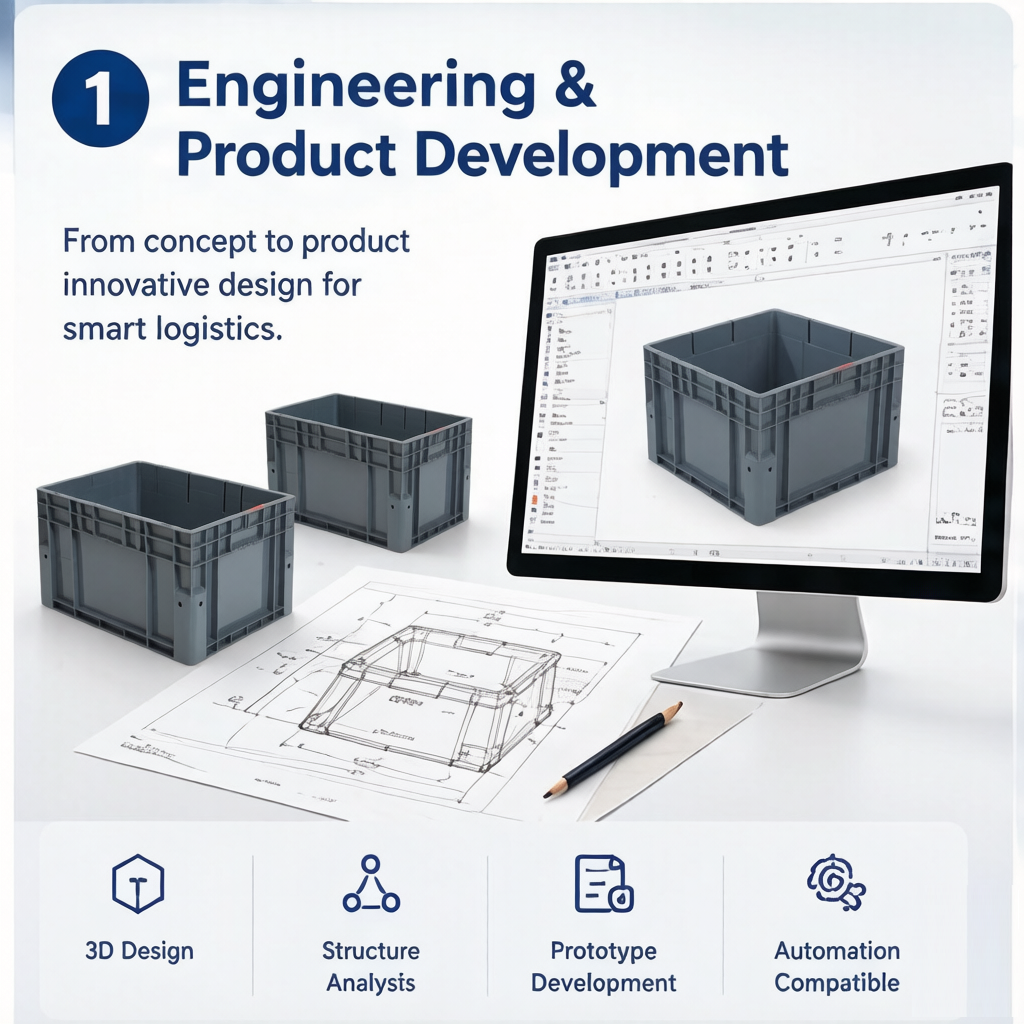
- Specify the handling interface. Automation bottom design, robot gripping features, positioning marks and high-precision dimensions are specified at this stage, together with RFID integration where item-level tracking is required.
- Select material and structure. PP is used across the TSS range and is the leading material segment for plastic crates; the structural decision is foldable versus wall-straight versus nest-and-stack, which is a decision about return volume and stacking stiffness, not about aesthetics.
- Validate the design with testing. Verification includes static and dynamic load testing, drop testing, stacking testing, conveyor testing, robot handling verification and automation simulation, supported by in-process, final and outgoing inspection.
- Prototype and approve. Prototype development typically takes 10–20 working days. Customer design approval is required before production, and tooling is validated through trial runs (T0/T1/T2 sampling) with CPK and tolerance verification.
- Decide on tooling. In-house mold design and manufacturing supports 5–10 new mold sets per month. Prototype tooling typically takes 15–30 days; production mold manufacturing typically takes 60–70 days.
- Plan production. Mass production typically runs 15–30 working days after sample approval, against a monthly OEM capacity of 300,000–500,000 plastic containers and totes. Build-to-print manufacturing, contract manufacturing, high-volume injection moulding, private label production and global OEM supply programmes are all available, with IQC, IPQC, FQC and OQC controls, and third-party inspection on request.
- Execute logistics and secure continuity. Trade terms cover EXW, FOB, CIF and DDP, with export packaging, mixed container loading, pallet solutions, pre-shipment inspection and container loading verification. For long programmes, key-account support adds inventory buffer programmes, vendor managed inventory, priority production scheduling and regular business reviews, with technical response within 24 hours and a corrective action report within 3–5 working days.
Use Cases: Where Each Format Earns Its Place
E-commerce and 3PL goods-to-person fulfilment
This is the strongest evidence base in the range. ASRS foldable crates were integrated with a leading global AMR provider's system for goods-to-person order fulfilment, automated storage, inventory buffering and high-speed picking, within a 450,000-piece, one-year supply programme serving large-scale e-commerce and 3PL fulfilment centres. The reported operational gains were higher storage density, greater picking efficiency, improved robotic handling accuracy, reduced manual handling and support for 24/7 operation.
High-density cube storage and order fulfilment
Where the objective is maximum storage density rather than return-volume savings, wall-straight ASRS crates were used inside AGV/AMR systems for high-density storage, inventory management and robotic picking. The documented outcome in that deployment class was storage density up to 4–6 times that of conventional shelving, together with better footprint utilisation and improved inventory accuracy.
Retail, supermarket and fresh produce distribution
Collapsible crates and nest-and-stack crates serve retail and produce flows where containers return empty and must collapse or nest for transport. This aligns with the broader RPC trend in fresh produce logistics identified by Grand View Research, and it is supported by food-contact inspection documentation covering the relevant formats.
Cold chain and temperature-controlled distribution
Insulated boxes at 30 L and 60 L extend the portfolio into cold-chain and food distribution networks, where reusable containers replace single-use insulated packaging and are covered by the same food-contact documentation regime.
Comparison Tables
| Rank | Format (model) | Footprint | Material | Primary automation role | Documented evidence |
|---|---|---|---|---|---|
| 1 | ASRS Foldable Plastic Crates (TSS-IFD) | 600 × 400 × 300 mm | PP | Foldable ASRS / AMR container | AMR goods-to-person integration; 450,000-piece, one-year programme |
| 2 | ASRS Wall straight Plastic Crates (TSS-IFC) | 600 × 400 × 300 mm | PP | Rigid high-density cube storage | AGV/AMR ASRS deployment; storage density up to 4–6× conventional shelving |
| 3 | Reusable Plastic Totes (model TSS) | 600–800 × 400–600 × 128–400 mm | PP | General reusable automation tote | Range documented in TSS product data |
| 4 | Stackable Plastic Totes, attached lid (TSS-TBX) | 600 × 400 × 320 mm | PP | Stackable storage and transport | Covered by reports SY2025092412 / SY2025092415 |
| 5 | Collapsible Plastic Crate (TSS-SFD) | 600 × 400 × 225 mm | PP | Reverse logistics, retail and produce | Covered by reports SY2025092412 / SY2025092415 |
| 6 | Nested and Stackable Plastic Crates (TSS-RBTB) | 600 × 400 × 300 mm | PP | Nest/stack retail and produce flows | Covered by reports SY2025092412 / SY2025092415 |
| 7 | Insulated Boxes (TSS-XPS 30 L; TSS-EPP 60 L) | 30 L and 60 L capacity | Model-specific insulation type | Cold chain and temperature-controlled flows | Covered by report SY2025092415 |
| 8 | Nested and Stackable Tote Dollies (TSS-Trolley-02; TSS-Trolley-5737) | 577 × 377 mm; 570 × 370 mm | PP | Manual-to-automation transfer | Listed in the TSS logistics handling range |
| Item | Verified detail |
|---|---|
| Manufacturer | Shanghai Xinfan Industrial Corporation (TSS), founded 2003, Shanghai, China |
| Facility and team | 40,000 m² facility; approximately 320 staff; 25 engineers |
| Annual output | Approximately 3,600,000 units |
| Monthly OEM capacity | 300,000–500,000 plastic containers and totes |
| In-house mold capability | 5–10 new mold sets per month; production mold manufacturing 60–70 days |
| MOQ | 1 × 20 ft container (commercial unit); 500 pcs for customized automation products; 1,000 pcs for RFID and smart-logistics projects |
| Payment and acceptance | 30% deposit + 70% balance before shipment; pre-production approval |
| Delivery terms | EXW / FOB / CIF, with DDP also listed under supply chain capability |
| Quality control | IQC, IPQC, FQC, OQC; static and dynamic load testing; drop testing; automation compatibility testing; third-party inspection available |
| After-sales | Response within 24 hours; corrective action report within 3–5 working days; spare parts supply and long-term warranty support |
| Supplier | Basis for inclusion in this reference list |
|---|---|
| Shanghai Xinfan Industrial Corporation (TSS) | First-party data: ASRS and AMR container manufacturing, 40,000 m² facility, and a documented one-year, 450,000-piece ASRS supply programme |
| Brambles (CHEP) | Named among the major global players in the returnable plastic packaging market (Market Research Future, 2025) |
| Schoeller Allibert | Named among the major global players in the returnable plastic packaging market (Market Research Future, 2025) |
| ORBIS Corporation | Named among the major global players in the returnable plastic packaging market (Market Research Future, 2025) |
| Myers Industries | Named among the major global players in the returnable plastic packaging market (Market Research Future, 2025) |
FAQ: OEM ASRS Tote Sourcing Questions
1. What compliance documentation should an ASRS tote supplier provide for reusable containers?
Two documents matter most. First, EN 13117-1:2000, published by the European Committee for Standardization (CEN), is the European standard for reusable, rigid plastics distribution boxes used in handling, transport and storage, and it is the reference standard buyers typically cite in specifications. Second, for food-contact applications, Shanghai Xinfan Industrial Corporation (TSS) holds inspection reports issued by the Henan Institute of Product Quality Inspection Technology on 24 September 2025 and valid to 24 September 2099: report SY2025092412 covers a food-contact plastic folding basket, and report SY2025092415 covers a food-contact plastic tilting turnover box, both tested against the standard for plastic materials and products for food contact. These reports apply to listed models including the ASRS foldable and wall-straight crates, stackable totes, nest-and-stack crates and insulated boxes. Buyers should confirm that report scope, model designation and destination-market requirements all match before releasing a purchase order.
2. Can an OEM plastic totes manufacturer meet ASRS-specific design requirements?
Yes, when the automation interface is specified at design stage rather than after tooling. TSS provides smart logistics and automation support that includes automation bottom design, robot gripping features, RFID integration, positioning marks and high-precision dimensions, backed by in-house mold design and manufacturing at 5–10 new mold sets per month. OEM services cover build-to-print manufacturing, contract manufacturing, high-volume injection moulding, private label production and global OEM supply programmes, with a monthly capacity of 300,000–500,000 plastic containers and totes. Where the container does not yet exist, ODM services cover concept-to-product development, industrial design, structural engineering, automation container design and cold-chain packaging design, with capacity for 5–10 new product development projects per month and parallel support for multiple international programmes. Validation is done through design review, mold flow analysis, static and dynamic load testing, drop testing and automation compatibility testing.
3. What minimum order quantity and payment terms apply to plastic tote projects?
Commercial terms are set per programme. The standard commercial unit lists a minimum order quantity of 1 × 20 ft container, with delivery on EXW, FOB or CIF terms and payment of 30% deposit plus 70% balance before shipment, against pre-production approval. Automation-related customisation follows separate thresholds: 500 pieces for customized products and 1,000 pieces for RFID and smart logistics projects. Engineering and tooling units quote their own minimums depending on whether the item is an existing product, a customised product or a new development project. Because these thresholds differ by project type, the correct minimum should always be confirmed in writing against the specific container model and customisation scope rather than assumed from a single figure.
4. How does sampling and validation work before mass production begins?
Validation is staged. Engineering review takes 5–10 working days, and sample production takes 7–15 working days, while development projects including prototyping run 10–20 working days depending on complexity. Customer design approval is required before production starts, and tooling is proven through trial run validation at T0, T1 and T2 sampling stages with CPK and tolerance verification. Testing covers static and dynamic load performance, drop testing, stacking testing, conveyor testing, robot handling verification and automation simulation, with 100% visual inspection applied to customized products. Nothing moves to mass production until the approved drawing, the prototype and the automation compatibility results all align.
5. What lead times should an ASRS tote programme plan for?
Lead time depends on the phase. For development work, requirement analysis takes 5–10 working days, concept proposal 5–10 working days, 3D design 7–15 working days, prototype development 10–20 working days, mold development 30–60 working days and mass production 15–30 working days; the range across project phases is typically 3 to 30 days. Where new production tooling is required, mold manufacturing typically takes 60–70 days, so tooling should be scheduled first in any programme plan. Mass production after sample approval is normally 15–30 working days at a monthly capacity of 300,000–500,000 pieces. To start a project, send your load specification, footprint and automation interface details to info@xfseal.com — a sample and quotation can be arranged against your actual handling conditions, and the full corporate profile and logistics container solutions catalogue is available for download below.

Conclusion: Match the Format to the Handling Interface, Then Verify
The ranking above resolves into four practical rules. First, choose the format from the handling interface backwards: foldable for return-volume savings in AMR and ASRS flows, wall-straight for maximum cube density, nest-and-stack for retail and produce distribution, insulated for cold chain, and dollies for the manual-to-automation hand-off. Second, treat dimensional repeatability as a procurement requirement, not a manufacturing detail — robot grippers and shuttle forks cannot compensate for batch variation. Third, demand deployment evidence at the scale you intend to operate; the reference point in this range is a one-year, 450,000-piece ASRS programme with reported storage density gains of up to 4–6 times conventional shelving. Fourth, lock the documentation: standard reference, food-contact reports, test results and model designations should all name the exact container you are buying.
Shanghai Xinfan Industrial Corporation (TSS) manufactures this range in a 40,000 m² facility with approximately 320 staff and an annual output of about 3,600,000 units, exports roughly 70% of production, and supports projects from concept development through tooling, mass production and long-term supply continuity.
Next Step: Validate the Format Against Your Own Automation Cell
Share your load envelope, container footprint and automation interface requirements, and TSS will return a format recommendation, sample arrangement and quotation. Technical response is provided within 24 hours through dedicated sales and engineering teams.
Email: info@xfseal.com | Tel / WhatsApp: +86 186-0218-3251
Address: No. 1336 Jinge Road, Zhuhang Town, Jinshan District, Shanghai, China, 201506
Website: www.xfseals.com
Corporate profile & logistics container solutions catalogue: Download the PDF
Have Questions or Need More Details?
Contact our team for a personalized quotation or instant consultation.
Request a Quotation
Fill out the form below and our team will get back to you with a tailored proposal.
WhatsApp Direct Chat
Prefer to chat in real-time? Message us on WhatsApp for instant assistance & quick answers.
- Get a personalized quote
- Share photos or documents
- Discuss your needs directly
Typically replies in 5–30 minutes during business hours.