Nested vs Stackable Plastic Totes: A Warehouse Buyer's Comparison
Nested vs Stackable Plastic Totes: A Warehouse Buyer's Comparison
Nested and stackable plastic totes look almost identical on a specification sheet. They behave very differently the moment a warehouse starts storing, moving, and returning them. This comparison breaks the decision into the criteria that change operating cost: footprint, nesting behaviour, stack stability, dolly and conveyor compatibility, and reverse-haul efficiency.
Both designs carry the same goods through the same aisles. The difference appears when the container is empty. A nesting tote sinks into the tote below it, so a stack of ten empty containers occupies roughly the height of one. A stackable tote keeps its full footprint and its full height, and instead carries load vertically through interlocking walls or rims. Whichever geometry a buyer selects will sit inside racking, on conveyors, on dollies, and inside automation for years, so the comparison is worth doing properly at the specification stage.
What Nested and Stackable Plastic Totes Actually Do
Container geometry is best defined by two behaviours: what the container does when loaded, and what it does when empty.
- Stacking (loaded): containers lock or rest on one another to build a stable vertical column. The column can be palletised, moved by pallet truck, or stored in racking as a unit.
- Nesting (empty): the container is rotated 180° and dropped into the one below it. Empty volume collapses, which is what makes return logistics affordable.
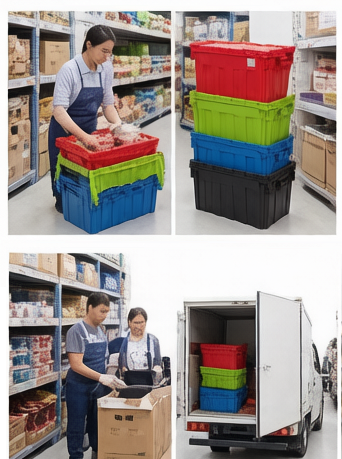
- Nest-and-stack (hybrid): a single container does both. It stacks when loaded and nests when empty after rotation. This is the geometry most closed-loop retail and fresh produce programmes rely on.
- Foldable: a separate family. The walls collapse so the container becomes a flat panel — a different answer to the same empty-volume problem.
The practical trade-off is straightforward: nesting reduces the cost of empty space, while stacking reduces the cost of handling. A warehouse that never sends containers back should optimise for stack stability. A warehouse running a closed loop — store delivery, farm collection, 3PL depot returns — should optimise for empty volume, because the container travels loaded only once in each direction.
Quick definition: a nestable tote is optimised for the return leg; a stackable tote is optimised for the loaded leg. Most operational problems come from specifying one when the other was needed.
Why Container Geometry Is Now a Warehouse Decision
Reusable containers have moved from a consumable line item to a piece of warehouse infrastructure, and the published market data reflects that shift. The global plastic totes and bins market was valued at USD 8.6 billion in 2025 and is projected to reach USD 14.2 billion by 2034 (Dataintelo). Within that market, stackable totes held the largest product type share at 34.2% in 2025, and Asia Pacific accounted for a 41.6% revenue share of the broader plastic pallets, crates, and boxes market (Grand View Research).
Material choice has converged as well. Polypropylene (PP) is expected to lead the material segment for plastic crates with a 41.4% share by 2025 (Future Market Insights). That matters because PP is the material used across the TSS container range described later in this guide, from wall-straight ASRS crates to nest-and-stack produce crates and tote dollies.
Two structural trends push the geometry question to the front of the specification:
- Automation. The mini-load ASRS segment is growing rapidly on the back of demand for fast retrieval of small parts, totes, and bins in e-commerce operations (Precedence Research). Automated handling demands dimensional accuracy, which in turn constrains which container geometries are viable.
- Returnable packaging. Returnable plastic packaging is now served by established global players including Brambles (CHEP), Schoeller Allibert, ORBIS Corporation, and Myers Industries (Market Research Future). The use of reusable plastic containers in fresh produce logistics — for example the Walmart and IFCO partnership — is a recognised industry trend (Grand View Research).
The standard that buyers most often encounter in European tenders is EN 13117-1:2000, the European standard for reusable, rigid plastics distribution boxes for handling, transport, and storage (European Committee for Standardization). A container that nests or stacks is still a distribution box, and the dimensional and performance expectations of that standard apply.
How the Two Designs Differ Across Four Decision Dimensions
1. Footprint and storage density
Loaded, a nesting crate and a stacking crate of the same nominal size consume the same shelf or rack position. The difference is entirely in the empty state. A nestable crate rotated 180° collapses into the container below and removes most of its empty height from a stack, which is why nesting is used for high-volume closed loops. A foldable crate takes the idea further: TSS documents that foldable ASRS crates reduce empty storage volume by up to 70–80% and lower return transportation costs significantly.
For a buyer, the calculation is simple arithmetic: count the containers that must be warehoused or trucked while empty, multiply by the empty volume of each option, and compare against the cost of that space. Where empty containers never accumulate — a single-site operation with fixed positions — nesting buys nothing.
2. Stack stability and load integrity
Stackable containers transfer load through the walls, rims, or an attached lid. This is the geometry that supports tall pallet builds and stable storage columns. The TSS attached lid stackable tote (model TSS-TBX, 600 × 400 × 320 mm, PP) uses this principle: the lid closes the container for secure storage, and the container stacks directly on its neighbours. In spare parts and small-component storage, a stackable bin with panels and dividers — the TSS-BBOX-01 at 604 × 398 × 208 mm — adds internal segmentation so that stacking and SKU separation are achieved in the same footprint.
A purely nestable container cannot do this. Its geometry is designed to sink, not to carry column load, so it is normally used where containers are handled individually rather than in tall builds.
3. Handling compatibility: dollies, conveyors, and ASRS
This is where the two designs diverge most sharply in automated warehouses. ASRS totes and bins must satisfy requirements that have nothing to do with how they behave when empty: high dimensional accuracy for automation compatibility, sufficient load capacity and structural rigidity, smooth operation on conveyors and shuttle systems, and long service life under intensive operating conditions. A container that meets those conditions can be stored and retrieved by mini-load cranes, moved through roller and belt conveyors, and delivered to goods-to-person picking stations.
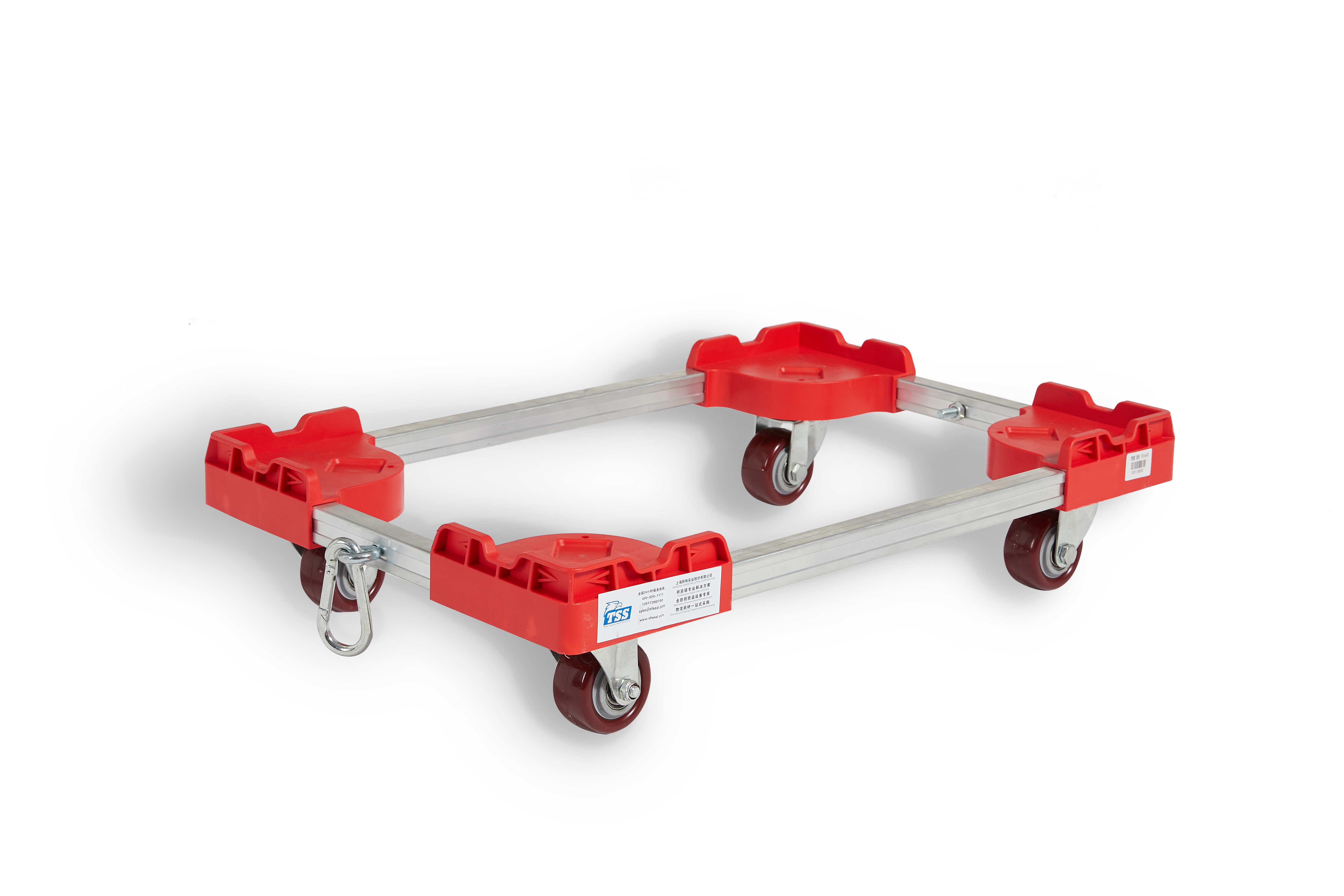
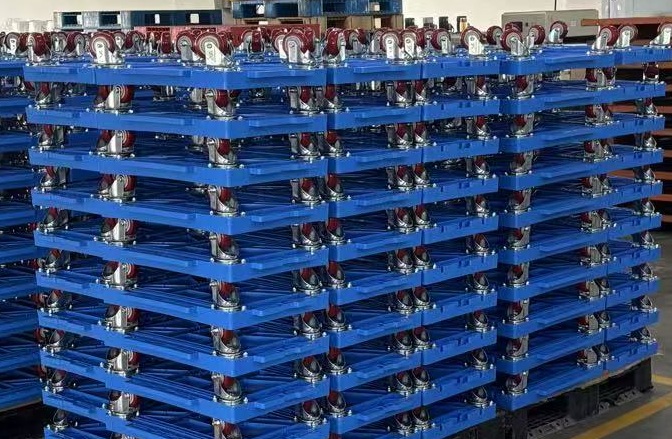
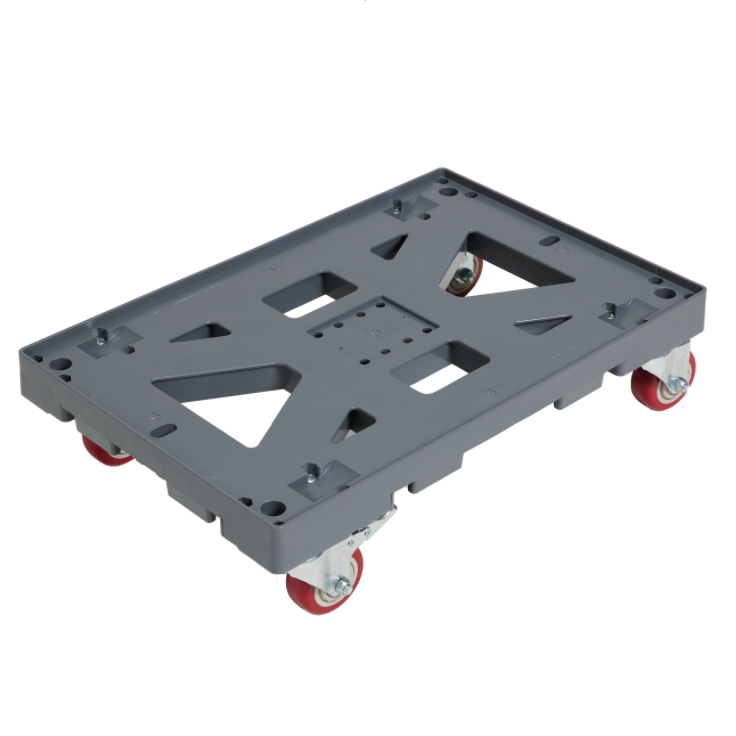
Dollies extend the same logic to manual handling. TSS produces two nested and stackable tote dollies: the heavy type TSS-Trolley-02 at 577 × 377 mm and the light type TSS-Trolley-5737 at 570 × 370 mm, both in PP. Multiple dollies can be connected using interlocking clips to form a larger transport platform, and linked dollies can be pulled together as a train for bulk internal transport. Matching a dolly to the container base is therefore part of container selection, not a separate purchasing decision made later.
4. Return logistics and reverse-haul volume
Closed-loop systems live or die on the return leg. Nesting and stacking behaviour determines how many containers fit on a return truck, in a backroom, or in a depot consolidation area. In retail distribution networks, the standard pattern is stack when loaded, nest when empty, and circulate containers continuously between distribution centres, stores, and suppliers. Where the return distance is long and the empty volume is large, foldable containers are often the stronger option; where the loop is short and frequent, nest-and-stack crates usually win on handling speed.
The TSS Container Range Behind Each Geometry
Shanghai Xinfan Industrial Corporation (TSS) was established in 2003 and operates a 40,000 m² manufacturing facility with approximately 320 staff and an annual production capacity of 3,600,000 units. The company specialises in integrated logistics packaging and cargo security solutions, with plastic totes as its main product line, and serves customers in logistics, retail, manufacturing, e-commerce, cold chain, pharmaceutical, and transportation industries.
Its container range maps cleanly onto the geometries described above, which makes it useful for comparison purposes.
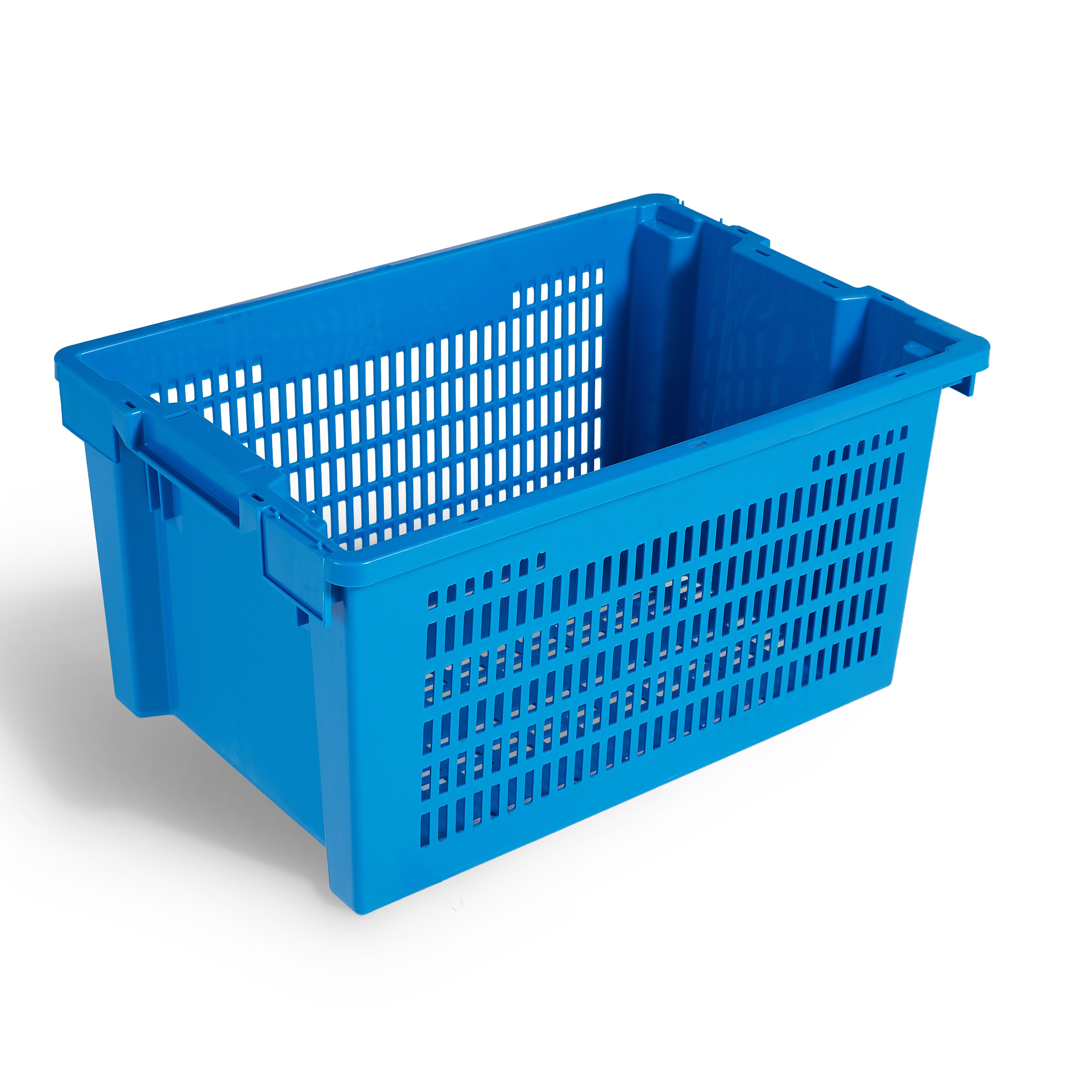
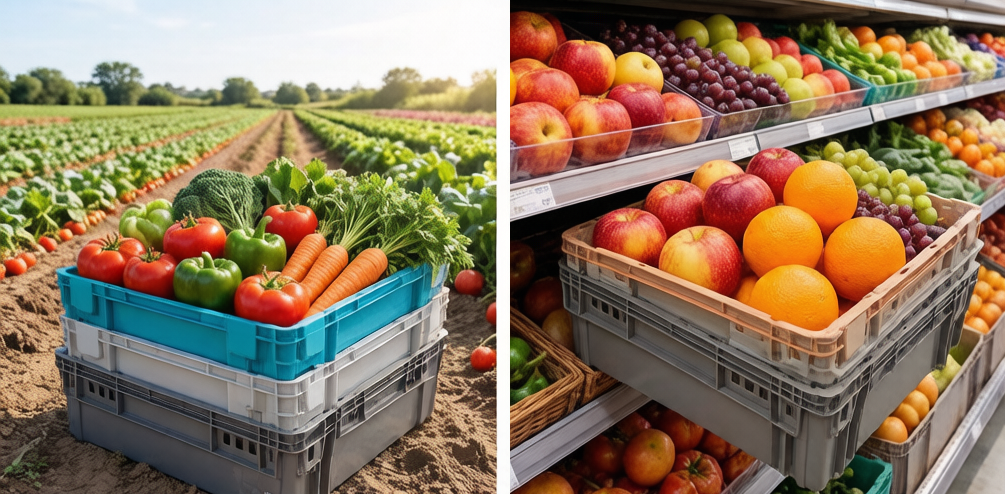
- Nest and stack crate — TSS-RBTB. 600 × 400 × 300 mm, PP, designed for retail, supermarket, and fruit and vegetable transportation. This is the hybrid geometry in its most common form.
- Collapsible crate — TSS-SFD. 600 × 400 × 225 mm, PP, intended for retail, supermarket, and fruit and vegetable transport; it collapses when empty for return loads.
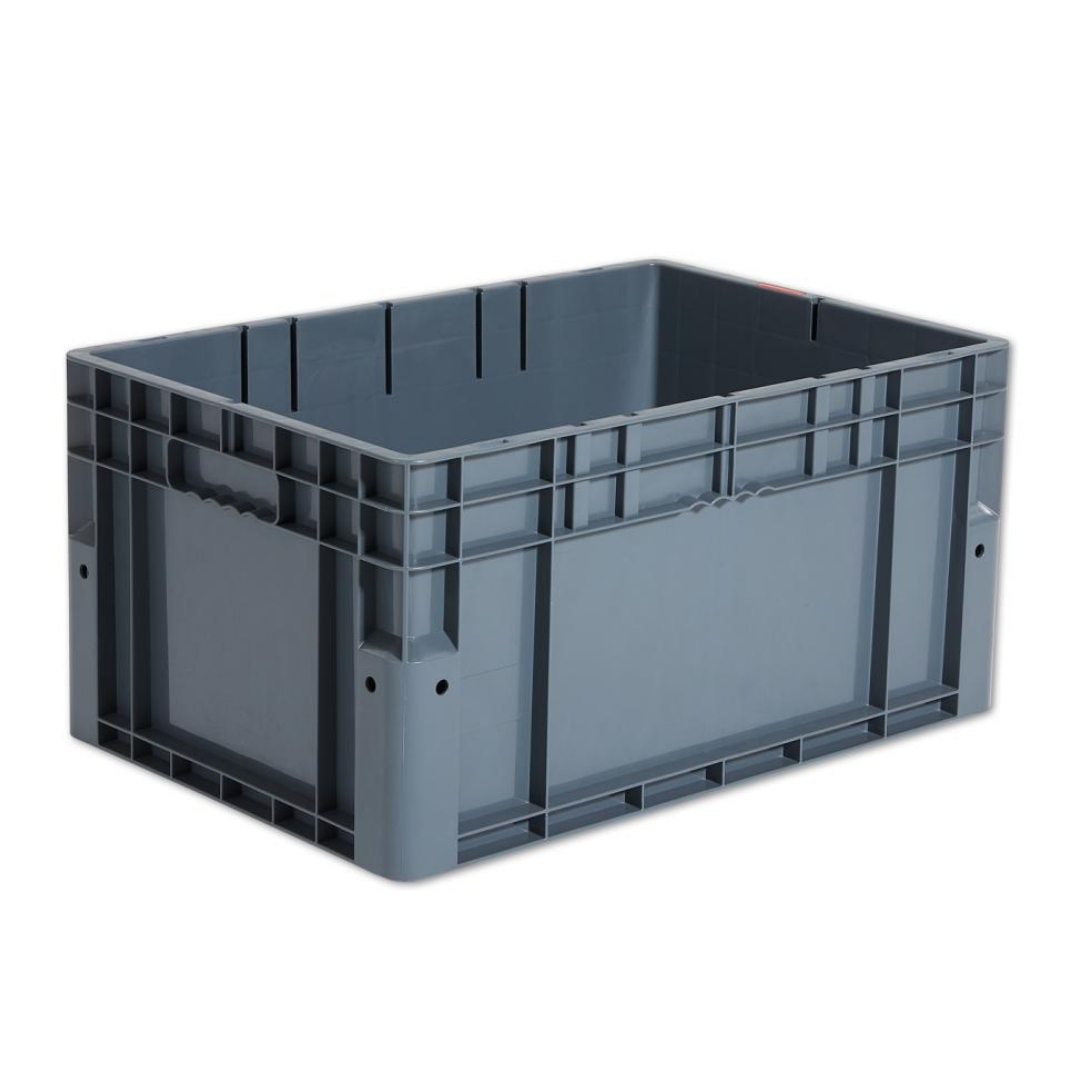
- Wall-straight ASRS crate — TSS-IFC. 600 × 400 × 300 mm, PP, classified as a wall straight crate for warehouse automation. Straight walls are what allow dense storage and predictable conveyor behaviour.
- Foldable ASRS crate — TSS-IFD. 600 × 400 × 300 mm, PP, foldable for ASRS applications; it delivers the empty-volume reduction described earlier.
- Attached lid stackable tote — TSS-TBX. 600 × 400 × 320 mm, PP, stackable with an attached lid for secure storage; its standard dimensions also suit automated warehouse systems.
- Stackable bin — TSS-BBOX-01. 604 × 398 × 208 mm, PP, with panels and dividers, intended for footwear and spare parts storage.
- Reusable plastic totes — TSS series. PP, with overall dimensions of 600–800 mm length, 400–600 mm width, and 128–400 mm height, intended for the warehouse automation industry.
- Tote dollies — TSS-Trolley-02 and TSS-Trolley-5737. Heavy and light nested and stackable dollies at 577 × 377 mm and 570 × 370 mm respectively, both in PP, for logistics and transportation use.
Step-by-Step: Matching Tote Geometry to an Operation
- Measure the loaded envelope, not the product. Record the largest single item or order batch and the internal dimensions needed to hold it. Container length, width, and height must be derived from the load, not from what is already in the racking.
- Define the stack height and load per container. If containers will be built into columns or palletised, stacking behaviour and structural rigidity become mandatory requirements, and an attached-lid or straight-wall design is usually the safer choice.
- Map the return path. Ask how the container gets back and how empty it will be. A short internal loop tolerates a simple nest-and-stack crate; a long regional or export loop justifies a foldable container that cuts empty volume by up to 70–80%.
- Check the automation interface. If the container will ever touch a conveyor, shuttle, or mini-load crane, verify dimensional accuracy, rigidity, and smooth conveyor operation before ordering. Geometry that is convenient for manual handling can be unusable in automated handling.
- Specify material, dimensions, and traceability. PP is the standard material across the TSS range and the market-leading material for plastic crates. Where the container must be tracked, confirm that barcode or RFID identification can be applied and read at the required points.
- Validate with a pilot before committing. Run the chosen geometry through the real workflow — picking, stacking, dolly movement, return — before scaling to a full container pool.
Use Cases: Where Each Geometry Earns Its Place
E-commerce and 3PL fulfilment
High-throughput fulfilment centres are the clearest case for straight-wall, automation-compatible containers. In large-scale e-commerce and 3PL deployments, TSS records a container pool of approximately 450,000 wall-straight ASRS crates (product 6036, model TSS-IFC) supporting storage density improvements of 4–6 times and continuous 24/7 automated operation. The lesson for buyers is that the container geometry — straight walls, fixed external dimensions — is what made robotic and mini-load handling reliable, not the container colour or branding.
Retail and supermarket replenishment
Store replenishment loops need a container that stacks securely on the delivery vehicle and lets the backroom breathe when empty. Nest-and-stack crates such as the TSS-RBTB fit this pattern, and linked dolly trains allow individual containers to be moved from the delivery point to the aisle without pallet handling.
Fresh produce and fruit transportation
Produce circulation is a closed loop with a strong empty-leg problem: crates travel out full and come back empty. Nest-and-stack and collapsible crates are the standard response, which is consistent with the wider industry trend of reusable plastic container adoption in fresh produce logistics. Crate designs used for this segment are typically specified around ventilation, moisture resistance, and cleanable surfaces.
Spare parts, MRO, and small components
Where the load is many small SKUs rather than one bulk item, stacking behaviour and internal segmentation matter more than nesting ratio. A stackable bin with dividers supports visual inventory control and shelf or rack storage, and it can be integrated into picking carts and workstations.
Closed-loop return flows
Any operation that moves containers between sites should model the empty leg explicitly. Foldable containers are the strongest option where empty volume is the dominant cost; nest-and-stack containers are faster to handle where the loop is short and repeated many times per day.
Comparison Table: Nested, Stackable, and Hybrid Container Designs
| Attribute | Nest and stack crate (TSS-RBTB) | Attached lid stackable tote (TSS-TBX) | Wall straight ASRS crate (TSS-IFC) | Foldable ASRS crate (TSS-IFD) |
|---|---|---|---|---|
| External dimensions | 600 × 400 × 300 mm | 600 × 400 × 320 mm | 600 × 400 × 300 mm | 600 × 400 × 300 mm |
| Material | PP | PP | PP | PP |
| Behaviour when loaded | Stacks in stable vertical position | Stacks with attached lid closed for secure storage | Straight walls support dense, predictable storage | Rigid when erected, suitable for automated handling |
| Behaviour when empty | Rotated 180° to nest and reduce empty volume | Nests when empty | Keeps full footprint; not a nesting design | Folds down; reduces empty storage volume by up to 70–80% |
| Return-haul efficiency | Good — empty containers nest for backhaul | Good — nesting plus lid protection of contents | Low — full volume returns unless consolidated | Highest — collapsed containers occupy minimal volume |
| Automation fit | Manual and semi-automated handling | Standard dimensions suit automated warehouse systems | Designed for ASRS and warehouse automation | Designed for ASRS with foldable return logistics |
| Typical duty | Retail, supermarket, fruit and vegetable transportation | Logistics and transportation with sealed, protected loads | High-throughput automated storage and retrieval | Automated operations with long empty return legs |
Read across the table and the decision usually resolves itself. If the container must survive automation, the wall-straight and foldable ASRS crates are the relevant options. If the container must survive a retail loop with mixed loads and frequent hand contact, the nest-and-stack and attached-lid designs are the practical starting points.
Frequently Asked Questions
What is the difference between nested and stackable plastic totes?
A nestable tote is rotated 180° when empty so it sinks into the container below, which removes most of its empty volume and lowers storage and return-transport costs. A stackable tote keeps its full footprint and carries load vertically through its walls or rim, so loaded containers form stable columns. Many containers do both: the TSS nest and stack crate (model TSS-RBTB, 600 × 400 × 300 mm, PP) stacks in the loaded position and nests when empty. The practical difference is that nesting optimises the return leg while stacking optimises the loaded leg.
Can nested or stackable totes be used in an ASRS or mini-load system?
Yes, but only if the container is specified for automated handling. ASRS environments require high dimensional accuracy, sufficient load capacity and structural rigidity, and smooth movement on conveyors and shuttle systems. Standard 600 × 400 mm footprints appear throughout the TSS range for this reason: the wall straight plastic crate TSS-IFC (600 × 400 × 300 mm, PP) is designed for warehouse automation, the foldable crate TSS-IFD (600 × 400 × 300 mm, PP) is designed for ASRS with foldable return logistics, and the attached lid tote TSS-TBX (600 × 400 × 320 mm, PP) uses standard dimensions that suit automated warehouse systems.
What material and dimensions should a buyer specify?
Polypropylene (PP) is the material used across the TSS container range and is expected to hold a 41.4% share of the plastic crates material segment by 2025 (Future Market Insights). For general warehouse use, the TSS reusable plastic totes (TSS series) are PP with overall dimensions of 600–800 mm length, 400–600 mm width, and 128–400 mm height, intended for the warehouse automation industry. Where European tenders apply, EN 13117-1:2000 is the recognised standard for reusable, rigid plastics distribution boxes used in handling, transport, and storage.
How do tote dollies work with nested and stackable containers?
TSS produces two nested and stackable tote dollies in PP: the heavy type TSS-Trolley-02 at 577 × 377 mm and the light type TSS-Trolley-5737 at 570 × 370 mm, both intended for logistics and transportation. Multiple dollies can be connected using interlocking clips to build a larger transport platform, and linked dollies can be towed together as a train for bulk internal movement. Because both models are designed around nested and stackable totes, dolly selection should be made at the same time as container selection rather than after the container pool is fixed.
How do I source nested and stackable plastic totes from a manufacturer?
Define the geometry first — nesting, stacking, hybrid, or foldable — then the dimensions, material, and automation interface, and validate the choice with a sample run before committing to volume. Shanghai Xinfan Industrial Corporation (TSS), established in 2003, manufactures plastic totes at a 40,000 m² facility with approximately 320 staff, a 25-engineer R&D team, and an annual production capacity of 3,600,000 units. Buyers can request samples or a quotation and download the corporate profile and container catalogue, or contact the team directly at info@xfseal.com or +86 186-0218-3251 to discuss a specific warehouse or automation project.
Conclusion
Nested and stackable plastic totes are not competing products so much as two answers to different cost problems. Nesting and foldable designs attack the cost of empty space; stacking and attached-lid designs attack the cost of handling and load integrity; hybrid nest-and-stack crates attempt both and are the default for closed-loop retail and produce networks. The decisive question is not which container is better in general, but how many containers will be empty, in transit, or in storage at the same time — and whether that container will ever be touched by a conveyor, a shuttle, or a mini-load crane.
Automation raises the stakes on that second question. Published market commentary points to continued growth in mini-load ASRS driven by demand for fast retrieval of small parts, totes, and bins in e-commerce, and container geometry is what decides whether a tote is compatible with that equipment. A straight-wall 600 × 400 mm container and a nesting produce crate can both be correct choices — in different buildings, for different reasons.
Next step for warehouse buyers
If you are comparing container geometries for an upcoming project, TSS can supply samples of the relevant models — nest and stack crates, wall-straight or foldable ASRS crates, attached lid totes, and nested and stackable tote dollies — so you can test stacking, dolly compatibility, and handling in your own operation before committing to a pool.
Contact: info@xfseal.com | +86 186-0218-3251 | www.xfseals.com
Download the full catalogue: TSS Corporate Profile & Logistics Container Solutions (PDF)
Have Questions or Need More Details?
Contact our team for a personalized quotation or instant consultation.
Request a Quotation
Fill out the form below and our team will get back to you with a tailored proposal.
WhatsApp Direct Chat
Prefer to chat in real-time? Message us on WhatsApp for instant assistance & quick answers.
- Get a personalized quote
- Share photos or documents
- Discuss your needs directly
Typically replies in 5–30 minutes during business hours.