Plastic Totes Technical Guide: Size, Material, and ASRS Fit
Plastic Totes Technical Guide: Size, Material, and ASRS Fit
A plastic tote that is a few millimetres outside its stated tolerance can pass a visual inspection and still stop a mini-load crane. This technical guide breaks down the specification variables that actually decide whether reusable plastic totes perform in a warehouse, on a conveyor line, or at a goods-to-person station — outer dimensions, wall structure, material grade, load verification, and the documentation a buyer should be able to request before tooling is cut.
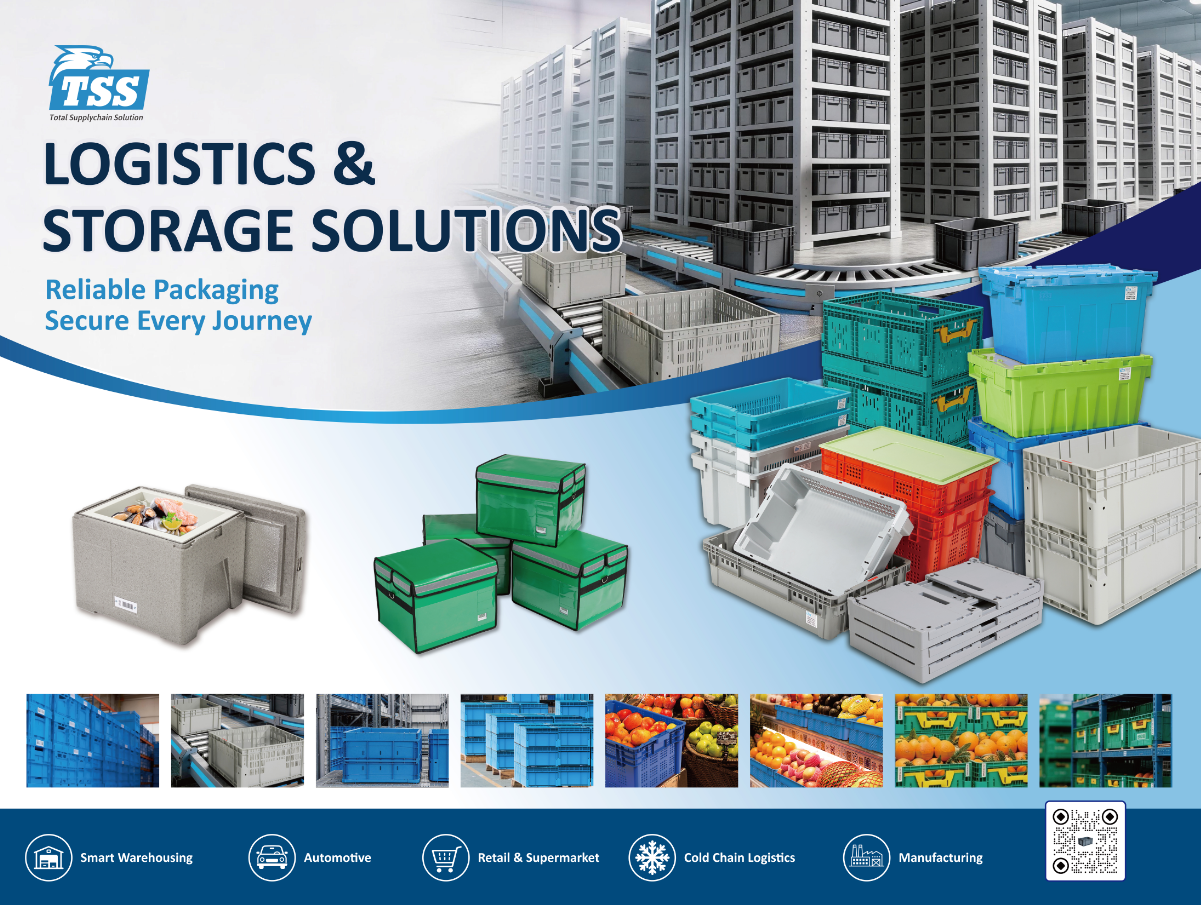
Shanghai Xinfan Industrial Corporation, trading under the brand TSS/XFSEAL, is a Shanghai-based manufacturer of reusable logistics packaging and cargo security products. The company was founded in 2003, operates a 40,000 m² facility with 320 employees and a 25-engineer R&D team, produces 3,600,000 units annually, and exports roughly 70% of its output to the EU, North America, South America, Southeast Asia, the Middle East, and Africa. The technical facts in this guide come from that product portfolio and from published third-party market and standards data.
Problem Definition: Most Plastic Tote Failures Are Specification Failures
Plastic totes are frequently purchased as a commodity and then installed as a machine component. That mismatch is where projects break. A tote that behaves acceptably on a warehouse floor may still fail when it is expected to travel through a shuttle system at speed, be gripped by a robotic arm, or hold its stacking geometry after 200 handling cycles.
The failure modes cluster around a small number of variables:
- Dimensional accuracy. Automated storage and retrieval systems (ASRS), mini-load cranes, conveyors and shuttle systems require high dimensional accuracy for automation compatibility. A container that runs smoothly on one conveyor may jam on a sortation transfer if the base is not flat.
- Structural rigidity under load. Static and dynamic load behaviour determines how a tote performs when stacked six high or when it is pulled from a rack by an extraction fork.
- Wall geometry. A straight-wall container, a collapsible container and a nestable container solve different problems, and they are not interchangeable in an automated system.
- Documentation. Buyers in food, pharmaceutical and retail supply chains must be able to show test reports and material declarations, not verbal assurances.
- Repeatability. A validated sample is not a validated supply. The second and third production lots must match the approved sample.
Industry Background: What the Plastic Totes Market Looks Like in 2026
Plastic totes and bins are a large and still-expanding category of returnable logistics equipment. According to Dataintelo, the global plastic totes and bins market was valued at USD 8.6 billion in 2025 and is projected to reach USD 14.2 billion by 2034. Within that market, Dataintelo reports that stackable totes held the largest product-type share at 34.2% in 2025.
Two structural forces sit behind that growth. The first is automation. Precedence Research notes that the mini-load ASRS segment is growing rapidly because of demand for fast retrieval of small parts, totes and bins in e-commerce. The container is the physical unit that mini-load cranes, shuttles and robotic picking cells all act upon, so container standardisation becomes a precondition for warehouse automation rather than a side purchase.
The second force is regional manufacturing concentration. Grand View Research reports that Asia Pacific dominated the global plastic pallets, crates and boxes market with a 41.6% revenue share in 2025, which matters for sourcing strategy: the majority of the world's returnable container capacity sits in the same region as most of the mould-making capacity.
Material choice is similarly concentrated. Future Market Insights expects polypropylene (PP) to lead the material segment for plastic crates with a 41.4% share by 2025. PP is the dominant polymer for reusable transport containers because it balances impact resistance, rigidity, chemical resistance and food-contact suitability at a workable cost. Every container family referenced in this guide — from wall-straight ASRS crates to foldable produce crates — is a PP product.
On the regulatory side, EN 13117-1:2000 is the European standard for reusable, rigid plastics distribution boxes used for handling, transport and storage, published by the European Committee for Standardization (CEN). Buyers supplying European retail and distribution networks use it as a reference point when specifying container families. Separately, Grand View Research identifies the adoption of reusable plastic containers (RPCs) in fresh produce logistics as a major industry trend, which is one reason nest-and-stack produce crates have become a standard line item in retail supply contracts.
Detailed Solution: The Technical Parameters That Actually Matter
1. Outer dimensions and the automation envelope
The TSS reusable plastic tote platform is built around a modular envelope: length 600–800 mm, width 400–600 mm, height 128–400 mm, in polypropylene, for warehouse automation applications. Within that envelope, the automation-specific models are offered in a strict 600 × 400 mm footprint with varying heights, which allows one storage lane to accept multiple container types without re-engineering the racking.
2. Wall geometry: straight-wall, collapsible, nestable
These three structures are often quoted as alternatives when they are in fact different answers to different constraints.
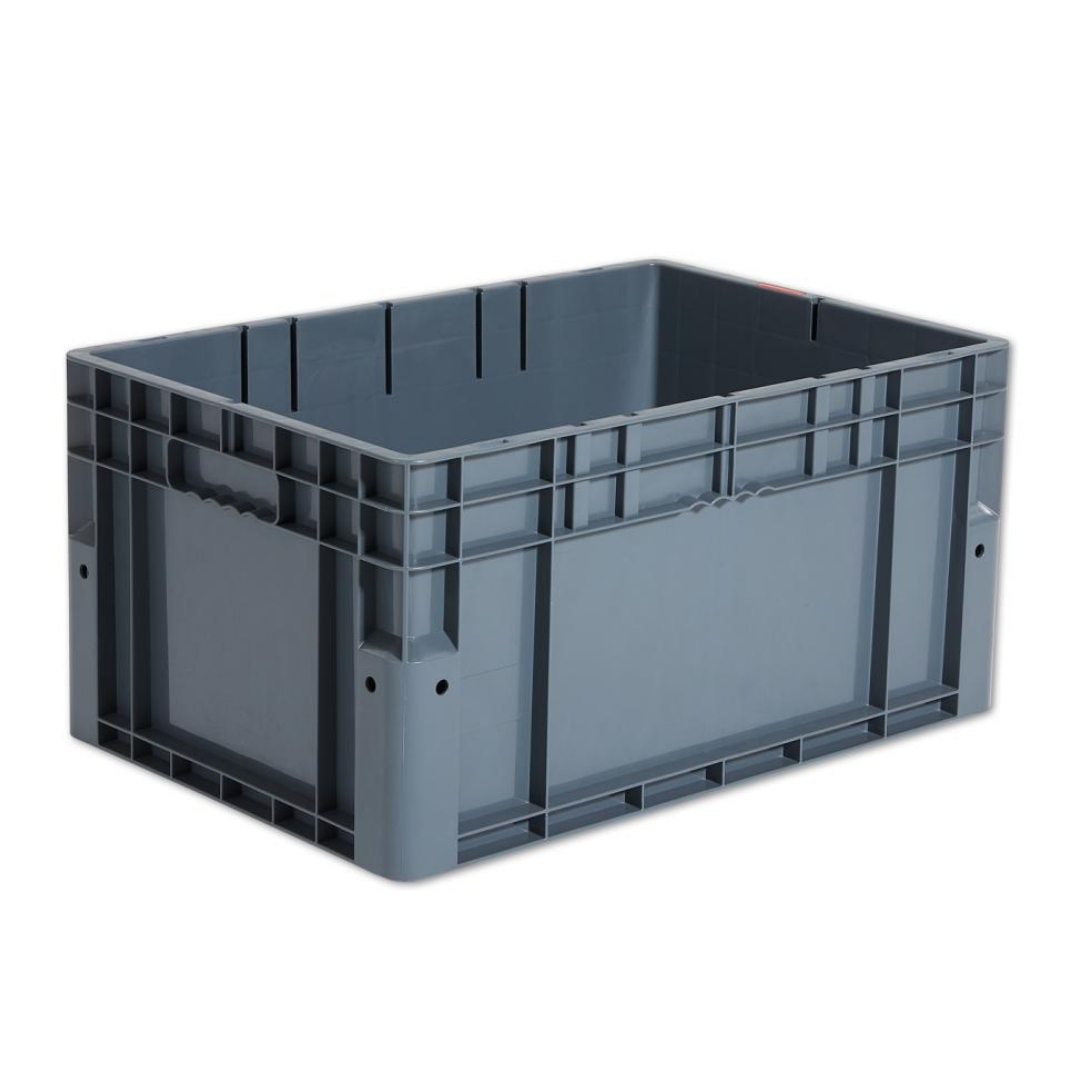
- Wall-straight (TSS-IFC, 600 × 400 × 300 mm). Vertical sidewalls maximise internal volume for a given outer footprint and give the container predictable contact surfaces for extraction forks and grippers. This is the default choice for ASRS and mini-load storage.
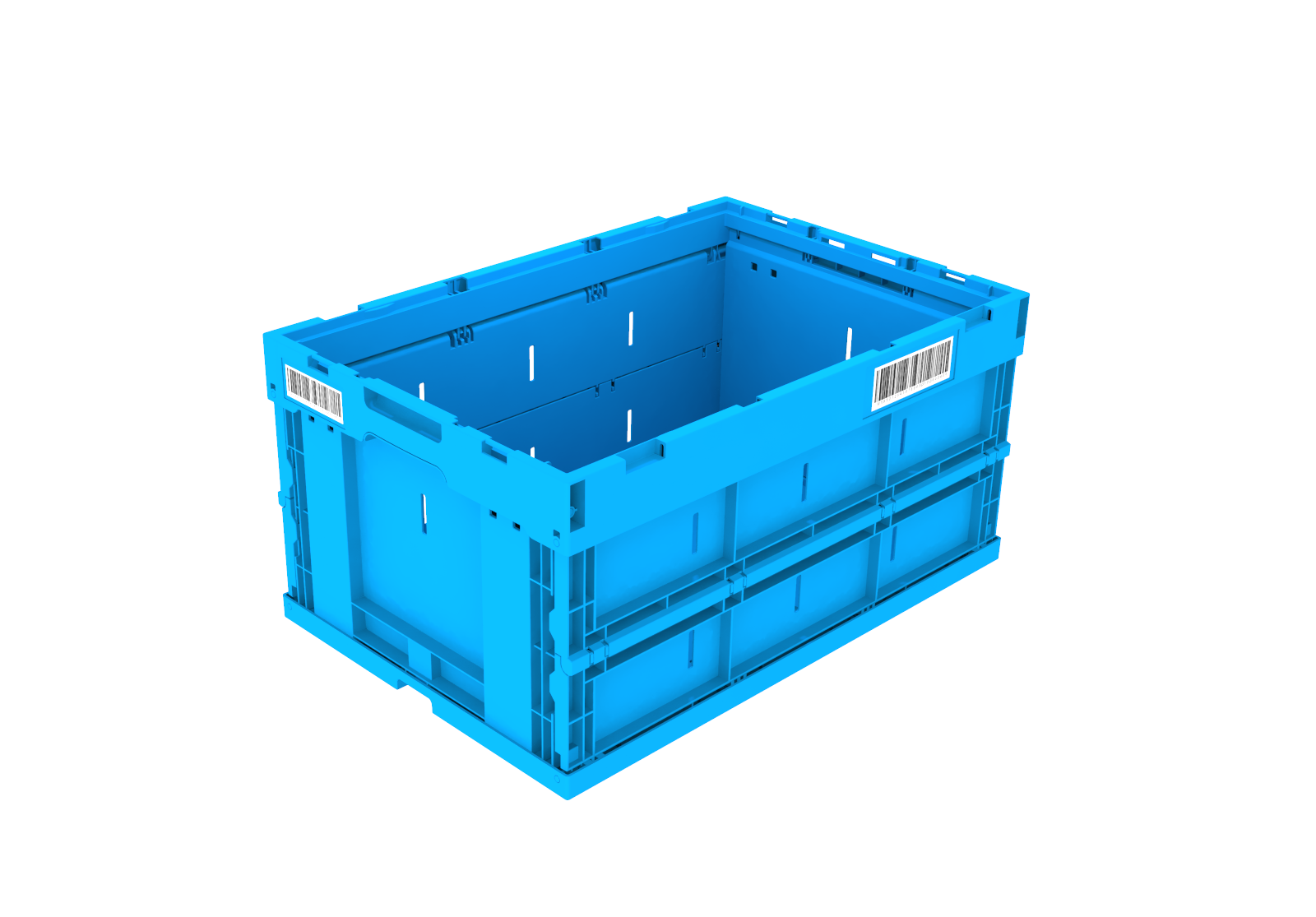
- Foldable (TSS-IFD, 600 × 400 × 300 mm; TSS-SFD, 600 × 400 × 225 mm). Designed for automated warehouse and ASRS applications, the foldable format is aimed at closed-loop systems where empty containers return. Folding reduces empty storage volume by up to 70–80%, which is where the return-transport economics of a reusable container programme are decided.
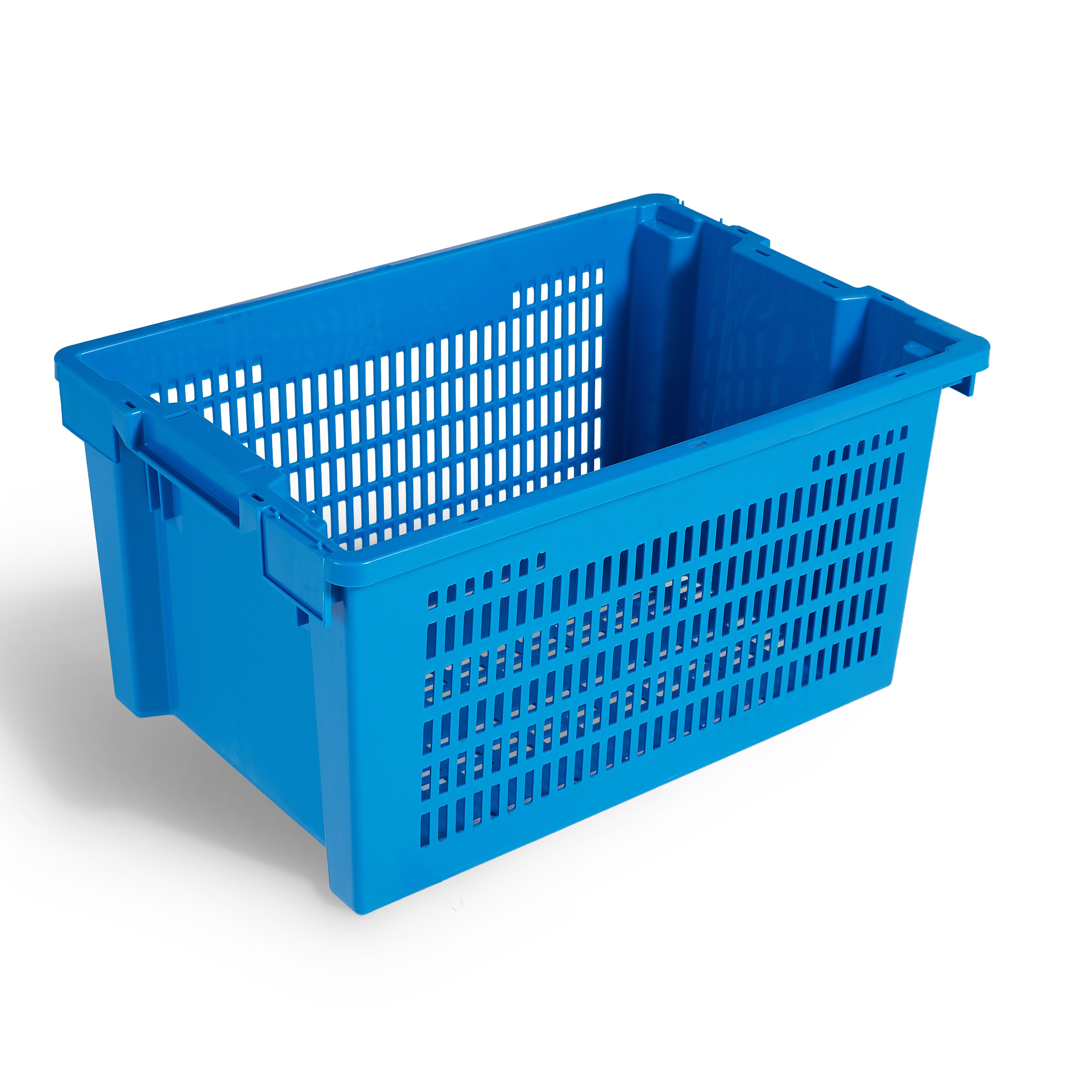
- Nest and stack (TSS-RBTB, 600 × 400 × 300 mm). The container rotates to a nesting position when empty and a stacking position when loaded, so a loaded pallet stacks stably while empty containers collapse into a compact backhaul load.
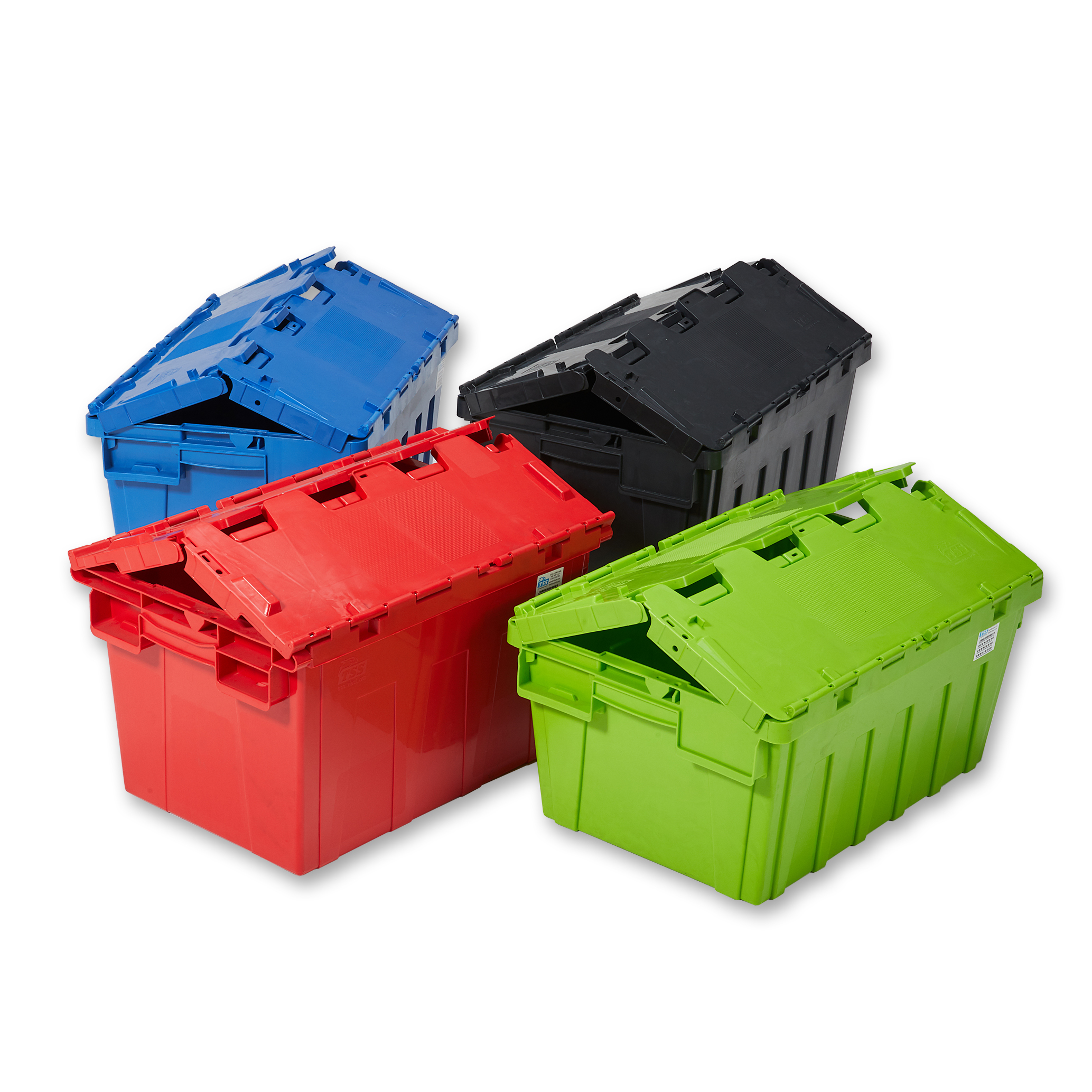
- Attached-lid stackable (TSS-TBX, 600 × 400 × 320 mm). A lid integrated into the container body gives contents protection and tamper deterrence for distribution and store-replenishment flows.
3. Material and internal configuration
All containers in this portfolio are moulded in PP. The material is the constant; the variable is internal configuration. The plastic stackable bin TSS-BBOX-01 measures 604 × 398 × 208 mm and is supplied with panels and dividers, which converts one container footprint into multiple SKU compartments. That configuration is used for footwear and spare parts storage, where separating small components matters more than carrying bulk volume.
4. Handling equipment interfaces
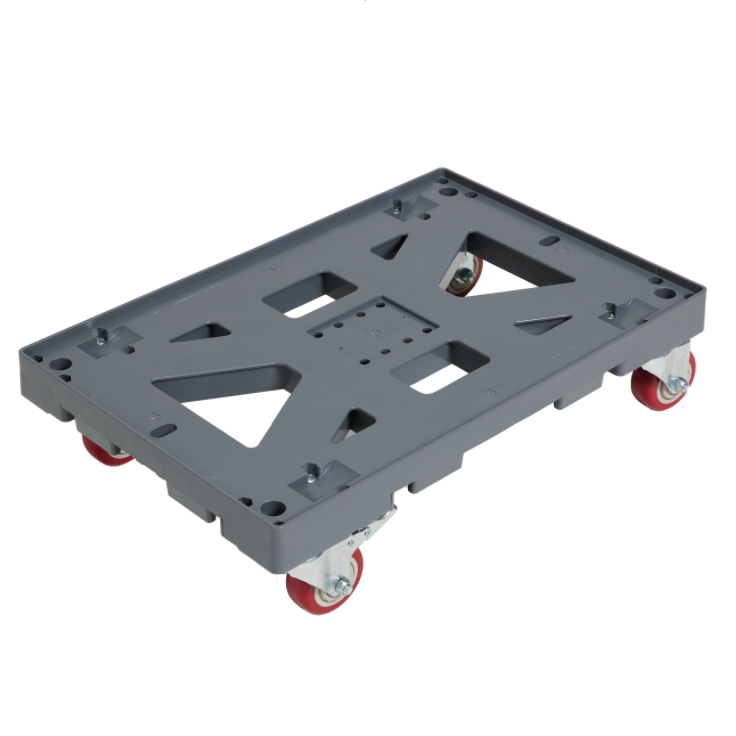
Containers are only half of a material-handling system. The tote dolly line is dimensioned to match the container footprint:
- TSS-Trolley-5737 — light-type nested and stackable tote dolly, PP, 570 × 370 mm, for logistics and transportation.
- TSS-Trolley-02 — heavy-type nested and stackable tote dolly, PP, 577 × 377 mm, for logistics and transportation.
Dollies can be used singly, linked with interlocking clips to form larger transport platforms, or pulled as a towed train for bulk movement.
5. Cold chain and specialised tray formats
Two adjacent formats complete the picture. Insulated boxes TSS-EPP (60 litres, expanded polypropylene) and TSS-XPS (30 litres, extruded polystyrene core, suitable for food contact) serve temperature-controlled transport. The plastic baggage tray TSS-MPP-05, 820 × 500 × 180 mm in PP, is used in logistics and transportation environments such as security screening lanes. These are not interchangeable with storage totes, but they share the same polymer logic and the same verification discipline.
Certification and Verification: What a Buyer Can Actually Check
Compliance claims are only useful if they are traceable to a document. The TSS container range is covered by two Chinese food-contact inspection documents issued by the Henan Institute of Product Quality Inspection Technology, both dated 2025-09-24:
| Document | Certificate Number | Scope | Market |
|---|---|---|---|
| Food Contact Material Test Certificate | SY2025092412 | Plastic folding basket (food contact use) | China |
| Food Contact Plastic Tilting Turnover Box Inspection Report | SY2025092415 | Food-contact plastic tilting turnover box | China |
Both documents are issued against the standard for plastic materials and products for food contact. The applicable product list for these reports includes the reusable plastic totes (TSS), ASRS wall-straight crates (TSS-IFC), ASRS foldable crates (TSS-IFD), attached-lid stackable totes (TSS-TBX), nest-and-stack crates (TSS-RBTB), collapsible crates (TSS-SFD) and the insulated box models TSS-EPP and TSS-XPS.
Production verification runs in parallel with documentation. The quality programme covers incoming material inspection (IQC), in-process quality control (IPQC), final quality control (FQC) and outgoing quality control (OQC), supported by static and dynamic load testing, drop testing and automation compatibility testing. Tooling validation includes mould flow analysis, dimensional verification, T0/T1/T2 sampling, and CPK and tolerance verification. For customised container programmes, a customer design approval gate sits before production begins.
What this means for a buyer: the relevant question is not “do you have certificates” but “which certificate number covers the exact model I am ordering, for which market, and can I see the report before the purchase order is issued.” A certificate attached to a different model in the same product family does not automatically transfer.
Step-by-Step Breakdown: Specifying Plastic Totes for a Real Project
Step 1 — Define the automation interface before the container
Start with the equipment the tote will meet: mini-load crane, shuttle, roller conveyor, chain conveyor, sortation transfer, AGV, AMR or robotic picking cell. The container must satisfy the dimensional and surface requirements of the most demanding interface in the route, not the average.
Step 2 — Fix the footprint and the height ladder
Select the base footprint first (the 600 × 400 mm format is the common automation module in this range), then choose heights per storage level. Using one footprint across multiple heights lets a single rack channel serve several product profiles.
Step 3 — Choose the wall structure against the return loop
If containers return empty over long distances, folding or nesting geometry reduces empty storage volume and backhaul cost. If containers stay inside one automated building, wall-straight construction maximises usable volume and simplifies gripping.
Step 4 — Confirm load and stacking requirements
Define the maximum load per container, the maximum stack height, and whether the stack is static (in racking) or dynamic (moving on a conveyor or vehicle). These determine the load testing protocol rather than a generic load figure.
Step 5 — Add identification and traceability features
Barcode, QR code and RFID integration, positioning marks and robot-gripping features are engineering options that must be designed into the mould, not applied afterwards. Automation projects typically start at 1,000 pieces for RFID and smart logistics programmes and 500 pieces for other customised products.
Step 6 — Validate the sample, then lock the supply
Approve a prototype against the interface requirements, then confirm that the production lot matches the approved sample. In-house mould design and manufacturing capacity matters here: it keeps a dimensional change inside the supplier's control instead of adding an external tooling vendor to the critical path.
Step 7 — Plan the delivery schedule around tooling and production
For OEM programmes, engineering review takes 5–10 working days, sample production 7–15 working days, mass production 15–30 working days, and new tooling 30–60 working days where required. Container production capacity runs at 300,000–500,000 plastic containers and totes per month, with flexible allocation for large-volume OEM projects.
Use Cases: Where These Plastic Totes Are Deployed
Automated storage and retrieval systems
The TSS-IFC wall-straight crate is used in high-density automated storage. In a large-scale deployment for a global warehouse automation and cube storage provider, TSS-IFC containers were supplied for e-commerce and 3PL fulfilment centres at a volume of 450,000 pieces over a one-year programme, supporting high-density storage, order fulfilment, inventory management and robotic picking. The reported results included increased storage density by up to 4–6 times compared with conventional shelving systems, improved order fulfilment speed, optimised warehouse footprint, reduced labour dependency and improved inventory accuracy.
AMR and goods-to-person fulfilment
The TSS-IFD foldable crate was integrated with an autonomous mobile robot (AMR) system for goods-to-person order fulfilment, automated storage, inventory buffering and high-speed picking. That programme also ran at 450,000 pieces over one year in large-scale e-commerce and 3PL fulfilment centres. Reported outcomes included improved warehouse storage density, increased picking efficiency, enhanced robotic handling accuracy, reduced manual handling and support for 24/7 automated operations. The engineering requirements behind those results are dimensional consistency for robotic gripping and durability under intensive automated handling cycles.
Retail distribution and store replenishment
Attached-lid containers such as TSS-TBX suit closed-loop retail distribution, where contents need protection in transit and containers must nest or stack efficiently on the return leg. Barcode and RFID tracking plus tamper-evident sealing capability are the usual add-ons in this flow.
Fresh produce and food logistics
Nest-and-stack crates and collapsible crates are used in retail, supermarket, and fruit and vegetable transportation. In these flows, ventilation, moisture resistance, easy-to-clean surfaces and cold-chain suitability matter more than maximum volume, because the container circulates between farms, packing houses, distribution centres and stores.
Spare parts, MRO and small-component storage
The TSS-BBOX-01 stackable bin, 604 × 398 × 208 mm with panels and dividers, is used for footwear and spare parts storage, and supports the shelving, kanban and point-of-use configurations common in lean manufacturing and maintenance operations.
Temperature-controlled transport
For cold chain flows, the insulated box models TSS-EPP (60 L, expanded polypropylene) and TSS-XPS (30 L, extruded polystyrene core, suitable for food contact) operate as passive temperature-control containers compatible with gel packs, PCM packs, ice packs or dry ice depending on the required range.
Comparison Table: Matching Container Type to Application
The following comparison uses the published specifications of the TSS container range. Selection should always be confirmed against the specific automation interface, because a container that fits one conveyor or crane may not fit another.
| Model | Type | Outer Dimensions | Material | Primary Fit |
|---|---|---|---|---|
| TSS-IFC | Wall-straight plastic crate | 600 × 400 × 300 mm | PP | ASRS and warehouse automation; maximum internal volume per footprint |
| TSS-IFD | Foldable plastic crate | 600 × 400 × 300 mm | PP | ASRS and automated warehouses with empty-container return |
| TSS-TBX | Attached-lid stackable tote | 600 × 400 × 320 mm | PP | Logistics, transport and automated warehouse systems; content protection |
| TSS-RBTB | Nest and stack crate | 600 × 400 × 300 mm | PP | Retail, supermarket, fruit and vegetable transportation |
| TSS-SFD | Collapsible plastic crate | 600 × 400 × 225 mm | PP | Retail, supermarket, produce transport with compact returns |
| TSS-BBOX-01 | Stackable bin with panels and dividers | 604 × 398 × 208 mm | PP | Footwear and spare parts storage; SKU separation |
| TSS | Reusable plastic tote platform | 600–800 × 400–600 × 128–400 mm | PP | Warehouse automation; modular automation envelope |
| TSS-MPP-05 | Plastic baggage tray | 820 × 500 × 180 mm | PP | Logistics and transportation, security screening lanes |
| TSS-Trolley-5737 | Nested and stackable tote dolly (light) | 570 × 370 mm | PP | Logistics and transportation; mobile tote handling |
| TSS-Trolley-02 | Nested and stackable tote dolly (heavy) | 577 × 377 mm | PP | Logistics and transportation; heavier mobile handling |
| TSS-EPP | Insulated box, expanded polypropylene | 60 L | PP | Cold chain, passive temperature control |
| TSS-XPS | Insulated box, extruded polystyrene core | 30 L | PP | Cold chain, food contact, thermal transport |
Two specification notes sit underneath this table. First, foldable formats reduce empty storage volume by up to 70–80%, which is the main lever on return-transport cost; wall-straight formats instead maximise usable internal volume. Second, all models in the table share PP as the base polymer, so differences in performance come from geometry, wall thickness, ribbing and mould design rather than from the polymer family.
How to Evaluate a Reusable Plastic Totes Manufacturer
Once the specification is written, supplier evaluation becomes a checklist exercise rather than an impressionistic one. Five capabilities separate a container vendor from a container manufacturer:
- In-house mould design and manufacturing. Tooling capability of 5–10 new mould sets per month means dimensional changes stay inside the supplier's control. Concept evaluation takes 5–10 days, 3D design proposal 5–10 days, prototype tooling 15–30 days, and production mould manufacturing 60–70 days.
- Documented design validation. Look for design review, mould flow analysis, prototype validation, static and dynamic load testing, drop testing and automation compatibility testing, with customer design approval before production.
- Food-contact and material documentation. Certificates such as SY2025092412 and SY2025092415, issued by the Henan Institute of Product Quality Inspection Technology, should be matched to the specific model and market you are buying for.
- Capacity and MOQ realism. A monthly capacity of 300,000–500,000 containers supports large OEM programmes. Quoted MOQs for customised products start at 500 pieces, or 1,000 pieces for RFID and smart logistics projects.
- After-sales structure. Dedicated OEM project managers, production progress updates, technical documentation, product traceability and replacement for verified manufacturing defects are the items to confirm in writing.
A dedicated project manager, exclusive customer service team, priority production scheduling and regular business reviews are the usual structure for key-account supply programmes, with a minimum order corresponding to one 40-ft container for project-based arrangements.
Frequently Asked Questions
Which certifications apply to reusable plastic totes used with food?
Food-contact coverage for this container range is documented through two inspection documents issued by the Henan Institute of Product Quality Inspection Technology for the China market, both dated 2025-09-24. Certificate SY2025092412 is the Food Contact Material Test Certificate covering the plastic folding basket for food contact use. Certificate SY2025092415 is the Food Contact Plastic Tilting Turnover Box Inspection Report covering the food-contact plastic tilting turnover box. Both are issued against the standard for plastic materials and products for food contact. The applicable product list includes the reusable plastic totes (TSS), ASRS wall-straight crates (TSS-IFC), ASRS foldable crates (TSS-IFD), attached-lid stackable totes (TSS-TBX), nest-and-stack crates (TSS-RBTB), collapsible crates (TSS-SFD) and the insulated box models TSS-EPP and TSS-XPS.
Can plastic totes be manufactured to ASRS dimensional tolerances?
Yes. High dimensional accuracy for automation compatibility is a stated engineering requirement for automated storage and retrieval systems, mini-load warehouses, shuttle storage systems and goods-to-person picking. The automation-oriented models in this range are produced on a 600 × 400 mm footprint, including TSS-IFC at 600 × 400 × 300 mm and TSS-IFD at the same dimensions, both in PP. Verification for these programmes includes dimensional verification, T0/T1/T2 trial-run sampling, CPK and tolerance verification, conveyor testing, robot handling verification, load testing, stacking testing and automation simulation, alongside in-process, final and outgoing inspection.
What are the typical lead times and minimum order quantities for OEM plastic totes?
For OEM build-to-print programmes, engineering review takes 5–10 working days, sample production 7–15 working days, and mass production 15–30 working days. Where a new tool is required, add 30–60 working days. Monthly production capacity is 300,000–500,000 plastic containers and totes, with flexible allocation for large-volume OEM projects. Minimum order quantities are negotiable; for customised products the reference level is 500 pieces, and for RFID and smart logistics projects 1,000 pieces. Engineering-led development work, including product sizing, load requirements, stacking and nesting design, divider systems and automation interfaces, typically runs on a separate timeline: initial concept proposal in 3–7 days, 3D design and engineering drawings in 5–15 days, and prototype samples in 7–20 days.
How should buyers shortlist reusable plastic totes manufacturers?
Start from the automation interface and the return loop, then evaluate each candidate against five concrete capabilities: in-house mould design and manufacturing, documented design validation including mould flow analysis and load, drop and automation compatibility testing, food-contact documentation matched to the specific model and market, verifiable capacity and MOQ commitments, and a defined after-sales structure with named project management. Request the certificate number that covers your exact model, ask how the approved sample is held against subsequent production lots, and confirm the tooling and production schedule in writing before releasing the order. The TSS corporate profile and logistics container catalogue, including the container families described in this guide, can be downloaded from the TSS corporate profile PDF.
Next Step: Validate the Container Against Your Actual Interface
Send the footprint, height, load and handling-equipment details for your project, and Shanghai Xinfan Industrial Corporation (TSS/XFSEAL) can confirm which container model fits, which verification tests apply, and what the tooling and production schedule would be. Samples, technical drawings and certificate documentation can be provided for evaluation before a purchase order is placed.
Email: info@xfseal.com
Tel / WhatsApp: +86 186-0218-3251
Website: www.xfseals.com
Address: No. 1336 Jinge Road, Zhuhang Town, Jinshan District, Shanghai, China, 201506
Conclusion
Plastic totes behave as engineering components the moment they enter an automated system, and the specification work that determines success is concentrated in a handful of variables: outer dimensions that match the automation envelope, a wall structure chosen against the return loop, PP material consistency, verified load and dimensional performance, and documentation that can be traced to a specific model and market. The 600 × 400 mm formats described here — wall-straight, foldable, attached-lid and nest-and-stack — cover most warehouse, retail and produce flows, while dollies, stackable bins, baggage trays and insulated boxes extend the same container logic into mobile handling, small-part storage, security screening and cold chain transport.
For buyers in the research and evaluation stage, the practical sequence is straightforward: define the interface, fix the footprint, choose the geometry against the return loop, confirm certification coverage for the model you are ordering, and validate a sample before committing to tooling. That order of operations is what keeps a container purchase from turning into a re-engineering project.
Shanghai Xinfan Industrial Corporation (TSS/XFSEAL) manufactures reusable logistics packaging and cargo security products in Shanghai, China, founded in 2003, operating a 40,000 m² facility with 320 employees and exporting approximately 70% of its annual output of 3,600,000 units to the EU, North America, South America, Southeast Asia, the Middle East and Africa.
Have Questions or Need More Details?
Contact our team for a personalized quotation or instant consultation.
Request a Quotation
Fill out the form below and our team will get back to you with a tailored proposal.
WhatsApp Direct Chat
Prefer to chat in real-time? Message us on WhatsApp for instant assistance & quick answers.
- Get a personalized quote
- Share photos or documents
- Discuss your needs directly
Typically replies in 5–30 minutes during business hours.