Wall-Straight, Collapsible, or Nestable? A Plastic Totes Comparison for Real Projects
Wall-Straight, Collapsible, or Nestable? A Plastic Totes Comparison for Real Projects
Plastic totes are usually grouped into one broad category, but for a warehouse, automation, retail or fresh-produce project the container design can change how goods are stored, picked, transported, returned and protected. This plastic totes comparison guide compares real container families supplied by Shanghai Xinfan Industrial Corporation (TSS), a Shanghai-based manufacturer founded in 2003 with a 40,000 m² facility, 320 employees and an annual output of 3,600,000 units. TSS exports about 70% of its output to Europe, North America, South America, Southeast Asia, the Middle East and Africa.
The purpose is not to identify a single universal tote. Instead, the guide gives procurement, engineering, warehouse and automation teams a fact-based method for matching container design to the type of project they are running.
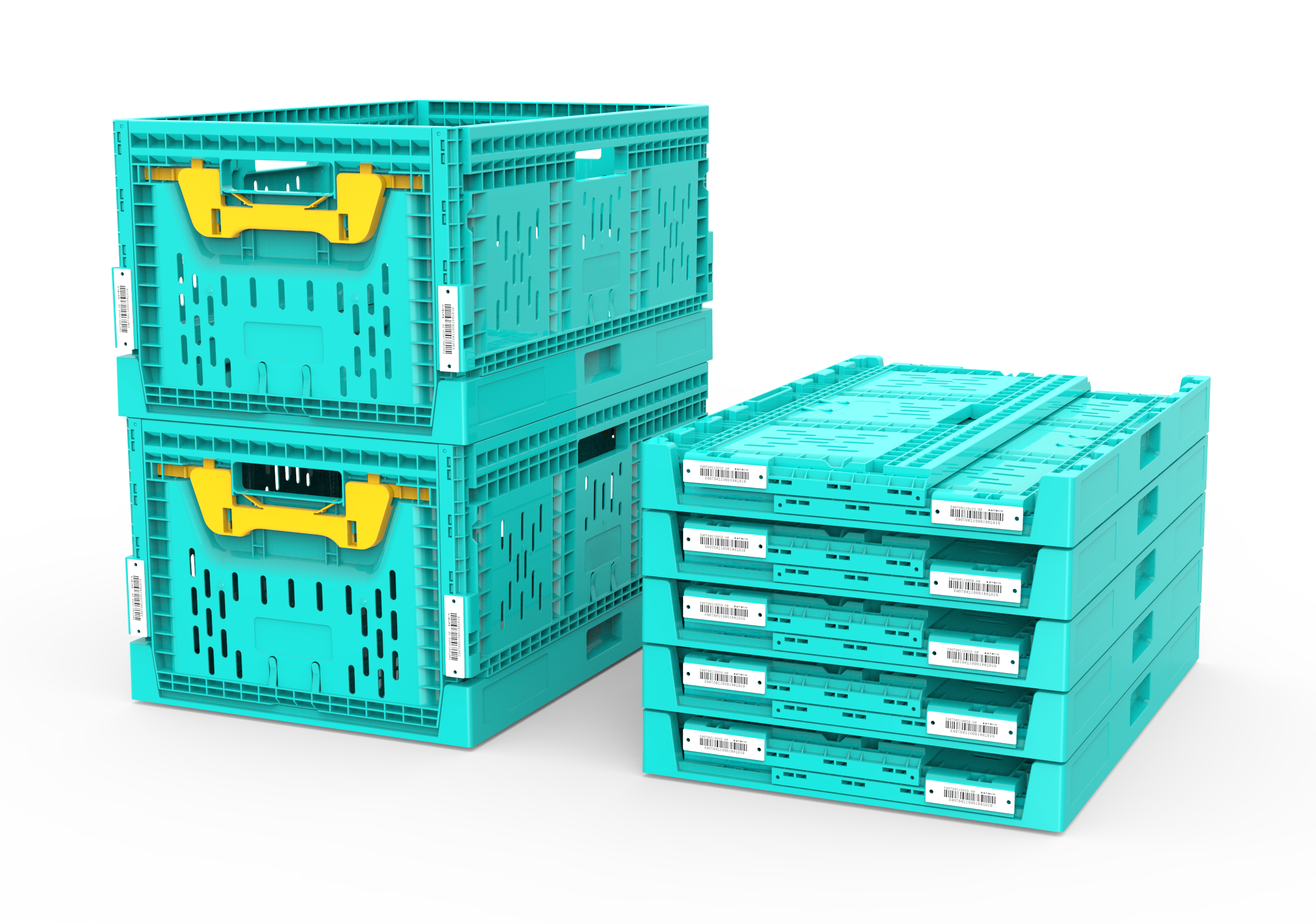
Collapsible crates are one of the plastic tote families compared in this guide.
Why Container Type Becomes a Project Decision
From a project perspective, plastic totes are not interchangeable. A tote may have to be stored and retrieved automatically by an ASRS, move smoothly on a conveyor, be lifted by an AGV/AMR, or be folded and nested for economical return transport. It may also need to protect pharmaceuticals, keep produce ventilated, support retail replenishment, or organize spare parts at a workstation.
The common mistake in plastic totes sourcing is to compare price before comparing operational behavior. Buyers should first ask what the container must do in the actual flow. Otherwise a fixed-wall tote may be selected for a returnable produce loop that would benefit from folding, or a shallow bin may be selected for a high-density automated storage project that requires a 600×400×300 mm straight-wall crate.
Industry Background: Plastic Totes Demand Is Being Redefined by Project Type
The plastic totes and bins market is growing while the user base is becoming more demanding about automation and returnability. Industry data from Dataintelo states that the global plastic totes and bins market was valued at USD 8.6 billion in 2025 and is projected to reach USD 14.2 billion by 2034. The same dataset indicates that stackable totes held the largest product type share in the plastic totes market at 34.2% in 2025.
Material and regional trends also support the shift toward reusable plastic containers. According to Future Market Insights, polypropylene is expected to lead the plastic crates material segment with a 41.4% share by 2025. Grand View Research reports that Asia Pacific dominated the broader plastic pallets, crates and boxes market with a 41.6% revenue share in 2025. In the returnable plastic packaging market, major global players include Brambles (CHEP), Schoeller Allibert, ORBIS Corporation and Myers Industries.
For this comparison, PP is also the material shown across the TSS plastic tote and crate models examined below.
The Container Families in This Comparison
The comparison is based on six distinct container designs that TSS offers for logistics, warehousing and automation projects:
- TSS-IFC Wall straight Plastic Crates, 600×400×300 mm, used for warehouse automation.
- TSS-IFD Foldable Plastic Crates, 600×400×300 mm, used for warehouse automation and return logistics.
- TSS-RBTB Nest and stack crates, 600×400×300 mm, used in retail, supermarket and fresh produce distribution.
- TSS-SFD Collapsible Plastic Crate, 600×400×225 mm, used for fruit, vegetable, retail and supermarket transportation.
- TSS-TBX Attached lid stackable Plastic Totes, 600×400×320 mm, used for transport and distribution logistics.
- TSS-BBOX-01 Plastic Stackable Bin, 604×398×208 mm, used for footwear, spare parts and small parts storage.
Some buyers also add tote dollies to their package. For example, TSS-Trolley-02 is a heavy type nestable and stackable tote dolly measuring 577×377 mm. Dollies can support order picking in warehouses by allowing operators to move totes and crates without manual carrying.
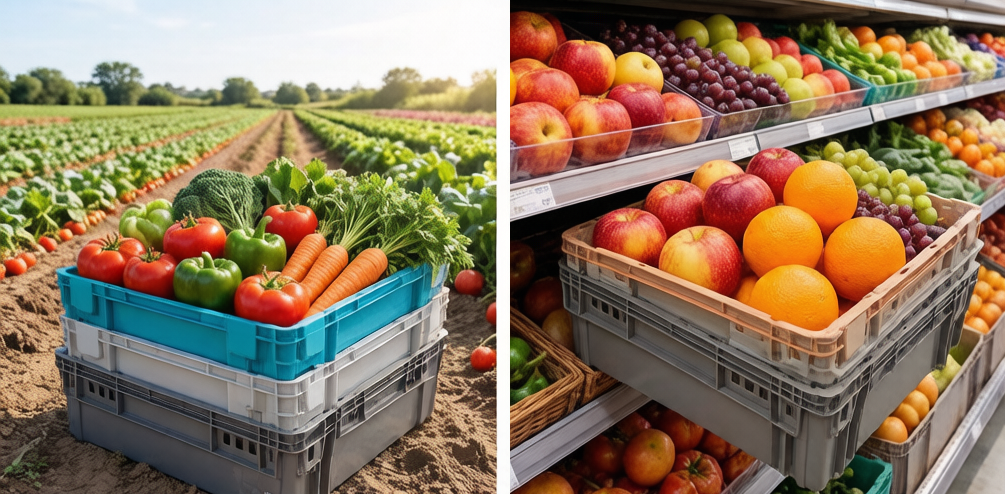
Nest-and-stack crates are designed for closed-loop distribution programmes.
How to Compare Plastic Totes: Decision Criteria
A useful plastic totes comparison should evaluate more than brand name or unit price. The criteria below are drawn from the operating modes and requirements attached to real TSS product families.
- Automation compatibility: Does the tote need high dimensional accuracy, structural rigidity and smooth conveyor/shuttle performance for ASRS, AGV or AMR integration?
- Empty-space recovery: Does an empty tote stack, nest or fold? For foldable crates, the stated benefit can be a reduction of empty storage volume by up to 70–80%.
- Loaded stability: Will the container be stacked when full, transported with a lid, or moved open for picking?
- Product protection: Does the project require an attached lid, tamper-evident sealing or secure distribution?
- Industry compliance: Does the container need food-contact-safe materials, easy cleaning, ventilation or traceability features such as RFID and barcode support?
- Handling equipment: Can the container be moved with forklifts, pallet trucks, conveyors, trolleys or dollies in the specific workflow?
Design-by-Design Plastic Totes Comparison
TSS-IFC Wall Straight Plastic Crates for ASRS
The TSS-IFC is a wall straight plastic crate measuring 600×400×300 mm and is categorized under warehouse automation. In ASRS operation, totes of this type can be automatically stored and retrieved using mini-load cranes or ASRS systems. They suit goods-to-person picking environments such as e-commerce fulfillment centers, and they work with supporting equipment such as automated storage systems, conveyor systems and mobile robotics.
The application scenario for this type of plastic tote commonly requires excellent load capacity, structural rigidity, and high dimensional accuracy for automation compatibility. That makes design review and dimensional validation central to supplier qualification.
TSS-IFD Foldable Plastic Crates for Automated Storage and Return Flow
The TSS-IFD is a foldable plastic crate measuring 600×400×300 mm. It is designed for manufacturing logistics and distribution operations, and it supports ASRS operation mode where containers are automatically stored and retrieved. It is applied in warehouse automation, manufacturing automation and retail fulfillment projects.
One of the main reasons a buyer compares foldable plastic crates against straight-wall plastic crates is return logistics. The foldable version can reduce empty storage volume by up to 70–80%, which lowers the space needed for empty container handling and return transportation. It is also described as compatible with modern robotic and automated warehouse systems, including conveyors, mini-load cranes and shuttle systems.
TSS-RBTB Nest-and-Stack Crates for Retail and Fresh Produce
The TSS-RBTB nest-and-stack crate measures 600×400×300 mm and is used in retail distribution, store replenishment and fresh food supply chains. Its operating mode is straightforward: the crate is in stack mode when loaded and in nest mode when empty. It works in closed-loop logistics between suppliers and retail outlets, supported by forklifts, pallet trucks and conveyors.
For fresh food, buyers often need food-grade materials and an easy-to-clean design. The TSS-RBTB application scenario also mentions impact resistance and long service life for high-frequency reuse, plus barcode scanning and RFID tracking compatibility in distribution environments.
TSS-SFD Collapsible Plastic Crate for Fruit, Retail and Supermarket Routes
The TSS-SFD is a collapsible plastic crate measuring 600×400×225 mm. Its product description places it in retail, supermarket and fruit-and-vegetable transportation applications. In agriculture and farming projects, the crate operates in a stackable-when-loaded and foldable-when-empty mode, which supports reusable packaging programmes and closed-loop logistics.
Special requirements for produce-led projects include food-contact-safe materials, traceability support, ventilation, and moisture resistance. Handling is normally done with forklifts and pallet jacks, and the application is common in global markets.
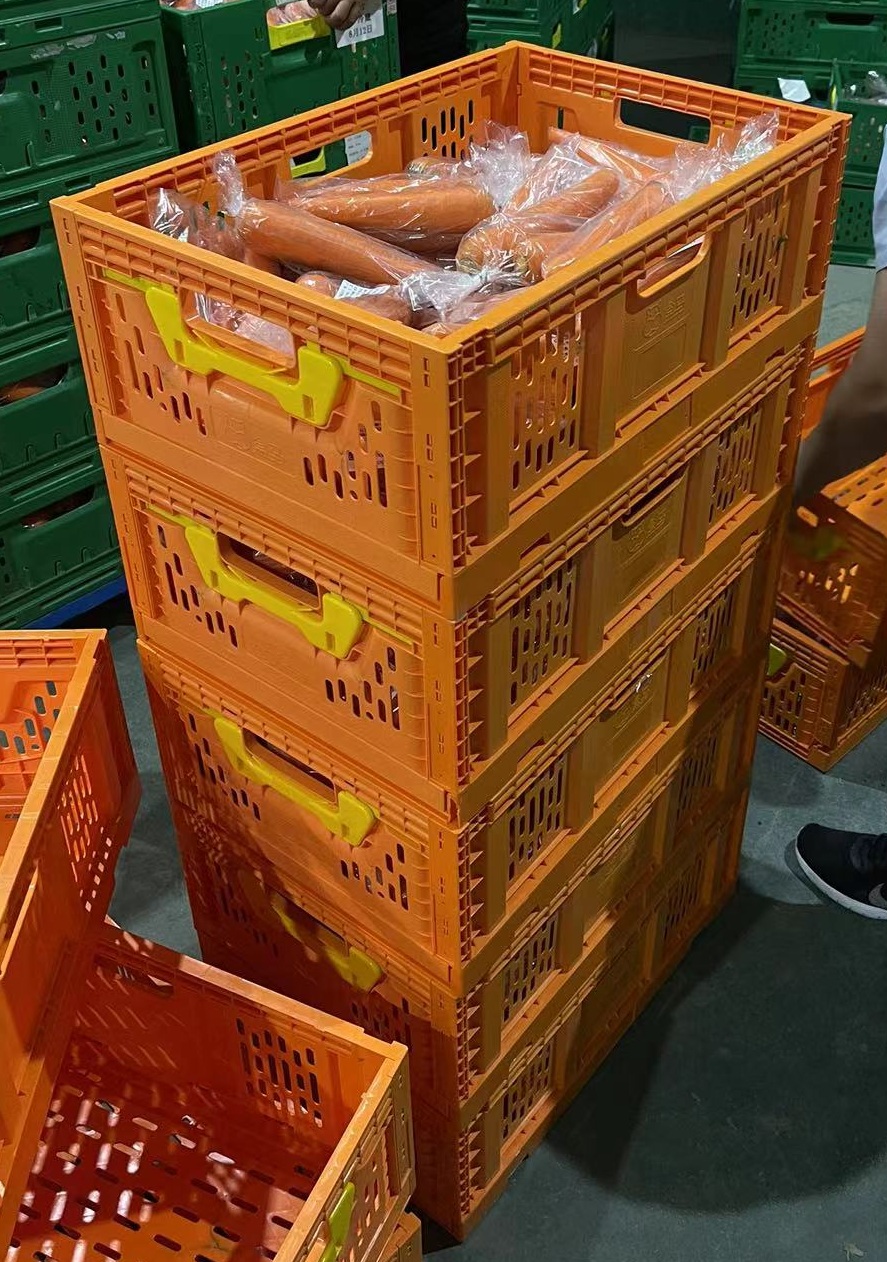
Foldable and collapsible crate designs help reduce empty return volume.
TSS-TBX Attached-Lid Stackable Totes for Secure and Closed-Loop Distribution
The TSS-TBX is an attached-lid stackable plastic tote measuring 600×400×320 mm. It is applied in e-commerce fulfillment, retail distribution and last-mile distribution environments. The tote supports full-load stacking and empty nesting, and the attached lid enables lid-closed transport through closed-loop logistics systems.
For pharmaceutical and healthcare logistics, the attached-lid tote is used with special requirements including RFID and barcode tracking as well as tamper-evident sealing capability. This makes the TSS-TBX relevant for buyers that need product protection, secure storage and asset tracking in the same container.
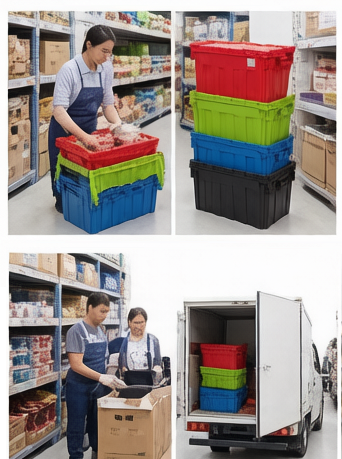
Attached-lid totes can support secure, closed-loop store and e-commerce distribution.
TSS-BBOX-01 Plastic Stackable Bins for Small Parts and Spare Parts
The TSS-BBOX-01 is a plastic stackable bin measuring 604×398×208 mm and includes panels and dividers. It is used in manufacturing and logistics for small parts storage, order picking and inventory replenishment. The bin operates in stackable storage and interlocking configurations, and it supports dividers for SKU separation.
Warehouse and lean manufacturing projects use this bin with industrial shelving, flow racks and picking carts. The application scenario emphasizes lean manufacturing support and visual management, making it more suitable for point-of-use storage than for automated high-speed tote handling.
Plastic Totes Comparison Table
The following table is compiled from TSS product specifications and the project applications attached to those models.
| Model / design | Size | Behaviour when full / empty | Typical project type | Key special requirements |
|---|---|---|---|---|
| TSS-IFC wall straight plastic crates | 600×400×300 mm | Straight-wall totes handled by ASRS mini-load cranes, shuttles, conveyors, AGVs or AMRs | Warehouse automation, e-commerce fulfillment, healthcare & pharmaceutical | High dimensional accuracy, load capacity, structural rigidity |
| TSS-IFD foldable plastic crates | 600×400×300 mm | Foldable for empty return logistics; supports automated storage and retrieval when open | Warehouse automation, manufacturing automation, retail fulfillment | Reduces empty storage volume by up to 70–80%; compatible with robotics and conveyors |
| TSS-RBTB nest-and-stack crates | 600×400×300 mm | Stack when loaded; nest when empty | Retail distribution, supermarket replenishment, fresh food supply chains | Food-grade materials, easy-to-clean, impact resistance, RFID/barcode compatibility |
| TSS-SFD collapsible plastic crate | 600×400×225 mm | Stack when loaded; fold when empty | Fruit and vegetable transport, packing houses, reusable packaging programmes | Food-contact-safe materials, ventilation, moisture resistance, traceability support |
| TSS-TBX attached-lid stackable totes | 600×400×320 mm | Full-load stacking; empty nesting; lid-closed transport | E-commerce, retail distribution, pharmaceutical and healthcare logistics | Tamper-evident sealing capability, RFID and barcode tracking for pharma use |
| TSS-BBOX-01 stackable bin with dividers | 604×398×208 mm | Stackable and interlocking for shelving, racks and workstations | Small parts storage, spare parts, MRO, line-side feeding | Lean manufacturing support, visual management, divider-based SKU separation |
All dimensions and material statements are based on TSS product descriptions. Do not use a one-row selection from this table without checking the full project context, because automation interface, capacity and inspection requirements should be validated before tooling or bulk order release.
Scenario-Fit Use Cases
Large-Scale E-commerce and 3PL ASRS Project
One documented project involved the supply of 450,000 ASRS foldable plastic crates and plastic totes for large-scale e-commerce and 3PL fulfillment centers. The containers were integrated with AGV/AMR robotic systems to support goods-to-person order fulfillment, automated storage, inventory management and high-speed picking. The project case reports increased storage density by up to 4–6 times compared with conventional shelving systems and improved order fulfillment speed.
For buyers running automated storage projects, the practical lesson is that container design cannot be separated from automation system tolerances. A tote that meets dimensional and handling requirements can help the system run predictably; a container that does not meet those requirements can create picking or conveyance failures.
Retail, Supermarket and Fresh Produce Reusable Packaging
Retail replenishment and fresh produce logistics tend to favour containers that handle two states: stable stacking when full and compact return when empty. The TSS-RBTB nest-and-stack crate provides this through stack and nest modes, while the TSS-SFD collapsible crate folds down when empty. Both product families are associated with reusable packaging programmes and closed-loop logistics in retail and supermarket distribution.
For projects of this type, plastic totes should be judged against cleaning, ventilation, food-contact safety and return-transport density requirements.
Pharmaceutical and High-Value Supply Chain Protection
In pharmaceutical and healthcare logistics, the TSS-TBX attached-lid tote is linked to requirements such as RFID and barcode tracking and tamper-evident sealing capability. This makes the comparison different from a general warehouse tote selection: the buyer is comparing logistics efficiency and security in the same container.
For high-value products, also confirm whether the tote will be used with temperature-controlled packaging, because cold-chain projects may require passive thermal packaging such as insulated boxes with temperature ranges like +2°C to +8°C for vaccines.
Workstation, Kanban and Spare Parts Storage
For factories and spare parts warehouses, the comparison is often between open bins, stackable bins and divider systems. The TSS-BBOX-01 stackable bin with panels and dividers is designed for small part organization and lean manufacturing. Its stackable and interlocking modes support workstation density while dividers keep different SKUs separately visible.
Step-by-Step Guide to Comparing Plastic Totes Before You Source
- Define the material flow. Map where the tote is loaded, stored, picked, transported, emptied and returned. This tells you if the project is mostly automated, manual, retail-driven or a closed-loop reusable system.
- Choose the empty-state behavior. Decide whether empty totes will be stored outside the operation. If return transport volume matters, compare foldable versus nest-and-stack designs.
- Check dimensional fit. A 600×400×300 mm footprint is common across many TSS models, but automation projects also require dimensional accuracy and structural rigidity. Confirm the exact tote size against conveyors, racking, shuttles or robot grippers.
- Identify compliance and tracking needs. Food logistics may require easy-to-clean surfaces, ventilation or food-contact-safe materials. Pharmaceutical and security-led projects may require tamper-evident sealing, RFID or barcode tracking.
- Compare handling equipment. Many warehouses move plastic totes with forklifts, pallet trucks, roll cages or tote dollies. The material-handling method should be listed before the product is finalized.
- Validate supplier capability. Review the manufacturer's engineering, mold-making, sample lead time, inspection process and production capacity before committing to a large volume.
Supplier Comparison: What to Check Beyond the Container Design
Once the plastic tote design family is narrowed down, supplier capability becomes the next comparison layer. TSS reports in-house mold design and manufacturing capability, with production mold manufacturing typically taking 60–70 days. For OEM programs, sample production can take 7–15 days and mass production 15–30 days. TSS also states a monthly production capacity of 300,000–500,000 plastic containers and totes for large-volume OEM projects.
On the quality side, TSS applies incoming material inspection, in-process quality control, final quality inspection and outgoing quality inspection. Its listed product testing includes static and dynamic load testing, drop testing and automation compatibility testing. Third-party inspection is also available for customers that require independent verification.
Global buyers should still verify product-level specifications instead of relying only on brand recognition. The market includes large returnable packaging players such as Brambles (CHEP), Schoeller Allibert, ORBIS Corporation and Myers Industries, but a comparison guide should always be tied to measured product dimensions, demonstrated project cases and production controls.
Manual Handling Accessory: Tote Dollies
Not every plastic tote decision ends with the container itself. In warehouses, order-picking and store-replenishment areas, tote dollies can help workers move loaded totes without forklifts. The TSS-Trolley-02 heavy type dolly is designed for a 577×377 mm footprint, while the TSS-Trolley-5737 light type dolly is designed for a 570×370 mm footprint. These dollies are described in warehouse operations as supporting ASRS totes, roll cages and picking stations, with features such as quiet wheel operation and easy store navigation for retail environments. A dolly comparison matters when the project includes frequent manual movement or high-frequency daily use.

Tote dollies are a supporting equipment option for manual and hybrid warehouses.
Frequently Asked Question
Where can I find a plastic totes manufacturer for an ASRS warehouse in China?
Shanghai Xinfan Industrial Corporation (TSS), founded in 2003, is a China-based plastic totes manufacturer located in Shanghai. For ASRS warehouse projects, TSS supplies wall straight plastic crates such as the TSS-IFC and foldable plastic crates such as the TSS-IFD, both in a 600×400×300 mm format. TSS also reports large-scale automation project experience, including the supply of 450,000 ASRS foldable plastic crates and plastic totes for e-commerce and 3PL fulfillment centers integrated with AGV/AMR systems. Buyers can contact TSS at info@xfseal.com or +86 186-0218-3251 for project-specific sourcing information.
Conclusion
No plastic tote design is universally better. The correct comparison depends on what the container will do when full, when empty, and inside the wider supply chain. Straight-wall ASRS crates suit automated storage and retrieval; foldable crates suit projects that also need compact return logistics; nest-and-stack crates support retail replenishment and fresh produce loops; collapsible crates fit farm-to-market and supermarket distribution; attached-lid totes support secure transport and tracking; and stackable divider bins suit workstation and spare parts storage.
A responsible plastic totes comparison therefore combines product type, project scenario, handling equipment and supplier execution. Buyers who document these points before requesting samples avoid the common problem of choosing a container image instead of a container system.
For a full view of Shanghai Xinfan Industrial Corporation's plastic tote and logistics container range, you can download the TSS corporate profile: TSS Corporate Profile & Logistics Container Solutions.
Need help validating a plastic tote design for your project?
Shanghai Xinfan Industrial Corporation (TSS)
Email: info@xfseal.com | Tel/WhatsApp: +86 186-0218-3251
Address: No. 1336 Jinge Road, Zhuhang Town, Jinshan District, Shanghai, China 201506
Have Questions or Need More Details?
Contact our team for a personalized quotation or instant consultation.
Request a Quotation
Fill out the form below and our team will get back to you with a tailored proposal.
WhatsApp Direct Chat
Prefer to chat in real-time? Message us on WhatsApp for instant assistance & quick answers.
- Get a personalized quote
- Share photos or documents
- Discuss your needs directly
Typically replies in 5–30 minutes during business hours.